
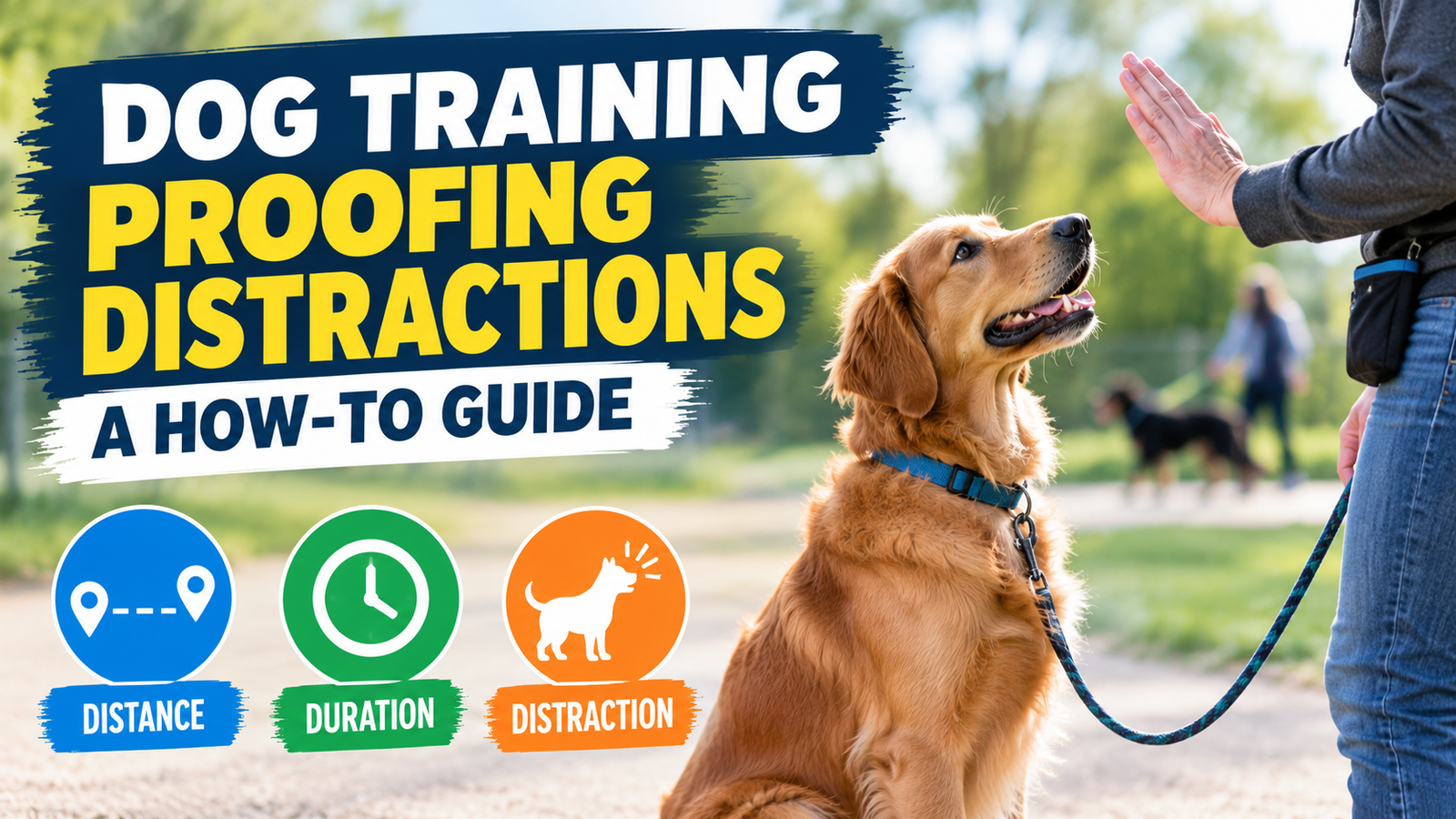
Dog training proofing distractions means practicing a cue your dog already knows in situations that pull attention away from you, so the behavior holds up outside a quiet room. The method is to change one variable at a time: first distance, then duration, then how distracting the setting is, always starting easy enough that your dog can succeed, and using a higher-value reward as the difficulty climbs. A dog that sits perfectly in the kitchen and seems to ignore you at the park has not forgotten the cue. It never learned that the cue applies outside the kitchen, and proofing is how that gap gets closed on purpose.
Why Dog Training Proofing Distractions Works: Dogs Do Not Generalize on Their Own
Dogs do not automatically apply a learned cue to every setting, an effect trainers commonly call context-dependent learning. A behavior rehearsed only in one room becomes tied to that room's cues: the carpet, the smell, the quiet. Move the same dog to a sidewalk with joggers and other dogs passing, and the physical cue word is still there, but so is a flood of new stimulation competing for the dog's attention.
This is not defiance and it is not the dog forgetting. It is a training gap: the behavior was never practiced under the conditions where it eventually needs to work. Proofing closes that gap by rehearsing the cue across many contexts on purpose, in increments small enough that the dog keeps succeeding, until the behavior stops being tied to one room and starts being tied to the cue itself.
The Three Variables That Make a Cue Harder: Distance, Duration, and Distraction
Most reward-based trainers describe difficulty using three variables, sometimes called the three Ds. Raising more than one at a time is the single most common reason a dog that "knows" a cue suddenly seems not to.
| Variable | What it means | Example |
|---|---|---|
| Distance | How far you are from your dog when you give the cue | Cueing "stay" from across the room instead of from your dog's side |
| Duration | How long your dog has to hold the behavior | A 30-second sit-stay instead of a 3-second one |
| Distraction | What is competing for your dog's attention | A dropped toy, a passing dog, a doorbell, another person |
The rule that keeps sessions productive is to change only one of these at a time. If today's goal is more distance on a stay, keep the duration and the distraction level the same as yesterday's success. Stacking a new location, a longer hold, and a bigger distraction into one attempt is asking for three new skills at once, and a dog that fails that combination has not regressed. It was simply given a harder test than the training so far supports.
Building a Distraction Ladder, Step by Step
A distraction ladder is a written list of the things that pull your dog's focus, ranked roughly from mild to overwhelming, that you climb one rung at a time.
- List the distractions your dog actually reacts to. Food on the counter, a squeaky toy, another dog on leash, a doorbell, a jogger. Rank each loosely from 1 (barely notices) to 5 (loses all focus).
- Start at rung 1, with distance and duration set at their easiest level. The dog should be able to succeed most of the time here before you move on.
- Use a reward worth more than the distraction. A plain kibble piece rarely outcompetes a squirrel; a piece of real chicken or cheese might, at least at the lower rungs.
- Raise only one rung at a time, and only after several solid successes at the current level.
- If your dog fails a rung twice in a row, that is information, not a setback to push through. Drop back one rung and rebuild from there.
- Once a cue is solid in one location, start the ladder again somewhere new. A dog that has fully proofed "sit" in the backyard still has to learn it applies at the vet's waiting room, because location is itself a variable the dog has to generalize across.
There is no universal timeline for finishing a ladder. Some dogs move through it in a couple of weeks of short daily sessions; others, especially with a high-value distraction like another dog, take longer. Treat the dog's success rate, not the calendar, as the signal to move up or hold steady.
Common Mistakes That Stall Proofing
A few habits explain most of the "my dog knows this at home but not anywhere else" frustration, beyond the single-variable rule above.
Practicing in an overwhelming environment before the basics are solid. A crowded dog park or a busy street is rung 5, not rung 1. Starting there teaches the dog that cues do not work in hard places, which is the opposite lesson.
Rewarding with something the dog can take or leave. As the distraction gets harder, the reward has to get better, not stay the same.
Working the dog past the point it can still think. A dog that is already fixated, barking, or straining toward a trigger is past the rung where new learning happens. The session should have stopped a step earlier.
Assuming one context transfers to all of them. Sit at home, sit on the porch, and sit at the park are three separate skills to a dog until each has been rehearsed on its own.
When Distractions Are Not the Real Problem
Not every case of "he won't listen around X" is a proofing gap, and it matters to tell the two apart before adding more repetitions.
If the trigger produces freezing, growling, snapping, frantic escape attempts, or a level of fixation that does not respond to a better reward, that is a fear or reactivity response, not an attention problem, and more distraction training in that direction can make it worse rather than better. The same is true if a dog's focus or responsiveness changes suddenly and stays changed. That pattern is worth ruling out with a vet before assuming it is a training issue at all; the general signs that warrant a call are covered on signs your dog should see a vet. Fear responses also have a developmental side, covered in more depth on understanding puppy fear periods, and a dog working through one needs distance and time from a trigger, not closer exposure to prove a cue still holds.
The American Veterinary Society of Animal Behavior's position statement on humane dog training, read September 18, 2026, states that current evidence supports reward-based methods for all dog training, including behavior problems, and does not support adding correction or punishment when a dog struggles, since that approach carries documented welfare and fallout risks without evidence that it is necessary. For anything involving a bite, a bite history, or a fear response that is not improving with patient, reward-based work, the next step is a certified professional rather than a home program: the credentials worth looking for and what the letters after a trainer's name actually mean are explained on how to choose a puppy class, and the Certification Council for Professional Dog Trainers' directory of certified trainers and behavior consultants, also checked September 18, 2026.
It is also worth ruling out the opposite problem: a dog that seems distractible everywhere, not just around one specific trigger, is often under-stimulated rather than undertrained. That pattern and the enrichment fix for it are covered on destructive behavior from boredom.
What Proofing Can and Cannot Fix
Proofing assumes the underlying behavior is already reliable somewhere quiet, and its job is to extend that reliability outward. It is not a fix for a cue the dog never fully learned in the first place, and it is not a fix for fear, pain, or a medical change dressed up as a training problem. Pushing a dog through distraction drills when the real issue is one of those tends to produce a dog that appears to comply while getting more stressed, which is a worse outcome than slower, honest progress.
Frequently Asked Questions
How long does it take to proof a command around distractions?
There is no fixed schedule, because it depends on the individual dog, the specific distraction, and how consistently short sessions happen. Progress measured in a dog's success rate at each rung is a more useful signal than a target number of days or weeks.
What are the "three Ds" of dog training?
Distance, duration, and distraction, the three variables that make an already-known cue harder to perform. Reliable proofing changes one of the three at a time rather than stacking several at once.
My dog listens at home but ignores me outside. Is the training broken?
No. This is the most common sign of an unproofed behavior rather than a forgotten one. The cue was learned in one context and has not yet been rehearsed in others, which is exactly what a distraction ladder is for.
Should I use a firmer correction when my dog is too distracted to respond?
No. The American Veterinary Society of Animal Behavior's position on humane training supports reward-based methods for all training scenarios, including moments a dog is struggling, rather than adding punishment. The more effective fix for a distracted dog is dropping back to an easier rung and using a better reward, not a stronger correction.
When should I get a professional involved instead of working through this alone?
Bring in a certified trainer or a veterinary behaviorist if the "distraction" actually triggers freezing, growling, snapping, or a level of fixation that does not respond to a better reward, if there is any bite history, or if a dog's focus and behavior have changed suddenly without an obvious training explanation. Those situations need a tailored plan and, in the case of a sudden change, a vet visit first.