
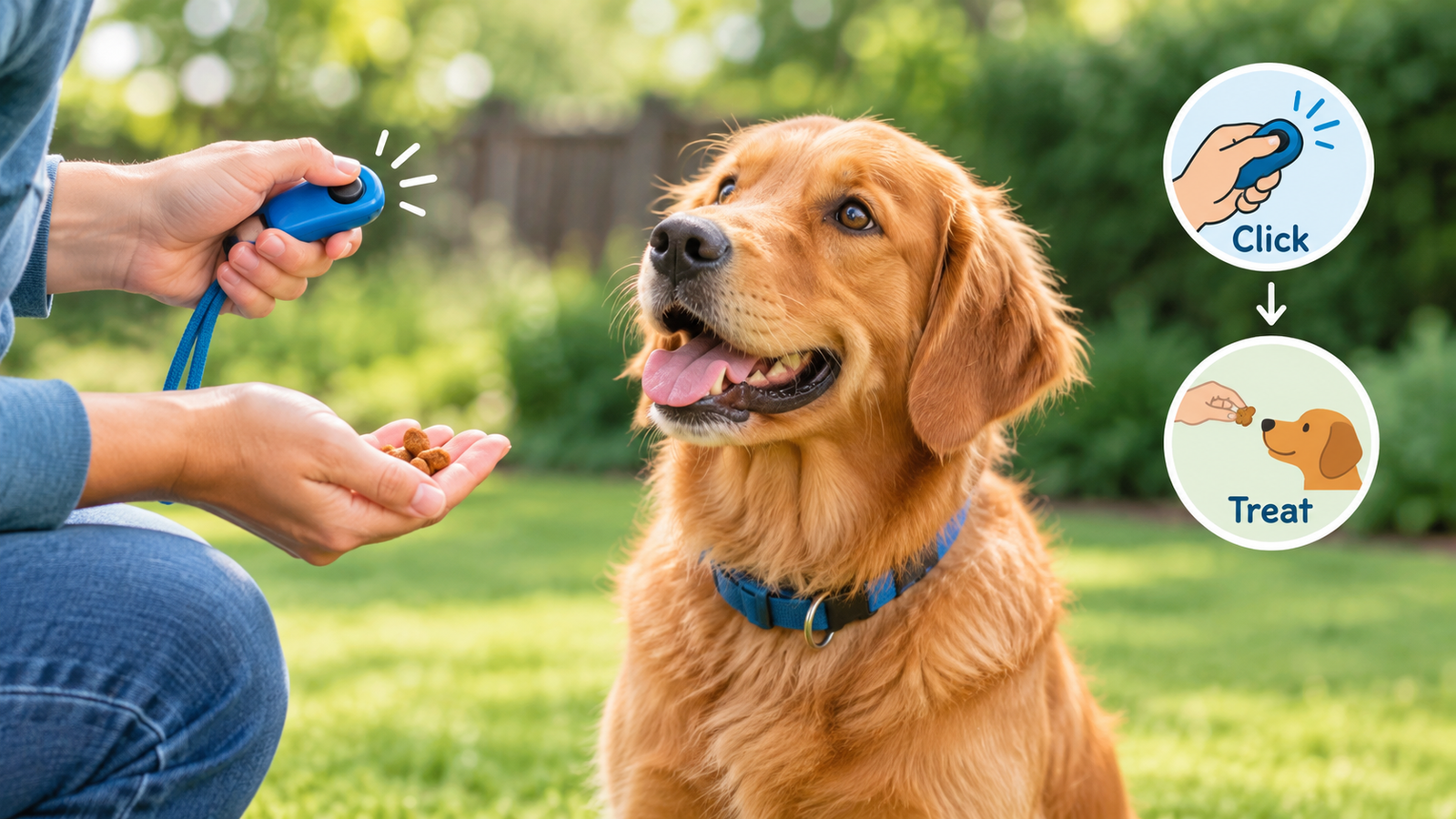
Clicker training for dogs works by pairing a distinct sound, the click, with a reward, so the click tells the dog the exact instant it did something right. The click itself does not train anything; it is a marker that bridges the gap between the behavior and the treat, which arrives a second or two later. Once a dog has learned that click means treat, the click becomes precise enough to shape complicated behaviors one small step at a time. You do not strictly need a plastic clicker to get this effect, a consistent word works too, but the clicker's advantage is that it makes exactly one sound and means exactly one thing.
What the Click Is Actually Doing
The mechanism behind clicker training for dogs is a marker signal, sometimes called a bridge or a conditioned reinforcer. A dog cannot connect a treat to a behavior that already ended half a second earlier; dogs live in the moment they are in. The click solves that timing problem by marking the correct instant, then the treat pays off a promise the dog already believes, because the click and the treat have been paired enough times that one reliably predicts the other. The click itself carries no value at the start; it earns its meaning entirely from being followed by something the dog wants, which is also why the sequence always runs click first, treat second, and never the other way around.
This is also why clicker training sits inside the broader category of reward-based training rather than being a separate method. The American Veterinary Society of Animal Behavior states, in its published guidance on reward-based methods (read 2026-09-18), that current evidence supports using rewards rather than corrections for training and for treating behavior problems. A clicker is one tool for delivering that reward-based approach with more precision than praise alone, not a separate philosophy from it, and a dog can be trained perfectly well with rewards and no clicker at all.
Charging the Clicker Before You Train Anything
Before the click means anything to a dog, it has to be taught, a step trainers call "charging" the clicker.
- Click once, then immediately give a treat. No cue, no behavior required yet.
- Repeat ten to fifteen times across a short session, always click first, treat second, never the reverse.
- Test it: click when the dog is not looking at you and not doing anything in particular. If the dog's head turns toward you expecting food, the clicker is charged.
Only after this step does the click get attached to an actual behavior. Skipping it is the single most common reason a new clicker "doesn't work": the dog has not yet learned the click predicts anything, so clicking during an actual training attempt teaches nothing yet.
Marking the Behavior: Luring, Shaping, and Capturing
Once the clicker is charged, there are three common ways to get the behavior you want to click.
Luring uses a treat or hand motion to guide the dog into position, for example moving a treat up and back over the nose to fold a dog into a sit. Shaping rewards small approximations toward a final behavior, clicking a dog for glancing at a target object, then only for touching it, then only for touching it with force. Capturing waits for the dog to offer a behavior on its own, like lying down, and clicks it the moment it happens with no prompting at all. Most training plans mix all three: luring to get a fast first result, shaping to refine it, and capturing for behaviors a dog already does naturally, like sitting to greet someone.
All three replace the older correction-based model where an unwanted action was punished after the fact. That older framing, often described in terms of dominance or "showing the dog who's boss," has been walked back by the behavior science community; a closer look at where that idea came from and why it fell out of favor is on this site's page on common puppy behavior myths.
Do You Need an Actual Clicker, or Will a Word Work?
This is the question most clicker guides skip. A physical clicker has one real advantage over a verbal marker: it makes exactly the same sound every single time, with no variation in tone, volume or emotion. A word like "yes" changes slightly depending on your mood, how tired you are, or whether you are also holding a leash and a phone. For a dog just learning to connect a marker to a reward, that consistency shortens the learning curve.
A verbal marker still works, and it wins in a few practical situations: when your hands are already full, when you have a dog that is startled by a sharp mechanical sound (some dogs are, especially noise-sensitive ones), or when you are working on behaviors like recall that need to travel further than a clicker's sound reliably carries. In a household with more than one dog, a mechanical click can also mark the wrong dog by accident if both are working nearby, so some multi-dog households switch to a verbal marker or train dogs separately for the early stages. Many experienced trainers use both, a clicker for precision skill-building at home and a verbal marker for everything in public.
If you are just starting out and want structured feedback on your timing rather than guessing alone, a session with a qualified instructor is worth the cost before habits set in either direction; this site's guide to choosing a puppy class covers what the credential letters after a trainer's name actually mean.
Common Timing Mistakes That Make It Look Like It Is Not Working
Most complaints that clicker training "doesn't work" trace back to timing, not the tool.
- Clicking late. If the click lands after the dog has already stood up from a sit, you just marked standing up.
- Clicking more than once per repetition. One click means one reward, every time; a double-click or a "click, click, good boy" muddies what the dog is being told.
- Skipping the treat, or delaying it too long. The click promises a reward is coming. If the treat does not follow within a second or two, the promise stops being reliable and the dog stops trusting the click.
- Using the clicker to get attention instead of to mark a behavior. Clicking to call a dog over teaches the dog that the click means "come," which then conflicts with using it to mark anything else.
Sessions that stay short, five to ten minutes at a time, make these mistakes easier to catch, because both handler and dog stay focused rather than tired. A long session where the dog starts sniffing the floor or wandering off is a sign the session ran past the dog's attention span, not a sign the dog is being difficult.
Where Clicker Training for Dogs Helps, and Where It Does Not
Clicker training is well suited to teaching new behaviors from scratch: sit, stay, targeting, loose-leash position, tricks, and replacing an unwanted habit with an alternative one you can reward instead. If a dog is chewing furniture out of boredom, for instance, clicking and rewarding an appropriate chew toy is a more durable fix than any correction, and this site's page on destructive behavior from boredom goes into the enrichment side of that same problem.
Clicker training is not the right starting point when the behavior is rooted in fear, aggression or a medical change. A dog that growls, snaps, freezes or suddenly avoids being touched is not offering a training opportunity, it is telling you something is wrong, and marking and rewarding calm behavior around the trigger needs a plan built by a professional who can read the dog in front of them. The Certification Council for Professional Dog Trainers maintains a directory of trainers credentialed in behavior work (read 2026-09-18), which is the right first call for anything involving fear or aggression. If the behavior change came on suddenly, alongside anything physical, a vet visit belongs before any training plan; this site's rundown of signs your dog should see a vet covers what "now," "soon," and "mention it at the next visit" each look like.
Fading the Clicker Once a Behavior Is Reliable
The clicker is a teaching tool, not a permanent requirement. Once a behavior is reliable on a verbal cue, most trainers fade the clicker out gradually: click and reward every time at first, then intermittently, then reserve it for teaching the next new skill. The behavior itself is maintained afterward with normal life rewards, praise, a game, a chance to go outside, rather than a click every time. A dog that still needs a click to sit reliably at home has not finished the behavior yet, and that is a normal, expected stage, not a failure. Trying to remove the clicker too early is a more common error than relying on it too long, so there is little downside to keeping it in the toolkit for an extra week or two of practice before phasing it out.
Frequently Asked Questions
Do I need to buy a special clicker, or can I use anything that makes a click sound?
Any consistent, distinct sound the dog does not already associate with something else can work, including a retractable pen or a tongue click, though a purpose-made clicker is inexpensive and gives the most consistent tone.
How long does it take to charge a clicker?
Most dogs connect the click to the treat within one or two short sessions of ten to fifteen repetitions, though the honest answer is that it varies by dog and there is no universal timeline worth treating as a guarantee.
Can clicker training fix aggression or reactivity?
Clicker training is a marking tool used inside a training plan; it is not a substitute for one, and it should not be the first thing tried on aggression, growling or sudden fear on your own. That work belongs with a certified trainer or veterinary behaviorist who can assess the dog directly.
Is it too late to start clicker training with an adult dog?
No. The mechanism, marking the exact moment of a correct behavior, works the same way regardless of a dog's age; older dogs generally learn new cues just as readily, though some may need more repetitions on physical behaviors if mobility is a factor.
What if my dog is scared of the clicker sound?
Stop using the mechanical clicker and switch to a verbal marker word instead. A marker that startles the dog works against the goal, and there is no requirement to use a physical clicker specifically for the method to work.