
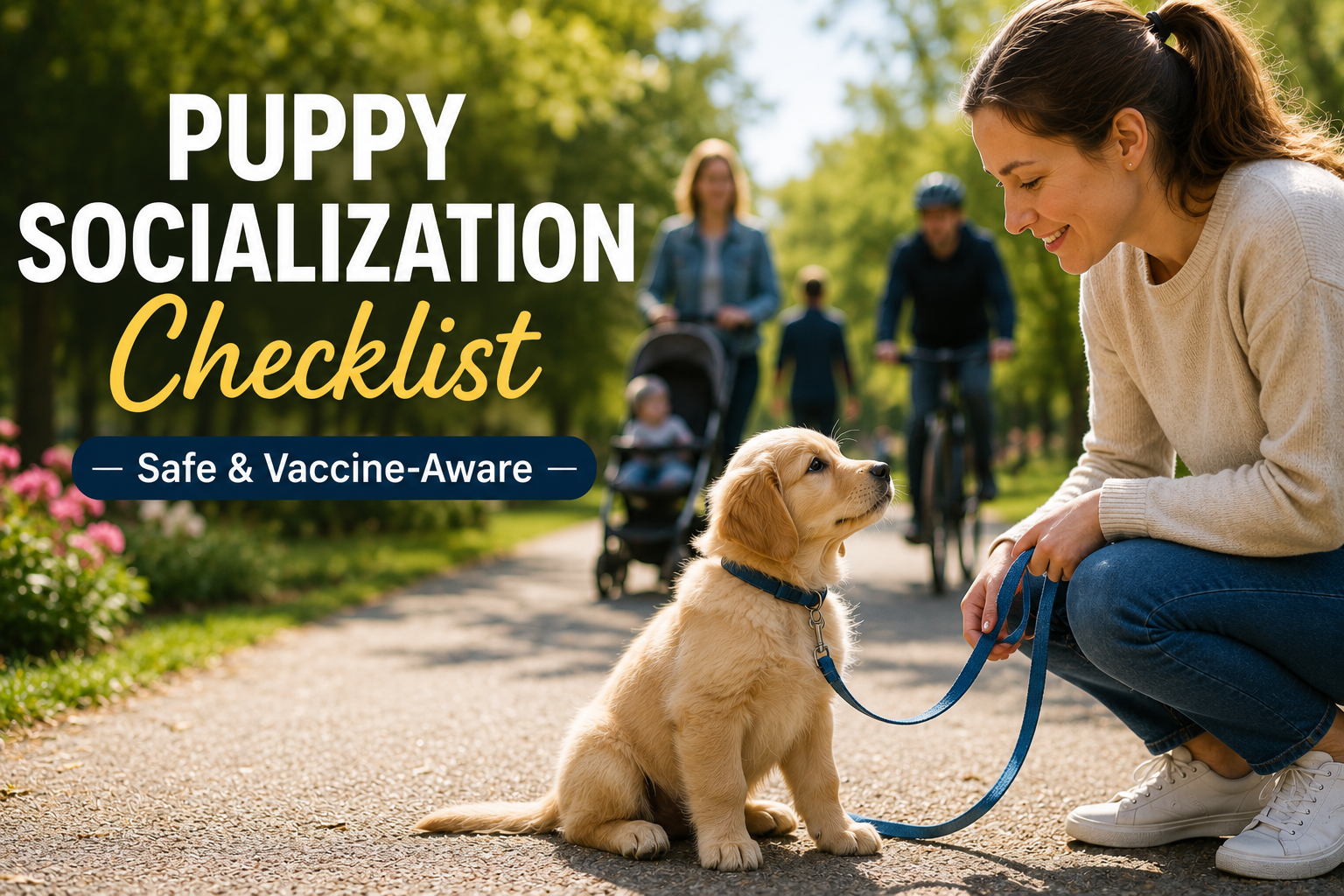
Socialization means controlled, positive exposure to new people, places, sounds, surfaces, and animals, not "meeting as many dogs as possible." The American Veterinary Society of Animal Behavior's position is that this should start before your puppy's vaccination series is finished, because the socialization window is short and closes early, and behavioral problems are a bigger cause of death in young dogs than infectious disease. The way to do it safely is to manage risk rather than wait: carry your puppy or use a stroller in public, choose low-traffic settings over dog parks, and let your puppy meet only vaccinated, healthy dogs you know personally until your vet says otherwise. The checklist below is organized by risk level so you know what's fine right away and what waits for your veterinarian's sign-off.
Every timing decision below is general. Your own puppy's exact vaccination schedule and the disease risk in your area are a conversation with your veterinarian, not something this page can answer for your dog specifically.
The tension new owners get told about, and how to read it
New owners hear two pieces of advice that sound like they contradict each other: keep the puppy home until vaccinations are done, and socialize during a window that closes by around three months of age. Both are true, and the resolution is that "socializing" does not mean unrestricted contact with unknown dogs. AVSAB's Position Statement on Puppy Socialization sets out a middle path: puppies can start controlled activities, including puppy classes, as early as 7 to 8 weeks old, with at least one set of vaccines given at least seven days beforehand, held in a clean environment away from dogs of unknown health and vaccine status.
The primary socialization window runs through roughly the first three months of a puppy's life. Waiting until the vaccine series is fully complete, often around 16 weeks, to begin any exposure means missing most of that window, which is the specific outcome AVSAB's guidance is written to prevent.
Checklist: tier one, safe from day one (no dog contact required)
These build confidence and expose your puppy to the world without any disease-transmission risk, so there is no reason to wait on any of them.
- Carry your puppy outside to sit on a bench and watch people, cars, bikes, and prams go by
- Sit in a friend's clean kitchen or living room, if their own pets are healthy and vaccinated
- Handle paws, ears, mouth, and tail gently at home, pairing it with food
- Introduce a range of surfaces indoors: tile, carpet, a wobbly cushion, a metal tray
- Play recordings of household and outdoor sounds at low volume: vacuum, doorbell, traffic, thunder, fireworks
- Let your puppy investigate a stationary umbrella, a bin bag, a bicycle leaning against a wall, and a person wearing a hat or sunglasses
- Meet a wide range of people at home or held/carried outside: men, women, children, people using mobility aids, people in uniform
- Ride in the car for short, calm trips that don't always end at the vet
Checklist: tier two, once your vet has confirmed it's appropriate
These involve more direct contact and generally wait for at least the first vaccine to have had time to take effect, on your veterinarian's advice for your specific puppy.
- Puppy socialization or kindergarten classes with health checks required at the door
- Supervised play with one or two known, healthy, vaccinated adult dogs
- Visits to a friend's securely fenced, private yard
- Walking (rather than being carried) in low-traffic areas away from where unknown dogs toilet
Checklist: tier three, once your vet clears full public access
- Dog parks and off-leash areas
- Pet stores and other spaces where unknown dogs' health status can't be verified
- Group walks with dogs outside your known, vaccinated circle
What "quality over quantity" actually looks like
The most common mistake in socialization is treating it as a numbers game: how many dogs, how many people, how many places, as fast as possible. That approach can backfire. A puppy that is overwhelmed does not learn "the world is fine," it learns "the world is a lot," and a handful of bad experiences can do more damage than dozens of good ones do good.
One calm, positive five-minute encounter, ended while your puppy is still comfortable, is worth more than an hour at a busy park. Go at your puppy's pace, keep sessions short, and always let your puppy choose to approach something new rather than forcing contact.
Reading the signals: when to stop
If your puppy freezes, tucks its tail, hides behind your legs, refuses treats it would normally take, or tries to move away, the situation is too much right now. The response is to increase distance immediately, not to push through it hoping your puppy will "get used to it." Forcing a frightened puppy closer to something it's afraid of teaches fear, not confidence.
A brief wary phase toward things your puppy previously ignored is also normal at certain ages and usually passes with patience rather than repeated exposure. If a fear response is intense, doesn't fade with distance and time, or starts affecting everyday life, a certified trainer using reward-based methods or, for more serious cases, a veterinary behaviorist is worth involving early rather than waiting to see if it resolves on its own.
The part socialization checklists usually skip
Most checklists stop at "expose your puppy to X, Y, and Z." What they leave out is that a bad experience with something on the list can do more harm than skipping it entirely. If a puppy class turns out to be chaotic and overwhelming, or a "friendly" dog at the park is actually pushy, that single encounter can set socialization back further than simply waiting a week and finding a calmer option would have. Vet the environment and the dogs involved as carefully as you vet the checklist item itself. Reputable trainers who run early puppy classes require proof of at least the first vaccine and generally keep class sizes and energy levels controlled for exactly this reason.
For the full first-month picture, including how socialization fits alongside potty training, sleep, and the week-three behavior dip most new owners aren't warned about, see our first 30 days plan for a new puppy. Everything on this page uses reward-based training: food, calm praise, and the puppy's own choice to approach, never forcing contact with anything on this list. If your puppy is already showing fear around unfamiliar people specifically, our guide to a dog that growls at strangers covers that pattern in more depth.
Frequently asked questions
Can I socialize my puppy before it's fully vaccinated?
Yes, and AVSAB's position is that you should. Waiting for the full vaccine series, often around 16 weeks, means missing most of the socialization window. The approach is controlled, risk-managed exposure, not unrestricted contact with unknown dogs, starting with tier-one activities that carry no disease risk.
What's the exact age I can start puppy classes?
AVSAB describes 7 to 8 weeks as workable, with at least one set of vaccines given at least seven days earlier, in a class that requires health checks and a clean environment. Confirm with your own veterinarian, since disease risk varies by location and by your individual puppy's health.
How many new experiences should my puppy have per week?
There's no fixed number worth chasing. A handful of calm, positive, puppy-paced experiences most weeks beats a rushed checklist. If your puppy is showing fear signals, slow down rather than push through the list.
What if my puppy seems scared of something on the checklist?
Increase distance right away, let your puppy watch from further back, and try again another day at a lower intensity. Do not force closer contact. A pattern of intense, persistent fear is worth discussing with a reward-based trainer or your veterinarian.
Is it too late to socialize an older puppy that missed this window?
The primary window closes early, but it isn't a hard cutoff. Older puppies and adult dogs can still build confidence around new things with patient, gradual, reward-based exposure; it typically just takes more repetition and more care than it would have at eight weeks.
This article is general owner guidance drawn from AVSAB's Position Statement on Puppy Socialization and veterinary practice resources, verified at the time of writing. It is not veterinary advice. Vaccination timing and what is safe for your individual puppy are decisions for your veterinarian, who knows the disease risk in your area.