
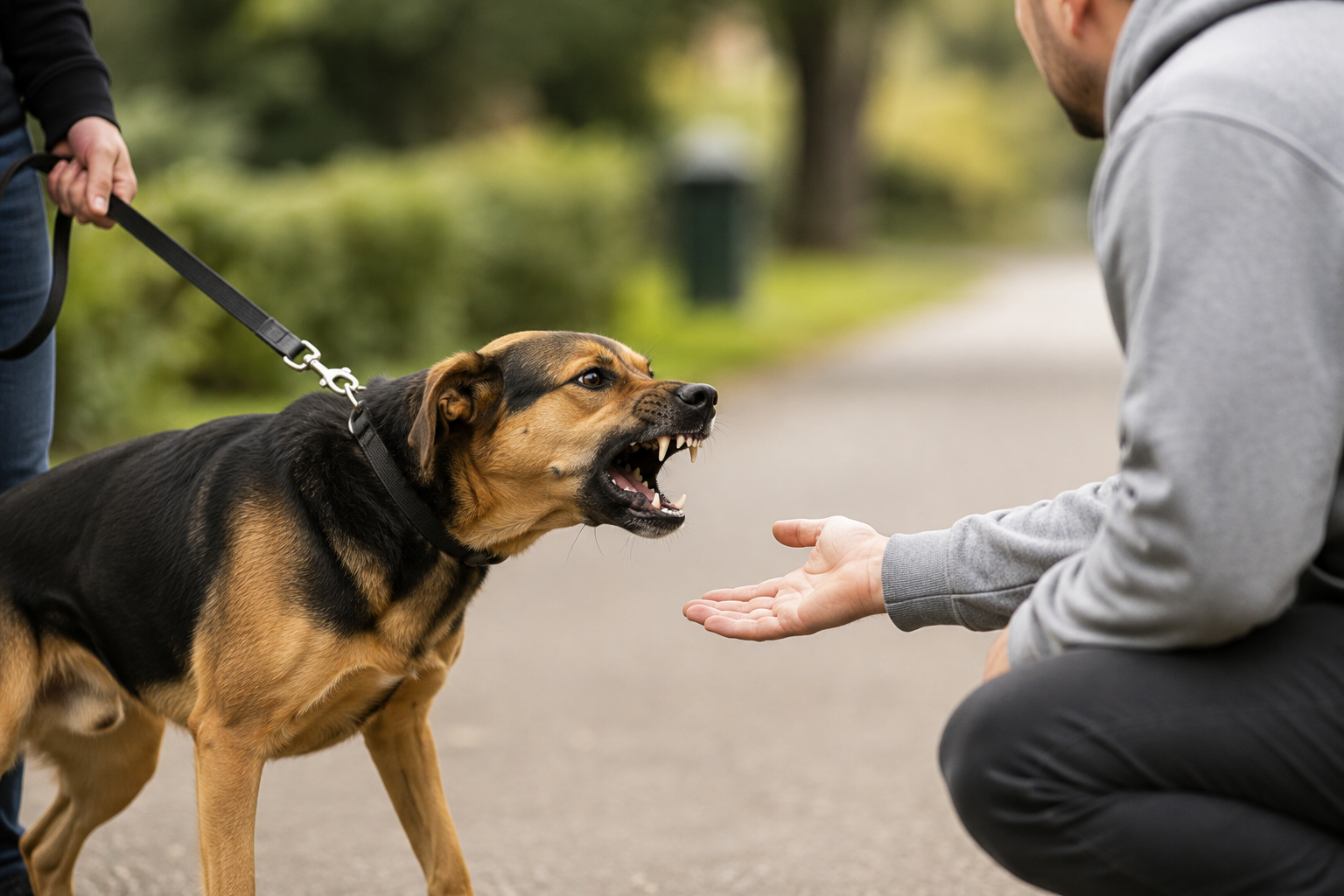
A dog that growls at strangers is communicating discomfort, not being dominant or badly behaved, and punishing the growl only removes the warning without changing how the dog feels underneath. The safe approach combines management (controlling the distance and pace of introductions) with desensitization and counter-conditioning (pairing a stranger's presence, from a distance the dog can handle, with something the dog loves, then gradually closing the gap only as long as the dog stays relaxed). Coach visitors to approach sideways, crouched, without direct eye contact, and let the dog choose to approach. If growling has ever escalated to a snap or bite, stop managing it alone and call a certified dog behavior professional.
Growling is a warning, not defiance
A growl is a dog's way of saying "I'm not comfortable, please back off," delivered before things escalate further. It is, in a real sense, useful information. A dog that growls is telling you exactly where its comfort line is, which is more than you get from a dog that goes straight to a snap with no warning at all.
That reframing matters because it changes what you're trying to fix. The goal is not to make the growling stop for its own sake. The goal is to change how the dog feels about strangers so there is nothing to growl about in the first place.
Why "just stop the growling" makes things worse, not better
Punishing a growl, a sharp "no," a leash correction, physical discipline, teaches a dog that growling brings an unpleasant consequence. Many dogs learn that lesson quickly and stop growling. What does not change is the underlying discomfort. The dog still feels the same way about the stranger; it has simply learned that saying so is punished.
The result is a dog that goes from calm to a bite with no growl in between, because the warning step has been trained out while the feeling that produced it never got addressed. This is the single most important thing to understand before doing anything else on this list: never punish a growl. Every step below is aimed at changing the feeling, not silencing the signal.
Read the ladder: body language before the growl
Growling rarely appears out of nowhere. Most dogs move through a sequence of smaller signals first, and catching them early lets you intervene before a growl is even needed.
| Body language | What it usually means | What to do |
|---|---|---|
| Relaxed posture, soft eyes, loose tail | Comfortable | Continue as normal |
| Stiffening, ears forward, weight shifting back | Noticing and assessing | Increase distance, don't force closer contact |
| Freezing, hard stare, tail stops moving | Uncomfortable, close to a threshold | Remove the dog from the situation calmly |
| Growling, lip lifting | Clear warning | Increase distance immediately, never punish |
| Snapping or biting | The warning system has been overridden or bypassed | Stop managing this alone, contact a professional |
Acting at the "stiffening" or "freezing" stage, well before a growl, is where most of the real progress happens, because you're managing the situation before the dog feels it has to escalate.
Management: control the setup before you try to change the feeling
Management means changing the environment so uncomfortable encounters happen less often while you work on the underlying feeling. This is not a cure, but it buys safety and reduces how often your dog rehearses being uncomfortable, which matters because every rehearsal of a growl-or-worse response can make the pattern more automatic.
Practical steps: keep greetings on your terms rather than letting strangers approach uninvited, use a leash and distance in public spaces where your dog has shown discomfort, and give guests a script (below) rather than letting them improvise. None of this is a lifetime plan. It is the floor you stand on while you do the actual behavior work.
Desensitization and counter-conditioning, step by step
This is the part that actually changes how your dog feels, not just how it behaves in the moment.
- Find the starting distance. That might be twenty feet from a stranger for one dog or five feet for another. The right distance is wherever your dog notices the stranger but stays loose and relaxed, not stiff or staring.
- Pair the stranger's presence with something great. The instant your dog notices the person at that safe distance, deliver a high-value reward, small pieces of real chicken or cheese work better than dry treats for this. The stranger doesn't need to do anything.
- Repeat until your dog starts anticipating the reward the moment it notices someone, rather than reacting to them.
- Only then, decrease the distance slightly, and repeat the pairing. If your dog stiffens or won't take treats, you've moved too fast; back up to the last distance that worked.
- Never rush this to "prove" your dog is fine. The pace is set by the dog's comfort, not by a timeline, and there is no fixed number of sessions that guarantees a result.
How to coach visitors and strangers to approach safely
Most people, without meaning to, do everything a nervous dog finds threatening: direct eye contact, leaning over, reaching toward the head, walking straight at the dog. A quick script helps:
- Turn sideways rather than facing the dog directly.
- Crouch or kneel rather than looming.
- Avoid direct eye contact.
- Hold a hand out low, palm down, and let the dog choose to approach and sniff.
- If the dog doesn't approach, that's the answer. Don't push it.
Giving guests this script before they meet your dog prevents a lot of the encounters that would otherwise end in a growl.
What not to do
Don't punish the growl, for the reasons above. It's the single most important rule on this page.
Don't force greetings. "He just needs to say hi" is one of the most common ways an uncomfortable dog ends up escalating. Let the dog set the pace, always.
Don't flood the dog with strangers to "get it over with." Overwhelming exposure tends to make fear and reactivity worse, not better, and it undermines the trust the desensitization plan depends on.
When this needs a professional, not a home plan
Occasional, low-intensity growling that resolves with a bit of distance and improves gradually with the steps above is a reasonable home project. It is a different situation if growling has ever been followed by a snap or a bite, if it escalates quickly with very little warning, if it happens with no identifiable trigger, or if it is getting more frequent despite consistent management. Those situations call for a certified dog behavior professional, not a do-it-yourself plan, because a professional can assess what a home guide cannot: the individual dog's specific triggers and risk in person.
This is a similar safety-first situation to what our guide on resource guarding describes, and the "never punish the warning signal" rule applies there too. If your household includes more than one dog and tension shows up between them rather than toward strangers, see dog aggression toward another dog in the house. Our positive reinforcement dog training guide covers the reward-based methods behind the desensitization steps above in more depth.
Frequently asked questions
Should I punish my dog for growling at a guest?
No. Punishing a growl removes the warning without changing how your dog feels, which can produce a dog that bites with no warning at all. Manage the distance instead and work on changing the underlying feeling.
Is growling at strangers a sign my dog is aggressive?
Not by itself. Growling is communication, and most dogs that growl at strangers are uncomfortable rather than dangerous. The picture that matters is the whole pattern: how often it happens, how quickly it escalates, and whether it has ever gone further than a growl.
How long does it take to fix growling at strangers?
There's no fixed timeline, and any guide that gives you one is guessing. Progress depends on the individual dog, how consistently the plan is followed, and how much practice the growling has already had. Slow, steady work at a pace the dog can handle produces more durable change than trying to rush it.
My dog only growls at certain types of people (children, men, people in hats). Why?
Dogs often generalize discomfort around specific features, size, movement style, unfamiliar clothing, or a lack of early exposure to that group of people. The desensitization approach above works the same way, just targeted at the specific trigger, and a certified trainer can help pinpoint it if it isn't obvious.
This article is general owner guidance drawn from the AKC, Whole Dog Journal, and Journey Dog Training. It is not a substitute for an in-person assessment. If growling has ever escalated to a snap or bite, please contact a certified dog behavior professional or your veterinarian.