
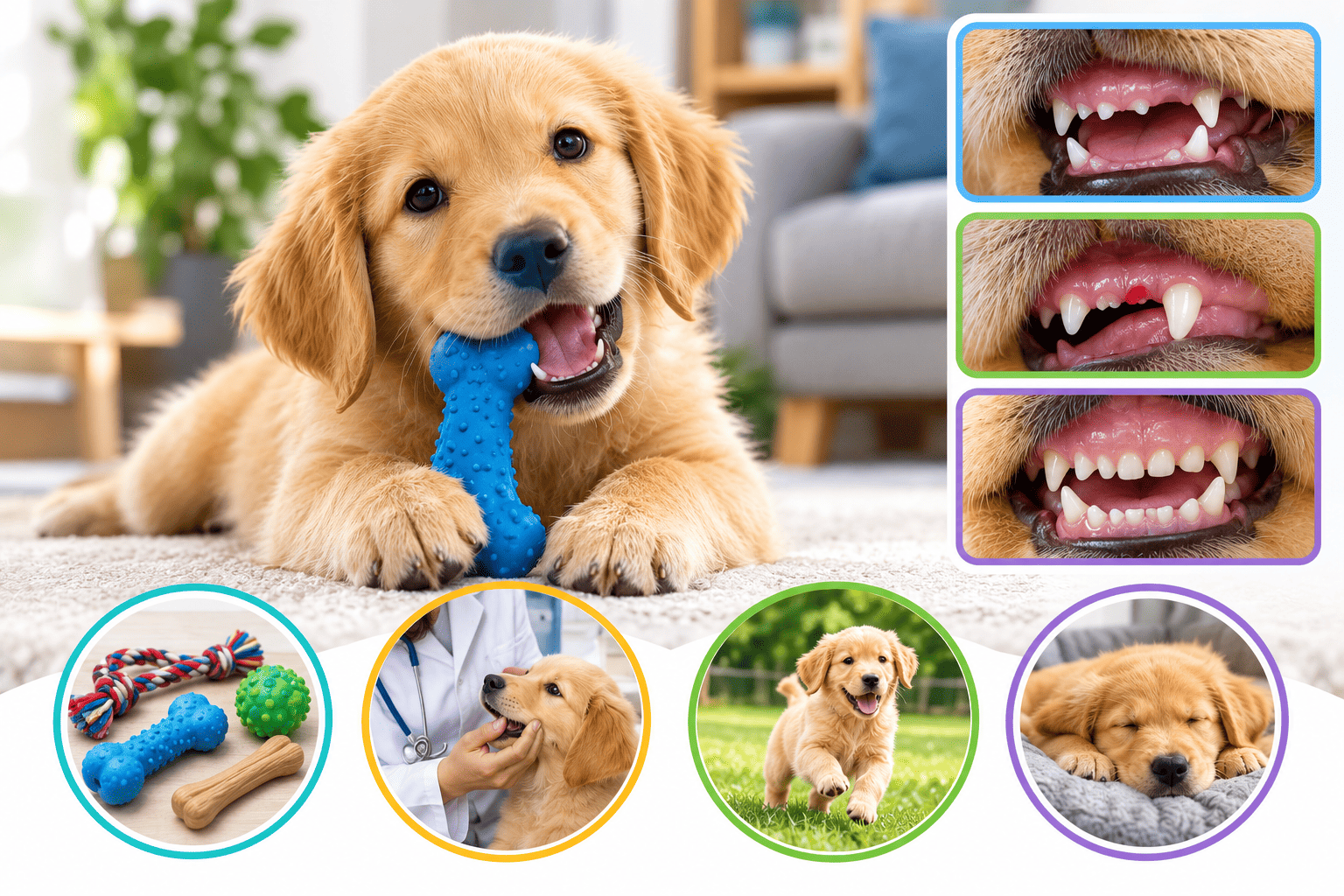
Teething is a phase with a rough age range, and there are three things you might find in a puppy's mouth that are not a phase. This page is the timeline and those three, in that order.
The behavior question, telling ordinary mouthing from teething discomfort, is covered separately on puppy mouthing versus teething, and this page does not repeat it.
The rough timeline
Puppies get a set of baby teeth first, lose them, and grow a permanent set, and the changeover happens over a period of months during the first half of the first year.
We give the range and not a table of dates per tooth. The reason is that it varies between individuals and between breeds, and a precise-looking calendar creates a false expectation that a puppy is behind or ahead. Your vet checks the mouth at routine appointments and can tell you where your particular puppy is, which is more useful than any published week number.
What is worth knowing as an owner:
You may find teeth. You may not. Puppies swallow most of them, and finding none is normal.
Some blood on a toy is common during the changeover and is not, on its own, a cause for alarm.
Chewing increases for a stretch and then settles. A puppy that has become dramatically mouthier in this window is usually not developing a behavior problem.
And chewing does not stop entirely when teething ends. Chewing is a normal adult dog behavior with its own outlet requirement, which is the thing people are surprised by when the phase passes and the chewing does not.
The three findings that are a vet appointment
This is the part most teething articles skip and it is the reason this page exists.
1. A retained baby tooth. Sometimes a permanent tooth comes in while the baby tooth is still there, and you see two teeth in one place. That is not something to wait out and it is not something to pull. It is a finding to show your vet, who decides what happens next.
2. A bite that looks wrong. How the upper and lower teeth meet changes as the mouth develops, and an alignment that is causing a problem is something a vet identifies. You are not expected to assess this, and this page does not describe how, because that is a clinical judgment.
3. Anything painful, swollen, bleeding persistently, or a puppy that will not eat. Reluctance to eat, pawing at the mouth, or obvious pain is not a normal part of teething and belongs with your vet promptly.
Add a fourth, which is not about teeth: a puppy that swallows part of a chew item. That can be an emergency depending on what and how big. Call your vet, or an emergency clinic, and do not wait to see what happens. We are a dog behavior site, not a veterinary clinic, and we do not diagnose, assess or advise on treatment.
Chew items, and what this site will and will not say
We do not name chew products, do not rank them, and do not assess any material's safety. That is a deliberate scope on this site, and it is the right one, because whether a given item suits a given dog depends on that dog's teeth, size and chewing style, and it is a question for a vet who can see the animal.
What can be said as principle rather than product:
Ask your vet. They will tell you what they see coming through the door with broken teeth, and that is the most useful recommendation available to you.
Match the item to the chewer, not to the dog's age. A determined chewer and a gentle one need different things at the same age.
Supervise, particularly with anything new, and particularly with anything that can be reduced to a swallowable piece.
Retire anything that has become small enough to swallow or that has broken into pieces.
Have more than one, in different textures, so that the puppy has an appealing legal option in the moment it wants one.
Managing the house through it
Remove the opportunity where you can. A puppy cannot practice chewing something it cannot reach, and rehearsal is what turns a phase into a habit. The room-by-room version is on how to puppy-proof your house.
Redirect rather than punish. When the puppy has the wrong thing, swap it for the right thing and then notice the right thing. Most owners only ever react to the wrong choice, which teaches the puppy that chewing the sofa gets attention and chewing the toy does not.
Reward the correct choice out loud. It is the cheapest training available and almost nobody does it.
And do not chase the puppy for the item. A puppy that learns picking something up starts a game will pick more things up. The wider version of that problem is on how to stop a dog counter-surfing.
If the chewing continues well past the teething window and is spread through the house, that is a different problem and it is usually about outlets rather than teeth. It is covered on how to stop a dog chewing furniture.
What not to do
No aversive methods, sprays, deterrent devices or punishment, including for teething-related chewing. This site's standing position on training methods is reward-based, following the American Veterinary Society of Animal Behavior, whose position statements page states that its Humane Dog Training statement recommends only reward-based methods for all dog training, including the treatment of behavior problems. (Read at avsab.org, 28 August 2026.)
No home remedies applied to the mouth, and nothing given for pain. Nothing from a human medicine cabinet ever goes to a dog, and dosing of any kind is a veterinary decision, not one for an article.
And do not assume every mouthy episode is teething. If a puppy's mouthing has become hard, tense, or is happening in situations that are not play, that is a different signal and it belongs with a qualified behavior professional. The distinction is on puppy mouthing versus teething.
Frequently asked questions
My puppy swallowed a piece of a chew item. What should I do?
Call your vet, or an emergency clinic, and do not wait to see what happens. As noted above, that can be an emergency depending on what was swallowed and how big it was. This page does not assess it, because we are a dog behavior site rather than a veterinary clinic.
There are two teeth in the same place in my puppy's mouth.
That is the retained baby tooth described above, where a permanent tooth comes in while the baby tooth is still there. It is not something to wait out and it is not something to pull. Show it to your vet, who decides what happens next.
I have not found any baby teeth around the house. Is something wrong?
Finding none is normal. Puppies swallow most of them, so you may find teeth and you may not. Some blood on a toy during the changeover is also common and is not, on its own, a cause for alarm. What does belong with your vet promptly is anything painful, swollen, bleeding persistently, a puppy pawing at its mouth, or a puppy that will not eat.
Can I give my puppy anything for teething pain?
No, and nothing from a human medicine cabinet ever goes to a dog. This page publishes no pain relief, no dose, no remedy and no treatment of any kind, including anything applied to the mouth, because dosing is a veterinary decision rather than one for an article. If the puppy seems to be in pain, that is a vet appointment.
Will the chewing stop once teething is over?
Not entirely. Chewing increases for a stretch and then settles, but chewing is a normal adult dog behavior with its own outlet requirement, which is what surprises people when the phase passes and the chewing does not. Chewing that continues well past the teething window and is spread through the house is a different problem, usually about outlets rather than teeth.
What this page does not publish
No per-tooth calendar and no week numbers. They vary and your vet has the answer for your puppy.
No chew product names, brands, materials or safety assessments.
No pain relief, dose, remedy or treatment of any kind. That is your vet's, always.