
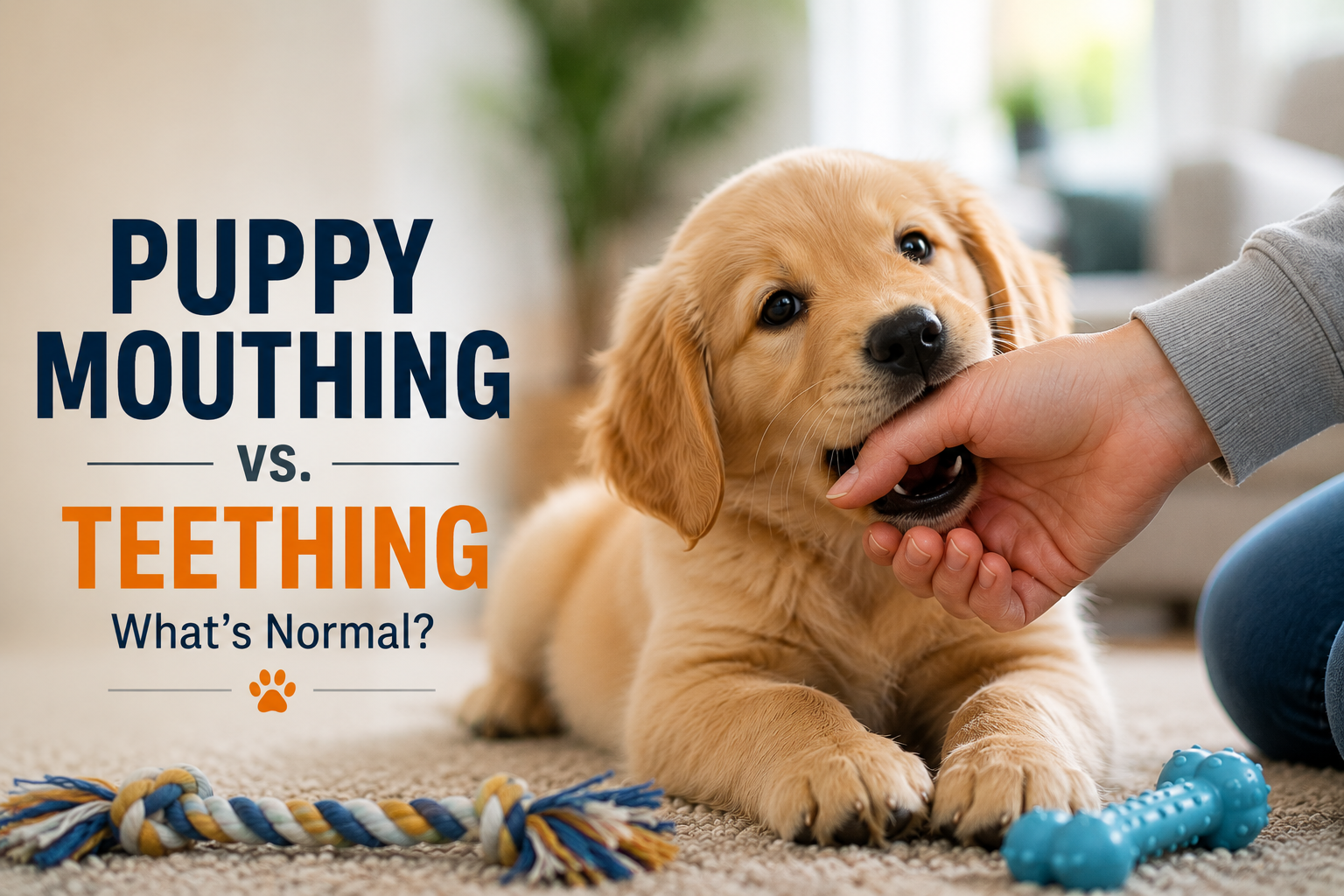
Mouthing is social and exploratory: a puppy grabbing your hand, sleeve, or a toy during play, usually with soft, controlled pressure that releases quickly. Teething is discomfort-driven: gum pressure from losing baby teeth and growing adult ones between roughly three and six months of age drives more gnawing and chewing on objects, and can make an otherwise well-mannered puppy suddenly mouthier for a stretch. The two overlap heavily, since a teething puppy mouths more and a mouthing puppy is often also teething, and most puppies go through both at once. Neither one is aggression, and both fade with age, though bite inhibition, the skill of learning to control jaw pressure, still needs deliberate teaching regardless of which is driving the behavior in the moment.
This page separates the two, gives a general age guide for teething sourced from veterinary and AKC material, and covers the one distinction most explainers skip: how to tell ordinary mouthing or teething from an early aggression signal that needs a different response.
Mouthing: what it is and why it happens
Puppies explore the world with their mouths the way toddlers explore with their hands, and mouthing is also how puppies play with each other and with people. In a litter, a puppy that bites a littermate too hard gets an immediate yelp and the game stops, which is how bite inhibition, learning to soften jaw pressure, normally develops. A puppy taken home early or without littermates to practice on often needs that feedback taught deliberately by a person instead.
Typical mouthing looks like: grabbing at hands, sleeves, or shoelaces during play, brief contact rather than a sustained hard bite, and a puppy that's generally loose and wiggly in its body language rather than stiff.
Teething: what it is and a general age guide
Between roughly three and six months of age, puppies lose their baby teeth and grow their adult set, a process the AKC and veterinary sources describe as usually complete by around six to eight months, when a puppy has its full 42 adult teeth. During this window, sore gums make chewing and gnawing on objects feel good, which is why teething puppies often go through phases of chewing furniture legs, skirting boards, shoes, and anything else within reach, sometimes more than they mouth people directly.
| Approximate age | What's typically happening |
|---|---|
| 2-4 weeks | Baby teeth begin coming in |
| 6-8 weeks | Full set of 28 baby teeth |
| 3-5 months | Baby teeth start falling out, adult teeth begin erupting, gnawing/chewing increases |
| 6-8 months | Full set of 42 adult teeth typically in place |
These ranges are general and vary by individual puppy and by breed size; use them as a rough guide rather than an exact schedule for your own dog.
Telling them apart in the moment
| Mouthing | Teething-driven chewing | |
|---|---|---|
| Target | Mostly hands, sleeves, moving things | Mostly objects: furniture, shoes, skirting boards |
| Trigger | Play, excitement, greeting | Gum discomfort, often worse after naps or during growth spurts |
| Body language | Loose, wiggly, play-invitation postures | Focused, repetitive gnawing, sometimes drooling more than usual |
| Age pattern | Present from early weeks, fades with training | Rises sharply around 3-6 months, settles once adult teeth are in |
In practice most puppies show a blend of both at the same time, and that's expected. The response, redirect to an appropriate chew, teach that human skin never gets bitten hard, and manage the environment, works for both, which is part of why the distinction matters less for what you do day to day than most articles suggest.
What actually helps with both
Redirect to something legal, immediately and consistently. The moment teeth land on skin or clothing, calmly withdraw the body part and offer an appropriate chew toy instead. Consistency matters more than any single toy choice.
Provide a genuine outlet for teething discomfort. Textured chew toys, and in many cases a toy that can be safely chilled, can feel soothing on sore gums; check any product's guidance for your puppy's size and supervise chewing as you would with any toy.
Never play rough hand games. Wrestling with bare hands teaches a puppy that hands are for biting, which works directly against the lesson you're trying to build. Use a toy as the buffer instead of a hand, every time.
Give feedback the moment teeth touch skin, without physical correction. A short "ow," disengaging, and a brief pause in play teaches bite inhibition the same way a littermate's yelp would. This is where mouthing and biting overlap with a different problem, and if the mouthing is already hard, frequent, and hurting, our guide to stopping puppy biting and building bite inhibition covers the fuller method.
Expect more sleep to help. A great deal of "difficult" evening mouthiness in puppies of any teething stage is an overtired puppy rather than a defiant one. Enforcing rest often reduces mouthing faster than more correction does.
Manage the environment during the teething months. Puppy-proof at floor level, use a pen or crate when you can't supervise, and expect a phase of extra chewing on furniture and belongings that isn't a training failure so much as a passing developmental stage. Our guide to stopping a dog from chewing furniture covers redirecting that specifically.
The distinction most explainers skip: when mouthing isn't just mouthing
Ordinary mouthing and teething chewing share a soft, playful, exploratory quality, and that's the pattern the advice above is built for. A different pattern is worth taking seriously and responding to differently: a puppy that goes stiff rather than loose before or during mouthing, growls with a hard stare rather than a play-invitation posture, bites and holds rather than grabbing and releasing, or escalates when you try to move away instead of easing off. That combination, especially around resources like food, toys, or a resting spot, is closer to an early guarding or fear response than ordinary puppy mouthing, and pushing through it with the same redirect-and-ignore approach can make it worse rather than better.
If you notice that pattern, the response is not more corrections; it's slowing down, avoiding the specific triggers while you get help, and involving a certified trainer using reward-based methods early. Catching this at eight or twelve weeks is far easier to work with than waiting to see if it resolves on its own.
When to check with your veterinarian
Persistent drooling well beyond what seems normal for the age, visible swelling or bleeding at the gums, a puppy that stops eating or seems to be in pain when chewing, or retained baby teeth (an adult tooth coming in alongside a baby tooth that hasn't fallen out) are all worth a veterinary check rather than waiting them out. Retained baby teeth in particular sometimes need a vet's attention, since they can crowd the adult teeth coming in behind them.
For the developmental picture around this stage more broadly, our first 30 days plan for a new puppy covers what to expect in the weeks right after a puppy comes home, and mouthing that's already an established, hard-biting habit rather than a passing phase is covered step by step in our guide to stopping puppy biting.
Frequently asked questions
Is puppy mouthing a sign of aggression?
Almost never at this age. Ordinary mouthing is social and exploratory, with soft, controlled pressure and loose, playful body language. A stiff body, hard stare, biting-and-holding rather than grab-and-release, or escalation when you try to move away is a different pattern worth taking seriously and, if it appears, worth discussing with a reward-based trainer.
At what age do puppies stop teething?
Teething generally runs from around three to six months, with a full set of 42 adult teeth typically in place by six to eight months, though this varies by individual puppy and by breed size. Mouthiness often eases once the adult teeth are fully in.
Can I give my puppy something frozen to chew for teething discomfort?
A chilled or textured chew toy is a common recommendation for soothing sore gums; check the specific product's guidance for your puppy's size and always supervise chewing. If you're unsure what's appropriate for your puppy, ask your veterinarian.
My puppy's baby tooth hasn't fallen out and the adult tooth is already coming in. Is that a problem?
It can be. Retained baby teeth sometimes need a veterinarian's attention because they can crowd the incoming adult tooth. It's worth a mention at your puppy's next vet visit rather than assuming it will resolve alone.
Does teething cause aggressive biting?
Teething increases the drive to chew and mouth, but it doesn't cause aggression on its own. If mouthing during this period looks stiff, guarded, or escalates rather than fading with redirection, that's a separate pattern from teething discomfort and is worth addressing with a trainer rather than waiting for the teething to pass.
This article is general owner guidance drawn from AKC and veterinary practice resources on puppy dental development and behavior, verified at the time of writing. It is not veterinary advice. Persistent pain, swelling, retained baby teeth, or a puppy that stops eating are reasons to see your veterinarian rather than wait it out.