
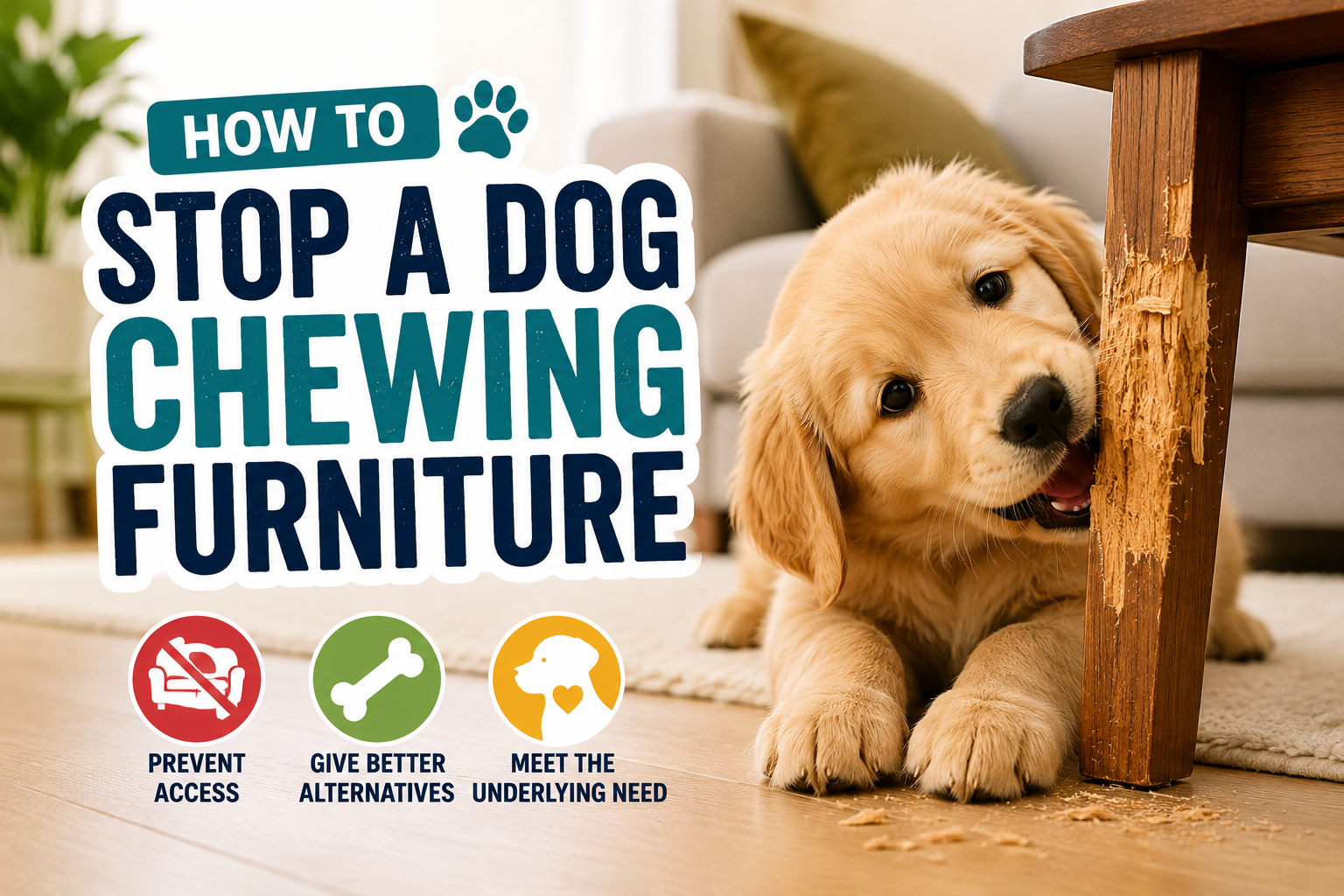
Dogs chew furniture for three main reasons: puppies chew because they are teething and exploring the world with their mouths, adult dogs chew because they are bored, under-exercised, or anxious, and some dogs chew simply because nothing better has ever been offered. The fix always has the same three parts. Prevent access while you work on it, give a legal chew that genuinely beats the sofa, and meet the need underneath. Never punish chewing you find after the fact. If your dog has swallowed foam, fabric, stuffing, or splintered wood, call your veterinarian, because that is a medical situation and not a training one.
First, the part that is not about the furniture
The chewed table leg is annoying. The piece of it that went down is the real risk, and it deserves to come before the training advice rather than after it.
Upholstery foam, fabric, stuffing, string, splinters of wood, and chunks of plastic can cause an obstruction in a dog's digestive tract. That is a genuine emergency, and it is diagnosed and treated by a veterinarian, not by an owner with a search engine. Call your vet if you know or suspect your dog swallowed part of what it destroyed, and call sooner rather than waiting to see, particularly for a small dog or a puppy.
Signs that should send you to the vet promptly include repeated vomiting, refusing food, straining without producing anything, a hard or painful belly, unusual lethargy, or drooling and restlessness that is out of character. We are not going to tell you what any of that means, because that is a diagnosis and it belongs to your veterinarian. What we can tell you is that these are reasons to call rather than reasons to wait.
Once your dog is safe, the rest of this article is about making sure it does not happen again.
Why dogs chew: teething, boredom, anxiety, and never having been taught
Chewing is not a malfunction. Dogs explore, relieve discomfort, and relax through their mouths, and a dog that never chews anything is the unusual one. Destructive chewing is that normal behavior pointed at the wrong object.
The ASPCA groups the causes in a way that is worth keeping in mind, because it maps cleanly onto four different plans:
- Puppy teething and exploration. Young dogs chew because their mouths hurt and because chewing is how they investigate a new world.
- Boredom and unspent energy. An adult dog with time to fill and nothing to do will find something, and furniture is available at exactly mouth height.
- Stress and anxiety. Chewing lowers arousal for a lot of dogs. Chewing that spikes when the dog is alone, or when there is noise or upheaval, is often self-soothing rather than mischief.
- Nobody ever taught an alternative. A dog that has never been given a chew it likes has no reason to prefer one.
There is also a fifth, smaller category: a dog that has learned that grabbing the remote produces an immediate, entertaining reaction from a human. That one is genuinely attention-driven, and the fix is unusual, because it involves being boring.
Teething or something else?
The single most useful thing you can do before choosing a plan is work out which fork you are on. These two situations look identical in the moment and need very different responses.
| Teething chewing | Adult or need-driven chewing | |
|---|---|---|
| Typical age | Roughly 3 to 7 months, tapering after adult teeth are in | Any age, including a dog that was previously fine |
| What gets chewed | Almost anything, especially cool or firm surfaces: table legs, chair rungs, shoes | Often more specific: one sofa arm, the doorframe, the thing near where the owner leaves |
| Pattern | Constant, opportunistic, worse when unsupervised | Often tied to a time or trigger, such as being alone or after a long empty stretch |
| Other signs | Sore gums, extra mouthiness, sometimes a lost tooth found on the rug | Restlessness, pacing, vocalizing, other damage, sometimes accidents indoors |
| What it needs | Relief, supervision, appropriate chews, and time | The underlying cause found and met |
| Does it end on its own? | Largely yes, once teething finishes | No |
The mistake owners make in both directions is real. Waiting out an adult dog's boredom chewing because "it is a phase" wastes months. Panicking about a four-month-old puppy as though it has a behavior disorder wastes worry. If you are also dealing with a puppy that bites hands as well as furniture, our guide to stopping puppy biting covers the mouth side of the same developmental stage.
Step 1: prevent the rehearsal
Every chewing session makes the next one more likely, because the dog is practicing and being rewarded by the texture and the relief. Management is how you stop paying for the habit while you build a better one.
Close doors to rooms you cannot supervise. Use baby gates or an exercise pen to shrink the dog's world to a space you have made safe. Physically block access to a favorite target with furniture rearrangement or a throw. Pick up the small, valuable, and dangerous things at dog height, which is a bigger list than most people expect once they get down and look.
None of this teaches anything. That is fine. Its job is to buy you a clean run at the training rather than fighting the same battle every evening.
Step 2: make the legal chew better than the sofa
Prevention on its own leaves a dog with a need and no outlet, which is how owners end up with a chewed carpet edge instead of a chewed chair. The legal option has to actually appeal.
Offer variety and texture. Dogs have preferences, and they are not subtle. Some want something firm and gnawable, some want soft and shreddable, some want frozen and soothing. Try several safe types rather than buying six of one thing and concluding your dog "does not like chews."
Rotate. A chew that has been on the floor for two weeks is furniture. Put most of them away and bring out a few at a time, and the old ones become new again.
Make food into a chewing job. A stuffed rubber toy, frozen, occupies a dog for far longer than a biscuit and gives the same jaw satisfaction. This is one of the highest-value habits an owner of a chewer can build.
Reward the right choice out loud. When you see your dog settle with its own chew, say something warm and quiet. Dogs repeat what pays, and most owners only notice chewing when it is the wrong item. Our positive reinforcement dog training guide covers the timing that makes this land.
Trade, do not grab. If your dog has the wrong item, swap it for something better rather than pulling it out of their mouth. Grabbing teaches a dog to run away with contraband or, worse, to guard it.
Step 3: fix the reason
This is where the diagnosis pays off, because the third step is different for each fork.
For teething: relief and time. Frozen wet washcloths, chew toys designed to be chilled, and plenty of supervision get most puppies through it. Also make sure the puppy is sleeping enough. A large share of what looks like relentless puppy chewing is an overtired puppy who cannot settle.
For boredom: more of everything a dog's brain wants. Sniffing walks where the dog gets to stop and read, training sessions of a few minutes several times a day, food puzzles, and scent games. This is exactly the same fix as the outdoor version of the problem; see how to stop a dog digging in the yard, which shares most of its enrichment advice with this page.
For anxiety: the chewing is a symptom, and treating it as a chewing problem will not work. If the damage happens only when your dog is alone, especially if it is aimed at doors, windows, or exits, and especially alongside howling, pacing, drooling, or accidents from a house-trained dog, read our guide to dog separation anxiety before doing anything else. That pattern needs a different plan and sometimes a professional.
For attention: be dull. React as little as possible to the theft, trade calmly for something else, and put real enthusiasm into moments when your dog is doing something you like. Chasing a dog around the living room is a wonderful game and dogs will pay a sofa cushion for it.
Bitter sprays and deterrents: an honest assessment
Almost every article on this topic recommends a taste deterrent, usually bitter apple, applied daily for a few weeks. It belongs on the list, and it deserves more honesty than it usually gets.
Deterrents work on some dogs, and on those dogs they work well. A meaningful number of dogs are indifferent to them, and a few appear to develop a taste for the stuff. They also wear off, which is why the reapplication schedule exists, and they can mark fabric, so test somewhere hidden first.
More importantly, a deterrent on its own is a half-measure. It makes one object unpleasant. It does not give the dog anything to do instead, so a dog with a real need will simply move to the next available surface. If you use one, use it as the fourth element of a plan that already includes prevention, a good legal chew, and a met need. Used that way, it is helpful. Used alone, it usually just relocates the damage.
Confinement, and where it stops being the answer
Crating or penning a dog when it cannot be supervised is standard advice and it is good advice for most dogs, particularly puppies. A crate that has been introduced properly is a place a dog chooses to rest, and our guide to crate training a puppy walks through building that association without the crying.
There is one important limit. A dog that chews because it panics when left alone can hurt itself trying to get out of a crate, and confinement can raise its distress rather than contain it. If your dog drools heavily, claws at the door, bends bars, breaks nails, or damages its mouth in a crate, stop crating and get help. In that case the crate is not managing the problem, it is intensifying it.
What not to do
Do not punish after the fact. A dog cannot connect your reaction now to something it did an hour ago. The guilty-looking face owners describe is a response to your body language in the present moment, not evidence of understanding. All the telling-off achieves is a dog that finds your homecoming stressful.
Do not use physical corrections or aversive devices. They do not tell a dog what to chew instead, and on anxiety-driven chewing they make the underlying feeling worse.
Do not give household objects as chew toys. An old shoe teaches a dog that shoes are chews, and a dog cannot tell your old ones from your new ones.
Do not leave a dog with a chew that breaks into swallowable pieces unsupervised. The point of this article is not to trade one trip to the vet for another.
When chewing is a sign of something bigger
Bring in your veterinarian if chewing appears suddenly in an adult dog with no change in routine, if it comes with other new behavior changes, or if your dog is chewing at itself as well as the furniture. Sudden change in an adult dog is worth a medical look before it is treated as a training issue.
Bring in a certified trainer or a veterinary behaviorist if the chewing is clearly distress-driven, if your dog injures itself, or if you have worked the plan consistently and nothing is moving. We are dog owners writing from reputable sources, not veterinarians or certified behaviorists, and on anxiety in particular the useful next step is a person in the room rather than a longer article.
Most furniture chewing is ordinary and it responds well to a boring, consistent plan. For the rest of the everyday issues this site covers, start at common dog behavior problems and their solutions.
Frequently asked questions
How long does puppy teething chewing last?
Teething generally runs from around three months to somewhere near seven months, when the adult teeth are through, and chewing usually eases after that. It does not vanish overnight, and a young adult dog still needs appropriate chews. If heavy chewing continues well past that window, look for boredom or stress rather than teeth.
Does bitter apple spray actually work?
For some dogs, yes, and for others it does nothing at all. It also needs reapplying regularly. Treat it as one part of a plan rather than the plan, because a deterrent alone tells your dog what not to chew without giving it anything better to do.
Should I crate my dog to stop the chewing?
Confinement is a reasonable management tool for most dogs when you cannot supervise, and it works best when the crate has been built up as a good place rather than imposed. It is the wrong tool for a dog that panics when alone, and a dog that hurts itself in a crate needs a different approach and professional help.
Is my dog chewing out of spite because I left?
No. Dogs do not do revenge. Chewing while you are out is either boredom, an unmet chewing need, or distress at being alone, and the third one is a welfare issue rather than a behavior complaint. Punishing it on your return makes every future departure worse.
My dog only chews one specific thing. Why?
Texture, smell, and location all matter. A sofa arm at chin height, a doorframe near where you leave, or a chair leg that gives satisfyingly under teeth can all become a habit spot. Block access to that specific target, offer a chew with a similar feel, and the habit usually breaks.
This article is general owner guidance drawn from the ASPCA, AKC, Humane World for Animals, and Preventive Vet. It is not veterinary advice. If your dog has swallowed part of what it chewed, or if the chewing is driven by distress, please contact your veterinarian or a certified trainer or veterinary behaviorist.