
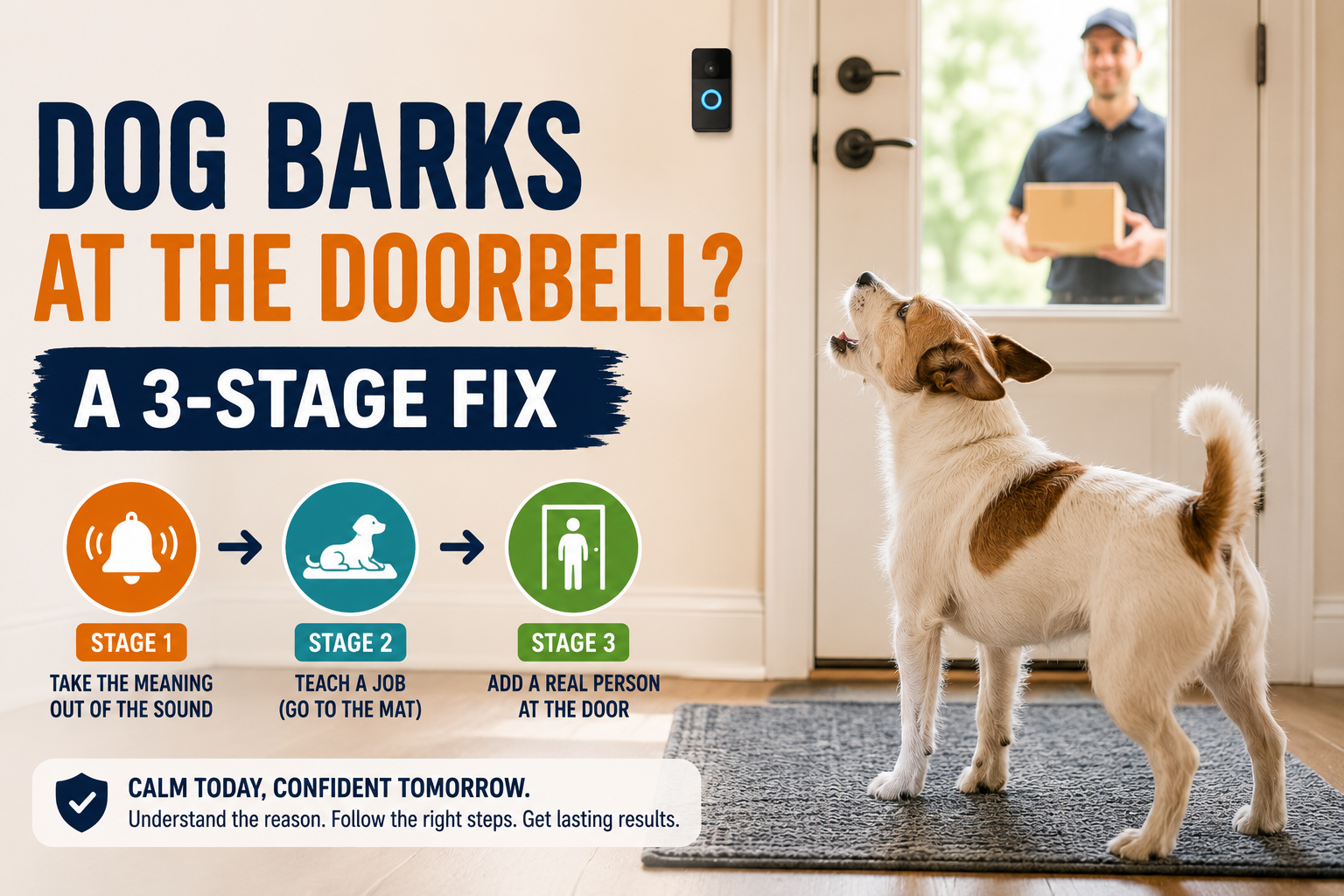
Dogs bark at the doorbell because the sound reliably predicts something exciting, and because from the dog's point of view barking works every single time: the person on the doorstep always leaves eventually. Fixing it means treating two separate problems in the right order. First take the meaning out of the sound, by ringing the bell yourself, quietly and often, when nobody is actually there, and paying your dog for staying calm. Then teach a job that cannot happen at the same time as barking, such as going to a mat. Only after both of those are solid do you add a real person at the door. Never punish barking at visitors, particularly a frightened dog.
This guide covers the doorbell specifically. If your dog barks at a lot of things, start with our live guide to stopping excessive dog barking, which covers the general picture, and come back here for the door.
Why the doorbell in particular sets dogs off
A doorbell is one of the most powerful predictors in a dog's life. It is loud, it is distinctive, it happens rarely enough to stay novel, and it is followed by something genuinely interesting: a person appearing at the threshold of the dog's home. Very few household sounds have a track record that consistent.
There is a second mechanism running underneath, and it is the one owners almost never spot. Barking at the door appears to succeed every time. The delivery driver drops the parcel and walks away. The canvasser gives up. Even a friend who comes in eventually stops being novel and the barking ends. The dog barked, and the situation resolved. Nothing about the sequence tells the dog that the barking was irrelevant.
Put those two together and you get a behavior that is heavily practiced, heavily rewarded by its own outcome, and attached to a stimulus the dog cannot ignore. That is why it does not fade on its own, and why the fix has to be deliberate.
The mistake that stalls most owners: two problems, not one
Here is the structural point that almost every guide on this topic blurs, and it is worth more than any individual technique.
The sound is one conditioned event. The arrival of a person is a completely separate one. They happen close together, so owners treat them as a single problem. Then they do a week of doorbell desensitization, it goes beautifully, a real visitor arrives, and the dog explodes. The conclusion drawn is that the training does not work. In fact the training worked on exactly what it addressed, which was the chime, and nothing had yet been done about the human.
Split them deliberately and the plan becomes obvious:
- Stage 1 removes the meaning from the sound, with nobody there.
- Stage 2 teaches the dog what to do instead, still with nobody there.
- Stage 3 introduces a person, starting far easier than a real visitor.
Skipping to stage 3 is the most common failure on this behavior. So is trying to run stages 1 and 3 at once, which is what happens when an owner "trains" on real deliveries.
Before you train: manage the door for a few weeks
Every unmanaged doorbell ring is a rehearsal, and rehearsals make the habit stronger while you are trying to weaken it. Buy yourself a clean run.
Put a note on the door asking visitors to text or knock quietly instead of ringing. Tell friends and family the same, and mean it. Where a delivery service lets you leave instructions, use them. If your dog barks worse when it can see out from beside the door, close that off during the training period. And if you can put your dog somewhere further from the door when you are expecting a delivery, that is a completely legitimate move rather than an admission of defeat.
This is temporary. Its only job is to stop the dog practicing while you build the replacement.
Stage 1: take the meaning out of the sound
The goal here is boredom. A doorbell that has rung four hundred times and predicted nothing at all stops being a starting pistol.
Work at a volume your dog notices but does not react to. That might mean a recording of your bell played quietly on a phone, a wireless chime turned down, or a knock so soft it barely registers. If your dog barks, the volume is too high and you are practicing the wrong thing.
The pattern is simple and repetitive. Sound, then immediately something excellent appears: a piece of chicken or cheese delivered to your dog, every time, no cue required and nothing asked for. You are not rewarding good behavior at this stage; you are building an association between a sound and food. Do a handful of repetitions, stop while your dog is still relaxed, and come back to it later.
Raise the volume only when the dog's reaction to the current level is a cheerful look at you rather than a look at the door. That look is the whole point: it means the sound now predicts you and food rather than an intruder. Expect this to take many short sessions across days or weeks. The precise mechanics of marking and timing are covered in our positive reinforcement dog training guide, and they matter more here than usual because the window between sound and reward is small.
Stage 2: teach the job
A dog with nothing to do at the door will do the thing it already knows. Give it a better job, and choose one that physically cannot happen at the same time as barking at the threshold.
A mat or bed a short distance from the door works well. Teach it away from the door entirely, first: reward stepping on the mat, then lying down, then staying while you move around, then staying while you walk to the door and back. Deliver the food to the mat rather than calling your dog off it, so the mat is where the payday happens.
Only when that is fluent do you connect the two threads. Now the quiet doorbell becomes the cue to go to the mat, and the reward arrives there. Many dogs find this genuinely satisfying, because it replaces a chaotic moment with a clear instruction, and dogs like clear instructions.
Keep the reward rate high for far longer than feels necessary. You are competing with one of the most exciting events in the dog's week.
Stage 3: put a real person on the other side
Now you add the part you actually care about, and you make it much easier than a real visitor to begin with.
Start with a household member stepping outside and giving the softest possible knock, then coming straight back in with no fuss. Then a quiet ring. Then a ring followed by the door opening and the person standing there for two seconds. Then a helper the dog knows. Then a helper the dog knows less well. Each step should look boring to an outside observer, and each one should end while your dog is still relaxed on its mat.
When you finally get to real visitors, brief them before they arrive. Ask them to ignore the dog completely on entry, to avoid eye contact and greeting, and to sit down and carry on a conversation. A visitor who bends over an excited dog in the hallway undoes a fortnight of work in four seconds. Once the dog has settled, calm greeting can happen on your terms.
Real life will not cooperate perfectly. Unannounced deliveries will happen, the dog will bark, and nothing is ruined by it. Go back to the management for a day and carry on.
Excited barking and frightened barking, and why it changes the plan
Two dogs can make an almost identical amount of noise at the door for opposite reasons, and the difference decides whether this is a manners project or something more serious.
Excited barking comes with a loose, wiggly body, a wagging tail carried in a normal position, and a dog that genuinely wants to reach the visitor. The plan above is the right plan.
Frightened barking looks different: the dog may bark and then back away, bark from behind furniture, dart forward and retreat, or go stiff and still. The tail may be low or tucked. This dog is not asking to say hello, it is asking the visitor to go away, and the fact that visitors do go away is teaching it that barking works.
That second dog needs the same distance-and-reward principle applied more carefully, and it needs a much lower difficulty level: a helper at the end of a driveway rather than at the door. If a frightened dog has ever lunged at, snapped at, or made contact with a visitor, stop the home training and contact a certified trainer or a veterinary behaviorist. Fear at the threshold combined with a stranger walking in is one of the more common circumstances for a bite in a household, and it is not a situation to work through from an article. The same distance-based logic, in more detail, is set out in our guide to leash reactivity toward other dogs.
What not to do
Do not shout at a barking dog. From the dog's side, you have joined in. Loudly.
Do not use bark collars, ultrasonic devices, or anything that works by startling or hurting. This site is reward-based, and on a frightened dog these tools add fear to a dog that is already afraid of what is on the other side of the door. They also do nothing about the reason for the barking.
Do not train on real doorbell rings. They arrive unpredictably, at full volume, with a genuine visitor attached, which is the hardest possible version of the exercise. Manufacture your own quiet rings instead, dozens of them.
Do not let the dog rush the door and then correct it. Prevention is easier: a gate, a leash held loosely, or a closed hallway door means the mistake never happens.
Do not expect silence. A single alert bark before the dog turns to you is a good outcome, and for many dogs a realistic one. Aiming for total silence usually means a plan that never feels like it is succeeding.
When to get help
Contact a certified trainer or veterinary behaviorist if your dog's door behavior includes lunging, snapping, or any bite; if the dog cannot be safely managed when someone comes in; if children live in or visit the house and the door routine is chaotic; or if the barking is clearly fear-driven and getting worse rather than better.
Speak to your veterinarian if this appeared suddenly in a dog that used to be fine, especially an older dog, or if it comes with other new behavior changes. Sudden change in an adult dog is worth a medical look before anyone starts a training plan.
We are dog owners writing from reputable sources, not veterinarians or certified behaviorists. On anything involving a dog and a stranger in a doorway, a professional watching your actual dog is worth far more than another article.
For everything else in this category, our guide to common dog behavior problems and their solutions is the hub, and if your dog is also vocal when the house is empty, howling when left alone covers a different problem that is often mistaken for this one.
Frequently asked questions
How long does it take to stop doorbell barking?
There is no honest number, because it depends on how long the habit has been practiced and how consistently you can manage the door while you train. What is predictable is the order: the sound work comes first, the mat job second, and real visitors last. Owners who skip to the last stage usually take longer overall.
Can I just cover the doorbell or disconnect it?
Disabling the bell removes the trigger, which genuinely helps in the short term and is fine as management. It does not teach your dog anything, so the barking usually returns the moment a bell rings somewhere. Use it to buy training time rather than as the solution.
My dog barks at the doorbell on television too. Is that normal?
Yes, and it is good evidence that the sound itself is the trigger rather than the visitor. It is also a convenient training opportunity, because a televised doorbell is a real ring with no person attached, which is exactly the stage-one exercise.
Should I let my dog greet visitors to get it out of their system?
Not while the dog is over threshold. A dog that is barking and rushing is not in a state to learn anything from the greeting, and an excited greeting rewards the whole sequence that came before it. Let the dog settle first, then allow a calm greeting.
Is barking at the door a good thing? I want my dog to alert me.
Many owners do, and that is a reasonable choice. The workable version is a couple of barks followed by the dog coming to you, which the mat work above builds directly. What is not workable is sustained barking that nobody can interrupt, and the training that produces the first does not remove the alert.
This article is general owner guidance drawn from the AKC, ASPCA, Hill's Pet, and Best Friends Animal Society. It is not veterinary advice. If your dog is fearful or has lunged or snapped at a visitor, please work with your veterinarian and a certified trainer or veterinary behaviorist.