
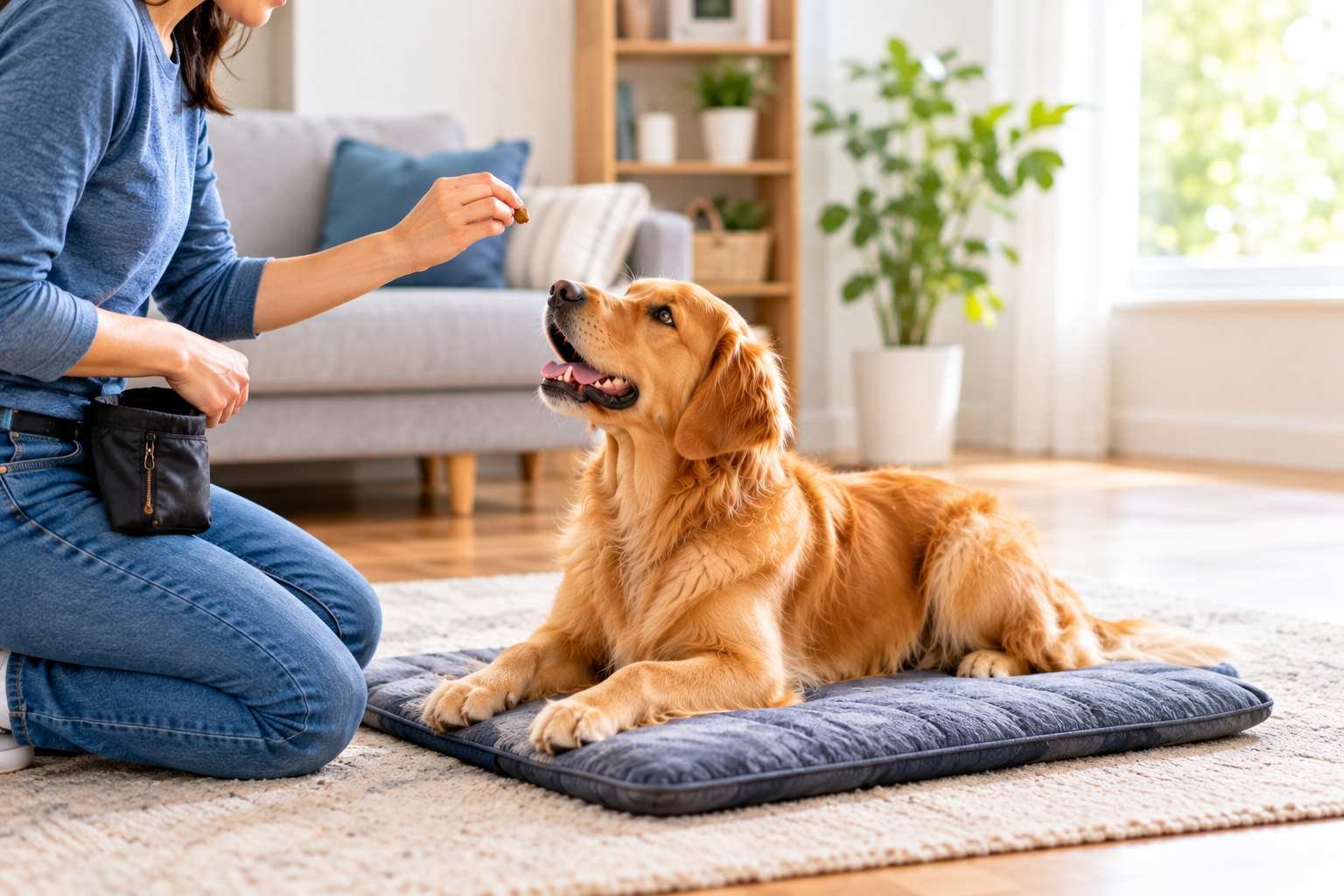
To teach dog place command skills, reward your dog for going to a specific mat, lying down on it, and staying there, calm, until you release them. Start by rewarding any interest in the mat, then add lying down, then build how long they stay, how far you can move away, and how many distractions they can ignore before adding the word "place." This is a reward-based skill, built in small steps, not a correction your dog avoids. Most dogs learn the basic idea within a handful of short sessions; a reliable place around real distractions takes longer, and that is normal.
What "place" actually teaches
"Place" is not the same skill as sit or down. Sit and down are quick positions you can ask for anywhere, for a few seconds. Place is a destination with a job attached to it: go to this exact spot, get into a settled position, and stay there until told otherwise, often for several minutes at a time.
That difference matters for what the command is good for. A dog with a solid place skill can lie quietly while you eat dinner, answer the door, or unload groceries, instead of underfoot, jumping, or pacing. It is one of the more practical skills in everyday dog training because it gives an anxious or overexcited dog a job that is incompatible with the behavior you are trying to avoid.
| Place | Down-stay (anywhere) | |
|---|---|---|
| Location | One specific mat or bed | Wherever you gave the cue |
| Typical duration | Minutes, sometimes much longer | Usually seconds to a couple of minutes |
| Best used for | Mealtimes, visitors, doorways, settling in public | Quick, short holds during a walk or a training set |
| What it builds | Duration, distance, and calm around distraction | Basic impulse control |
Why reward-based place training works
Place only works if the mat means something good, not something the dog is sent to as a punishment. That is not just a training preference. The American Veterinary Society of Animal Behavior's position on reward-based training methods (read 2026-09-18) states that reward-based methods, meaning added rewards and removed access to rewards, should be used for all dog training, and it names aversive tools and techniques, including leash corrections and forced positions, as carrying documented welfare risks without evidence that they train faster or better. A dog dragged to a mat, or held down on one, learns to avoid the mat. A dog who is paid every time they choose the mat learns to offer it on their own, which is the entire point of the skill.
This is also why place training should never be used as a timeout for bad behavior. If the mat becomes the place a dog gets sent when it has done something wrong, the settle behavior falls apart along with the dog's willingness to go there at all.
Before you start
Pick a mat, bed, or raised cot that is reserved for this skill, not the dog's everyday bed, so the object itself becomes a clear cue. Have 15 to 20 small, soft treats ready so you are not fumbling with packaging mid-session. Start in a quiet, low-distraction room, on leash if your dog tends to wander off, and keep first sessions short, just a few minutes at a time. If your dog does not yet have a settled routine of short, frequent training sessions, building one first will make every skill you teach, including place, come together faster; see how to build a puppy daily routine for a framework that works for adult dogs too.
How to teach dog place command in five stages
Stage 1: Get your dog onto the mat
Toss a treat onto the mat or lure your dog there with one in your hand. The moment all four paws are on it, say your marker word ("yes") and reward. Repeat until your dog starts stepping onto the mat on their own, hoping for a treat.
Stage 2: Add lying down
Once your dog reliably goes to the mat, ask for a down while they are on it, or wait for them to offer one. Reward generously for lying down specifically on the mat, not just standing on it.
Stage 3: Build duration
Start delaying the reward by a second or two after your dog lies down, then gradually stretch that to several seconds, then a minute, building slowly across sessions. If your dog gets up early, that is information that you asked for too much too soon; go back to the last point where they succeeded and rebuild from there rather than repeating a failure.
Stage 4: Add distance and duration together
Take one step away, then return and reward before your dog has a chance to break position. Gradually increase how far you move and how long you are gone, working toward tasks like answering the door or plating food while your dog stays put.
Stage 5: Add the cue, then distractions
Once your dog is moving to the mat and settling reliably, start saying "place" just before they go. Then practice with mild distractions: a family member walking by, a doorbell sound, a toy in view. Reward more often when a distraction is present, since staying put around something interesting is a harder job than staying put in an empty room. Always end with a clear release word, and make the release itself rewarding, a chance to move, sniff, or play.
Building place into daily life
Place earns its keep once it moves off the training mat and into real moments: mealtimes, visitors at the door, or the times a dog would otherwise be pacing and hard to settle. A dog that has learned an incompatible, rewarded way to occupy itself is also less likely to fall into the kind of restless, repetitive destruction that comes from having nothing to do; the enrichment side of that problem is covered in destructive behavior from boredom, and place is one of several tools that address it from the calm-and-settled direction rather than the tired-out direction.
Keep the mat's meaning consistent. If it is a settle spot during the week and a free-for-all on weekends, your dog will struggle to know which one applies, and progress will stall.
Common problems and what to do
Your dog keeps getting up. You likely progressed duration or distance faster than your dog was ready for. Shorten the ask, reward more frequently for a short time, then rebuild slowly.
Your dog will go to the mat but will not lie down. Lure the down with a treat traced from their nose down to the floor between their front paws, and reward the instant their elbows touch the mat.
Your dog only holds the position when you are looking at them. This usually means duration was built too fast relative to distraction. Practice brief departures, out of sight for a second at first, and reward on your return rather than while you are away.
Your dog seems reluctant to lie down at all, even off the mat. Reluctance to get into or hold a down can be linked to joint or muscle discomfort rather than a training gap. If a dog that used to lie down easily starts avoiding it, or seems stiff getting up, that is worth mentioning at a veterinary visit rather than pushing through it; signs your dog should see a vet covers what belongs in a "soon" conversation versus an emergency one.
When place training is not the right first step
Place training assumes a dog that is comfortable, not fearful, and physically able to hold a down. A few situations call for a different first move.
If your dog shows fear, freezing, growling, or snapping when guided toward the mat or asked to lie down, stop the exercise. That is not a training gap to push through with more repetition; it is a welfare signal. A certified trainer credentialed through a body such as the Certification Council for Professional Dog Trainers (read 2026-09-18), or a veterinary behaviorist for anything involving aggression, can assess what is actually happening before any further training is attempted.
If a young dog's sudden hesitancy lines up with a known developmental stage, the cause may be more about timing than about the mat itself; understanding puppy fear periods explains why a puppy that was previously confident can temporarily react differently to new objects, including a training mat.
If discomfort, not fear, seems to be the reason your dog avoids lying down, that again points toward a veterinary visit before more training, not a more persuasive lure.
None of this means place training is unsafe for most dogs. It means the small number of dogs showing fear, aggression, or physical discomfort need that addressed first, by the right professional, rather than more repetitions of the same exercise.
Frequently asked questions
How long does it take to teach a dog the place command?
It varies by dog. Many dogs pick up the basic idea of going to the mat and lying down within a handful of short sessions across a few days. Building real duration, distance, and reliability around distractions takes longer, often several weeks of short, regular practice, and that timeline is normal rather than a sign something is wrong.
Is place the same as a dog bed?
Not necessarily. A place mat works best when it is reserved for this skill so your dog associates it clearly with settling and staying, rather than treating it like just another spot to nap wherever it happens to be.
Can I use place to stop a dog from jumping on guests?
Yes, once the skill is solid in low-distraction settings. Practice with mild distractions first and build up to the excitement of a real arrival gradually, rather than testing it cold with actual guests at the door.
What if my dog will not stay without a treat every time?
That is expected early on. Duration should be built gradually with intermittent, then occasional, rewards, and the release itself should also feel rewarding so your dog is not solely working for food in hand.
Is it ever okay to physically push my dog into a down for place?
No. Reward-based methods, luring and rewarding rather than forcing a position, are the approach recommended by the American Veterinary Society of Animal Behavior for all dog training. A physically forced down teaches a dog to avoid the mat and the person doing the pushing, which works against the entire goal of the skill.
The short version
Place is a rewarded destination skill: go to a specific mat, lie down, and stay until released, built in small steps of duration, distance, and distraction. Never use it as a punishment spot and never force the position. If your dog shows fear or discomfort around the exercise, get a certified trainer or veterinary opinion before continuing, and build the skill into daily routines like mealtimes and visitors once it is solid.