
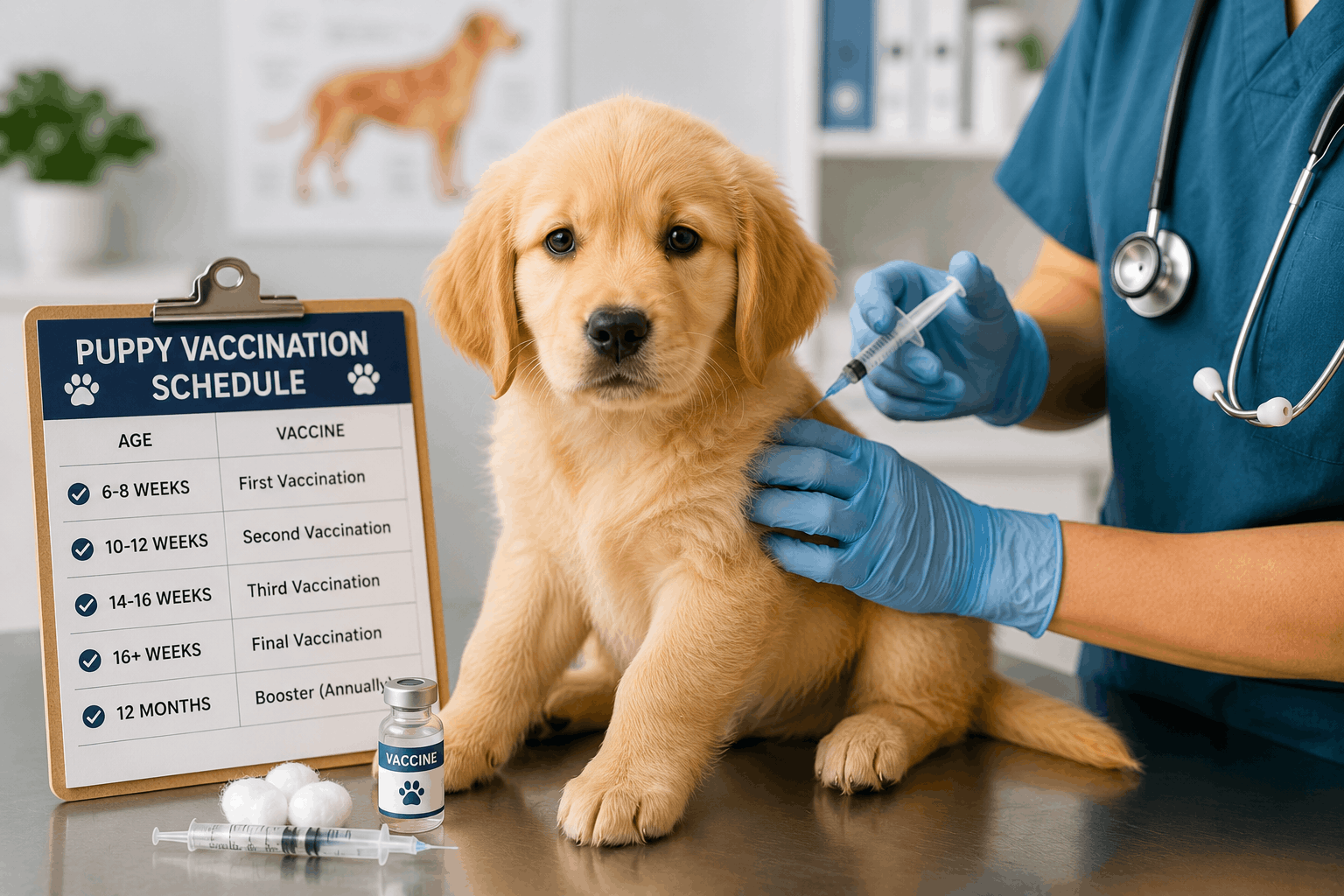
There is no single puppy vaccination schedule, and the veterinarian who examines your puppy is the one who sets yours. What the profession publishes is a shape. The 2022 AAHA Canine Vaccination Guidelines, updated in 2024, and the WSAVA 2024 Guidelines for the Vaccination of Dogs and Cats both describe a primary series that begins at 6 to 8 weeks of age, repeats every 2 to 4 weeks, and ends with a final dose at 16 weeks of age or older, with a booster within the following year. Which vaccines, on which dates, depends on your region, your puppy's life, and your puppy.
This page explains that shape so you can follow the conversation at the clinic. It is not veterinary advice, it names no doses, and nothing here is a reason to change, delay or skip anything your vet has recommended.
What the published guidelines actually say
Both of the documents veterinarians in the United States most often work from divide vaccines into two groups. Core vaccines are the ones the guidelines recommend for every dog, and per the AVMA's owner guidance the exception is a specific medical reason not to vaccinate a particular animal. For dogs the core group covers rabies plus a combination vaccine against canine distemper virus, canine adenovirus and canine parvovirus, commonly given alongside parainfluenza.
The 2022 AAHA guidelines were updated in 2024, and that update moved leptospirosis into the recommended-for-all-dogs category in the United States. WSAVA's 2024 guidance describes the same series structure and adds a point most owner-facing pages leave out: it advises revaccination at or after 26 weeks of age rather than waiting for the usual 12 to 16 month booster, for reasons covered in the next section.
Sources read 2026-08-24: AAHA Canine Vaccination Guidelines (2022, 2024 update), WSAVA Guidelines for the Vaccination of Dogs and Cats (2024), AVMA owner guidance on vaccinating your pet.
Why the puppy vaccination schedule is a series, not one shot
This is the part that makes the rest of the schedule make sense, and almost nothing written for owners explains it.
Puppies are born with antibodies from their mother, and WSAVA's guidelines state plainly that these maternally derived antibodies interfere substantially with how well early core vaccines work. The mother's antibodies are protecting the puppy and blocking the vaccine at the same time. The problem is that nobody can see the exact moment that protection fades.
WSAVA notes that the level varies substantially both between litters and between puppies in the same litter. In general it has waned by 8 to 12 weeks of age to a point where the puppy can mount its own response, but some individuals carry high enough levels that they cannot respond until sometime after 12 weeks.
So the series is not a stack of stronger and stronger protection. It is repeated attempts, spaced out, so that at least one dose lands after the mother's antibodies have faded. That is why WSAVA sets the final dose at 16 weeks of age or older, and why a missed dose is not a shortcut. It is a missed attempt.
Core, noncore, and why the clinic asks about your lifestyle
The AVMA describes noncore vaccines as ones recommended for certain pets based on their risk of exposure, through lifestyle or geographic location. That is why a good puppy appointment includes questions that sound unrelated to medicine. AAHA publishes a lifestyle questionnaire for exactly this purpose, and the AVMA's reporting on the guidelines gives the standard example: vaccines such as Bordetella and canine influenza are recommended for dogs that go where other dogs gather, including boarding kennels, daycare and training classes.
The practical consequence is that two healthy puppies of the same age in the same city can correctly receive different vaccines. A puppy that will hike, swim and board is not carrying the same exposure as one that will not. Neither owner is being upsold or shortchanged. If you cannot see why a particular vaccine is on your puppy's list, the useful move is to ask which exposure it is for, and how common that disease is where you live.
The three things that move the dates
Where you live. Disease prevalence is regional. The 2024 addition of leptospirosis to the core group in the United States reflects a national picture, and local risk still varies within it.
How the puppy will live. The lifestyle questions above decide the noncore list, and the noncore list can change the visit schedule.
The individual animal. Health status, age at adoption and what was already given before you got the puppy all matter. AVMA guidance frames core vaccines as recommended for all dogs unless there is a medical reason not to vaccinate a specific one, and identifying that reason is a clinical judgment made in front of the animal.
Getting a puppy settled before that first appointment helps more than people expect, and the practical setup is covered in first-week puppy supplies and setup basics.
What this page will not do, and why
It will not print a date table for your puppy, name a dose or a product, or tell you that any vaccine can be skipped, delayed or given at home.
That is not caution for its own sake. The schedule only works if the person setting it has examined the animal and knows the local disease picture, and none of that is available to a web page. Vaccines are also prescription veterinary products in most places, with storage and handling requirements and a legal record attached, and rabies vaccination in particular is governed by local law that differs between jurisdictions.
If you have read something online that suggests a different schedule than your vet's, the productive thing to do with it is bring it to the appointment. A reasonable vet will explain their reasoning, and you will get an answer that applies to your actual puppy instead of an average one.
Getting the most out of the first appointment
Take every piece of paper the breeder, shelter or rescue gave you, including any vaccination record, worming record and date of birth. If the puppy came with no records at all, say so plainly rather than guessing, because a guessed history is worse than a blank one.
Four questions worth asking: which of these are core and which are noncore for my area, what exposure is each noncore one covering, when is the next dose due, and what should I watch for in the next day or two and who do I call about it. Book the next visit before you leave, because the 2 to 4 week spacing is the part of the series that slips.
A puppy that finds the clinic frightening makes every future visit harder, and the groundwork for that starts at home with handling practice, described in the new puppy first week guide. If your puppy mouths hard during handling, how to stop puppy biting covers the calm version of that lesson, and a puppy that already loves its crate travels to appointments far better, which is one of the quieter benefits of crate training a puppy.
The socialization question, in one honest paragraph
You will hear that a puppy should stay home until the series is finished, and you will also hear that the socialization window closes early. Both concerns are documented. The American Veterinary Society of Animal Behavior's Position Statement on Puppy Socialization holds that it should be the standard of care for puppies to receive socialization before they are fully vaccinated, and states that behavioral issues, not infectious disease, are the number one cause of death for dogs under three years of age. The vaccination guidelines above exist because parvovirus and distemper are also real. These are two genuine risks being weighed against each other, not a right answer and a myth, and the person who can weigh them for your puppy is the vet who knows the disease picture on your street.
FAQ
How many rounds of shots does a puppy need?
There is no fixed number. WSAVA describes doses every 2 to 4 weeks with the final one at 16 weeks of age or older, so the count depends on the age at which the series started and on your vet's plan.
Why does my vet want another dose at around six months?
WSAVA's 2024 guidelines advise revaccination at or after 26 weeks of age rather than waiting until 12 to 16 months, to cover the minority of puppies that still had interfering maternal antibodies at their 16 week dose.
Is the rabies vaccine required by law?
Rabies is a core vaccine in AAHA's guidelines, and rabies vaccination is separately regulated by local law in many places, including timing and proof of vaccination. Requirements differ between countries, states and counties, so check the rule where you live rather than a general figure.
We adopted at 12 weeks with no paperwork. What happens?
Tell the clinic exactly that. Where prior doses cannot be confirmed, the vet decides how to proceed based on the puppy's age and local risk. Do not assume the previous owner completed anything.
Is leptospirosis part of the core series now?
The 2024 update to the 2022 AAHA Canine Vaccination Guidelines moved leptospirosis into the group recommended for all dogs in the United States. Whether and when it appears on your puppy's schedule is still your vet's call.
The short version
- Guidelines describe a shape, not your puppy's dates. Primary series from 6 to 8 weeks, doses every 2 to 4 weeks, final dose at 16 weeks or older, booster within a year, per AAHA 2022 (2024 update) and WSAVA 2024.
- The series exists because maternal antibodies block early vaccines and fade at an age nobody can predict for an individual puppy, per WSAVA.
- Core is for every dog; noncore is chosen by exposure risk, which is why the clinic asks about boarding, hiking and daycare, per the AVMA.
- Region, lifestyle and the individual animal all move the dates.
- Nothing here is a reason to skip, delay or self-administer anything. Bring the question to the appointment instead.