
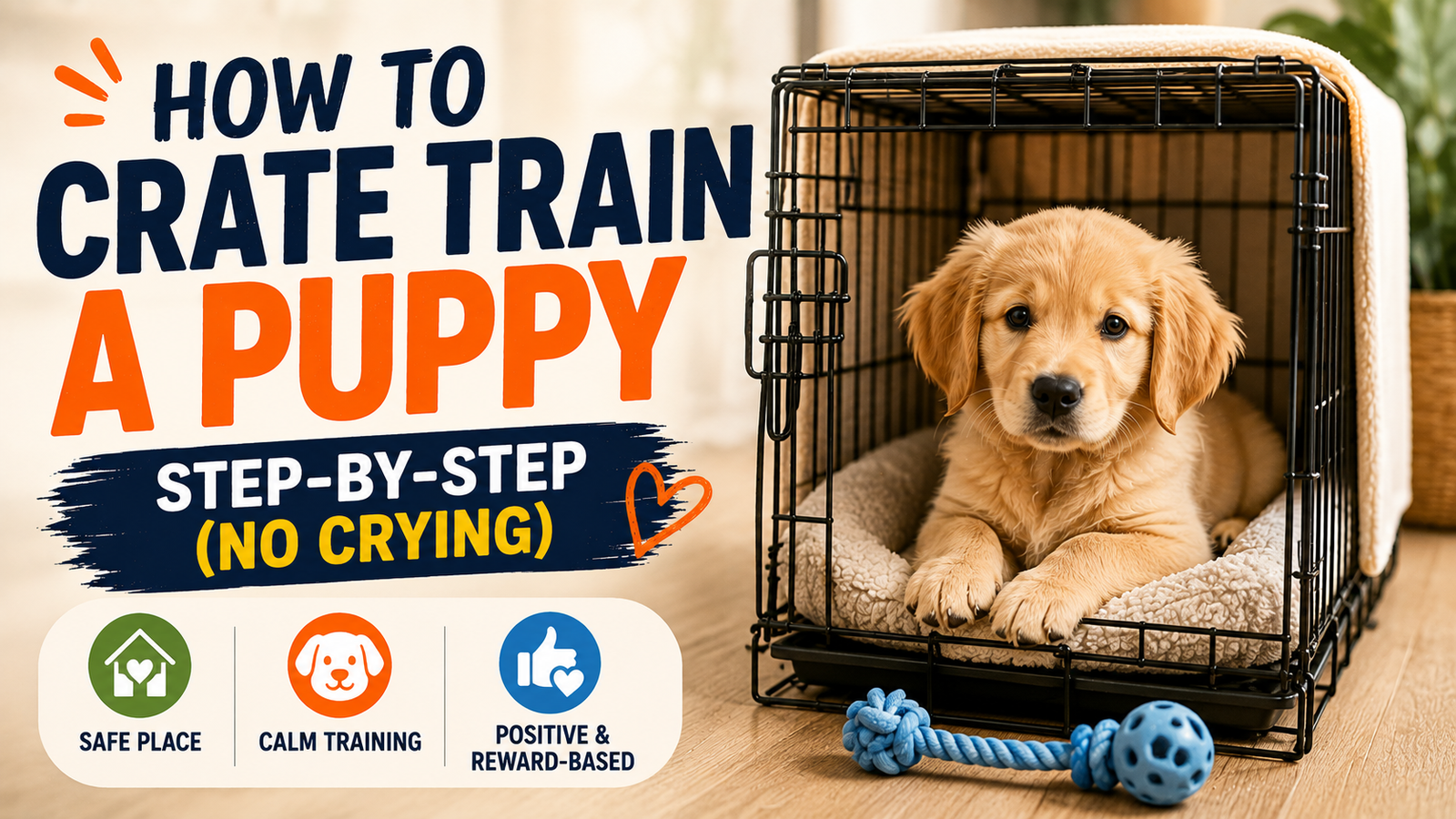
Crate training works by making the crate feel like a safe den, then building up the time your puppy spends inside in small, positive steps. Start with the door open and treats inside, feed meals in the crate, add a simple cue, then close the door for a few seconds and slowly extend to minutes. Never use the crate as punishment, and always give a potty break before and after. Done gradually, most puppies settle within a few weeks, though some take longer, and that is normal.
If you feel guilty at the idea of putting your puppy behind a door, you are not alone. That worry is the reason so many owners quit halfway. So let us start there.
Is crate training cruel? The honest answer
A crate is not a cage or a time-out box. Used the way trainers and welfare groups recommend, it taps into a natural instinct: dogs are den animals, and most feel calmer in a small, enclosed space they can call their own. The American Kennel Club (AKC), the ASPCA, and Humane World for Animals (formerly the Humane Society) all describe crate training as a normal, humane practice when it is introduced gently and never forced.
The word "gently" is doing real work in that sentence. A crate becomes unkind when it is used the wrong way: as punishment, or for hours that stretch past what a puppy's body can handle. Avoid those two things and the crate turns into what it is meant to be, which is your puppy's safe place to rest, a huge help with potty training, and a calm spot when the house gets busy. We will cover both limits in detail below, because being honest about them is what makes the rest of the method work.
Choosing the right crate and size
Size is the one setup detail people get wrong most often. The crate should be just big enough for your puppy to stand up, turn around, and lie down comfortably. That is it.
If the crate is too large, your puppy can potty in one corner and sleep in the other, which quietly ruins the potty-training benefit. Because puppies grow fast, buying a crate sized for the adult dog usually makes more sense than buying two. Many crates come with a divider panel you can move as your puppy grows, so the space stays snug at every stage without you buying anything twice.
Beyond size, keep it simple. A crate in a spot where the family spends time (not isolated in a far room) helps your puppy feel included rather than banished. Soft bedding is fine for most puppies, though if yours chews or shreds bedding, remove it until that phase passes so nothing gets swallowed.
Step 1: Introduce the crate with food and treats (door open)
Do this on a calm day, not five minutes before you leave the house. Prop the door open so it cannot swing shut and startle your puppy.
Drop a few small treats near the crate, then just inside the door, then all the way to the back. Let your puppy wander in and out freely. If they will only go halfway at first, that is completely fine. Do not push, lure with your hands, or shut the door. You are teaching one idea only: good things happen around this crate. Toys and a favorite chew placed inside work the same way.
Step 2: Feed meals inside
Once your puppy walks in willingly, start serving regular meals in the crate. Place the bowl toward the back so they step all the way in to eat.
Meals are the fastest way to build a warm association, because your puppy links the crate with the best part of the day. Keep the door open for the first several meals. When they are eating calmly with their whole body inside, you can begin closing the door for the length of the meal and opening it again the moment they finish. If they whine when the door closes, you extended too soon. Back up a step and go slower. Nothing about this stage should feel like a fight.
Step 3: Add a cue and close the door for seconds
Now give the behavior a name. As your puppy trots in for a tossed treat, say a short cue like "crate" or "bed," then praise and reward. Repeat until the word alone sends them in.
Then start closing the door for seconds, not minutes. Close it, feed a treat through the bars, open it. Build up slowly: a few seconds, then ten, then thirty, then a minute. Sit nearby at first so your puppy is not alone and shut in at the same time, which are two hard things at once. Keep every session upbeat and end it before your puppy gets frustrated, not after.
Step 4: Build duration and add short departures
When your puppy rests quietly with the door closed and you sitting beside them, begin adding small departures. Step a few feet away, come back, reward calm. Then leave the room for a moment and return.
The goal is to teach that a closed door and your absence both predict a calm wait and a happy return, not abandonment. Stretch the closed-door time gradually, from a few minutes toward the 10-minute mark after eating, and only then toward longer stretches. A stuffed chew or a food puzzle gives your puppy a job to do and makes the time pass easily. Always take your puppy out to potty right before the crate and right after, every single time.
Patience matters more than speed here. The AKC notes that some puppies get comfortable within a week while others need several weeks or more. Going slowly is not falling behind. It is the training.
Nighttime: how to tell "let me out to pee" from "let me out to play"
Here is the moment most guides skip, and it is exactly where owners give up: the puppy cries at 2 a.m. and you have no idea whether to go to them or wait it out. Get this one call right and the rest gets much easier.
Set the night up for success first. Take your puppy out to potty right before bed, and put the crate in your bedroom so you can hear them and they are not alone in the dark. Both the AKC and Humane World recommend keeping the crate close by for the first weeks for exactly this reason.
Then use the sound to decide:
- A potty cry is urgent and rising. It tends to be sharp, frantic, and it does not settle. This usually means a real need. Take your puppy out on leash, quietly, with no play and no chatter, let them potty, and put them straight back in the crate. Boring on purpose.
- A protest cry is a grumble. It whines, pauses, restarts, and often fades if you do not react. This is your puppy testing whether crying opens the door. If you already know they are empty (you just took them out and nothing happened), you can wait this one out.
The trap is answering every protest cry with a trip outside, because that teaches your puppy that crying is the button that summons you. The opposite trap, ignoring a genuine potty cry, causes accidents that set potty training back and make the crate feel like a bad place. When you are unsure, err toward a quick, boring potty trip. You would rather take out an empty puppy than force a full one to hold it. This is also why age matters, which brings us to the single most important number in this guide.
How long can a puppy hold it? Age-based guidance
A puppy cannot be crated all day, and pushing past their bladder capacity is one of the fastest ways to stall training. A widely cited rule of thumb from the AKC and ASPCA is roughly one hour per month of age, up to a point.
| Puppy age | Rough maximum stretch in the crate |
|---|---|
| 8 to 10 weeks | About 1 hour |
| 3 months | About 3 hours |
| 4 to 5 months | About 4 to 5 hours |
| 6 months and up | Work toward, but rarely exceed, a normal adult limit |
Even for a healthy adult dog, most experts consider a stretch beyond several hours too long to do routinely. These are general ranges, not promises: a specific puppy may need to go out sooner, and health conditions change everything. If your puppy cannot last close to these times, or seems to need out constantly, talk to your veterinarian rather than pushing the crate schedule. Overnight is a partial exception, since a sleeping puppy holds it a little longer, but a very young puppy will still likely need one middle-of-the-night trip.
What crate training can NOT fix
This is the part no one selling you a crate mentions. A crate is a helpful tool, not a cure-all, and using it for the wrong problem makes things worse.
A crate cannot substitute for exercise and stimulation. A puppy who has been cooped up with no outlet does not need more crate. They need a walk, a training game, a chew, and a chance to be tired the honest way. An under-exercised puppy crated for quiet is a puppy who learns to hate the crate. If overtired, nippy behavior is your real issue, crate naps help as part of a routine, and our guide on how to stop puppy biting covers the rest.
A crate cannot fix true separation anxiety, and can make it worse. There is a real difference between a puppy protesting a new routine and a dog in genuine panic. Signs of real distress include frantic escape attempts, drooling, injuring themselves on the crate, or house-soiling only when left alone. Forcing a panicking dog into a closed crate can turn fear into terror. If that sounds like your dog, stop escalating crate time and read our guide on dog separation anxiety, because that problem needs a different, slower approach and often a professional's help.
And crate training is not right for every dog. Some rescued or older dogs have a bad history with confinement and do better with a gated room or an open crate they can leave. The goal was never the crate itself. It was a calm, safe dog. If the crate is fighting you at every step despite slow, positive work, that is information worth listening to.
Once your puppy is comfortable resting in the crate, you have built the foundation for calmer behavior across the board. For the bigger picture on shaping good habits, our guide on how to stop a dog pulling on the leash uses the same reward-based logic on your daily walk.
FAQ
Where should I put the crate?
Somewhere the family spends time during the day, and in your bedroom at night for the first several weeks. Being near you helps your puppy feel secure and lets you hear a genuine potty cry. Avoid isolating the crate in a far, quiet room early on.
Should I cover the crate with a blanket?
Some puppies settle faster with a partial cover that makes the crate feel more den-like, while others do fine uncovered. If you cover it, leave airflow and never fully seal it, especially in warm weather. Watch your own puppy and follow what calms them.
How long is too long to leave a puppy crated?
Use the roughly one-hour-per-month-of-age guide, and treat a stretch beyond a few hours as too long for most dogs to do routinely, even adults. A puppy who cannot last close to these ranges should see a veterinarian. The crate is for rest and short waits, not all-day confinement.
My puppy cries every night. Am I doing it wrong?
Not necessarily. Some crying is normal in the first week or two. Take your puppy out for a quiet, boring potty trip if the cry is sharp and rising, and wait out the grumbling protest cry once you know they are empty. If the crying is frantic, escalating, and paired with panic rather than settling over days, look into separation anxiety instead.
How long does crate training take?
It varies. The AKC notes some puppies are comfortable within a week and others need several weeks or longer. Going slowly and keeping every session positive gets you there faster than rushing and creating a bad association you then have to undo.