
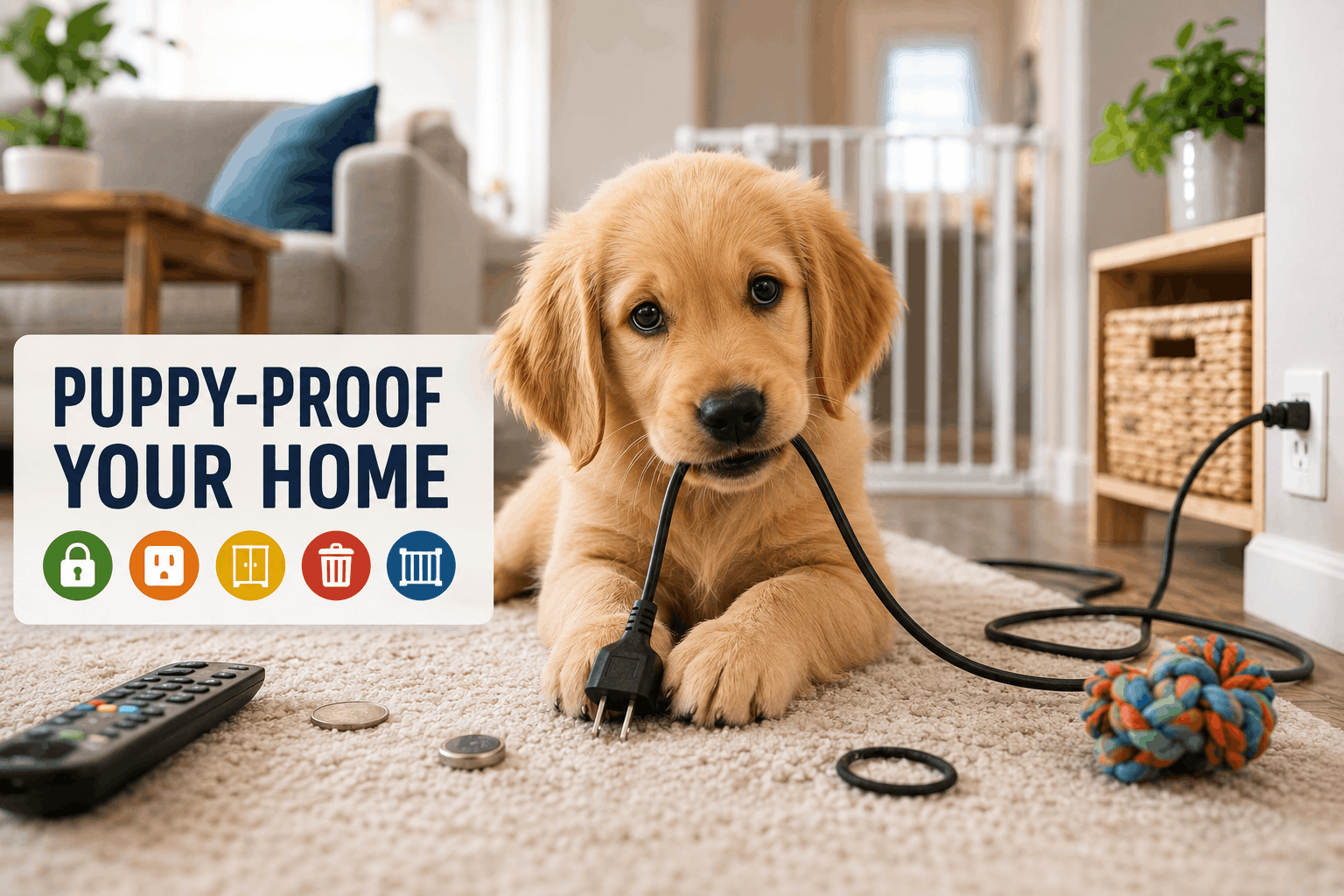
Puppy-proofing is one survey done at floor height and then five decisions repeated in every room: what can be swallowed, what can be chewed through, what can fall, what can trap, and what can be escaped through. Do the survey on your knees before the puppy arrives, close off the rooms you have not done yet, and plan to repeat the whole thing at around four and six months, because the puppy's reach grows faster than the checklist you wrote in week one.
The room lists below are the practical version. The habit that makes them work is the survey, so start there.
Do the survey at three heights, not one
Every puppy-proofing guide tells you to get down to your puppy's level. That is right and it is not enough, because a puppy operates at three different heights and they fail differently.
On the floor, lying down. Put your cheek on the carpet and look along it. This is the height that finds the coin under the sofa, the hair tie behind the door, the gap between the couch and the wall that a small dog can get into and not out of, and the loose staple in the carpet gripper.
Sitting up, roughly knee height. This is the reach of a puppy that has learned to stand on its back legs against furniture. Coffee tables, low shelves, the open dishwasher door, the trailing end of a tablecloth.
Head height, which is yours. Anything hanging. Blind cords, charging cables draped off a nightstand, the strap of a bag on a chair, the end of a curtain. A puppy pulls what dangles, and what dangles is usually attached to something heavier.
Write down what you find rather than fixing as you go. You will fix faster in one pass, and the list is what you re-read at four months.
The five ways a home actually hurts a puppy
Organizing by hazard rather than by room is what stops you from missing the same thing in five places.
Swallowing. The AVMA's household hazards guidance for owners lists small items that fall on the floor as a leading problem, naming coins, buttons, batteries, small children's toys, medicine bottles, jewelry, nails and screws. Swallowed objects can lodge or, in the case of sharp items, injure the digestive tract, and a swallowed battery is an emergency call, not a wait-and-see.
Chewing through. The AVMA notes that plugged-in electrical cords can cause burns or electrocution when pets chew them, and recommends cord covers and blocking access to cords and wires.
Falling and crushing. Anything a puppy can pull off a surface onto itself, plus unsecured bookcases, freestanding lamps and the television.
Trapping. Gaps behind and under furniture, reclining chair mechanisms, self-closing doors, and any narrow space a puppy can enter facing forward and not turn around in.
Escaping. Front doors, gaps under gates, deck railings, and fence lines with a gap a puppy can get through even though the adult dog it was built for cannot.
How to puppy-proof your house, room by room
Work through the rooms the puppy will actually be allowed in first, and gate off the rest until you get to them.
Kitchen
The busiest room and usually the one the puppy is allowed in first.
Fit child-proof latches on the low cupboards, particularly the one holding cleaning products, which in most homes is under the sink. Keep the trash behind a door or in a bin the puppy cannot nose open, because the AVMA specifically flags garbage as a source of intestinal problems and pancreatitis in dogs.
Close the dishwasher between loads. An open dishwasher door is a step, a shelf and a collection of dirty knives at once. Same for the oven door and the fridge.
Get cords off the counter edge. Kettles, toasters and phone chargers are all attached to something heavy by something chewable that hangs down.
Decide now where the puppy's food and water go, and keep them away from the family's traffic path. Feeding location is worth getting right early for reasons that go beyond safety, as dog resource guarding around food explains.
Living room
Cord covers on everything running along the baseboard, and cable tidies for the tangle behind the television. Secure the television and any tall, narrow bookcase to the wall.
Move breakables up a level for six months. Not because a puppy is malicious, but because a tail at coffee-table height clears a coffee table.
Check underneath and behind every piece of soft furniture for the gap problem. If a puppy can get behind the sofa, either block it or move the sofa flush.
Blind and curtain cords get tied up out of reach or cut short. A looped cord at a puppy's head height is a strangulation risk, and it is the one hazard on this page that people consistently walk past.
This is also the room where the furniture legs get chewed. Prevention is management plus something better to chew, and the full approach is in how to stop a dog chewing furniture.
Bathroom and laundry
Close the lid on the toilet and keep the door shut by default.
All medication goes in a closed cabinet, not on a shelf and not in a bag on the floor. The AVMA's owner list names medicine bottles among the small items pets swallow, and a chewed blister pack is a poison call.
Small personal items are the specific bathroom problem: razors, cotton buds, dental floss, hair ties, and the ends of toilet roll. Floss and string are worse than they look because of what a long thin object does inside an intestine.
In the laundry area, keep the washer and dryer doors closed, keep detergent pods completely out of reach, and check the drum before every cycle if the puppy has access to the room at all.
Bedrooms, hall and stairs
Bedrooms look harmless and are full of chewable, swallowable objects at exactly the right height: shoes, socks, charging cables, jewelry, the underwire in things left on a chair.
Use baby gates rather than closed doors where you can, so the puppy can still see and hear the household. Choose gates with vertical bars rather than horizontal ones, since horizontal bars are a ladder. Gate the top and bottom of the stairs until the puppy is reliably competent on them, and be aware that a young puppy going down stairs is a fall risk before it is a fitness question.
The entryway needs a plan, not a fix. Every person coming through that door is an escape opportunity, and a puppy that has learned the door means freedom is a long-term problem. Give the puppy somewhere to be when the door opens, which is one of the practical uses of crate training a puppy.
The reach that grows, and why you do this twice more
The single most common failure in puppy-proofing is treating it as a one-time job done before the puppy arrives.
A ten week old puppy cannot reach the kitchen counter, the back of the couch, the middle of the dining table or the bathroom windowsill. A six month old dog of the same breed can reach some or all of them, and by then everybody has relaxed. Put two reminders in your calendar now, at roughly four months and six months, to walk the same three heights again. The list will be different both times.
The counter is the specific one worth expecting, because the first successful theft teaches the habit in one repetition. What to do about it is how to stop a dog counter surfing, and the easiest version of that lesson is the one where the counter was never rewarding.
What gates, covers and closed doors do not do
Honest limits, because equipment gets treated as a solved problem.
A baby gate is a barrier, not a babysitter. Pressure-mounted gates come loose, and a determined puppy learns to lean. Gates buy you supervision time; they do not replace supervision.
Cord covers stop casual chewing. They are not armor. A puppy that has decided a cord is the best thing in the room will work at it.
A closed cupboard door is only closed if it latches. Puppies open unlatched cupboards with their noses, generally at the moment nobody is watching.
Puppy-proofing does not remove the need for confinement. The safest room in the house is still a room where a puppy can eat a sock. When you cannot watch, use the crate or pen, which is the whole logic behind the setup in first-week puppy supplies and setup basics.
The poison question, and where it belongs
This page is about physical hazards, and toxic substances are a separate subject that deserves better than a paragraph. Two things belong here anyway.
Keep the ASPCA Animal Poison Control Center number where you can find it under stress, not in a browser tab: (888) 426-4435, available around the clock. The ASPCA notes that a consultation fee may apply. Write it on the fridge alongside your own vet's number and the nearest emergency clinic, and do that before you need it.
And read the AVMA's own household hazards guidance for owners, which is short, free and covers the substance side properly. If your puppy has eaten something and you are reading a web page to decide whether it matters, stop reading and call.
FAQ
Where should I start if the puppy arrives tomorrow?
Pick one room, do the three-height survey there, and gate the rest of the house off. One properly done room plus a crate beats a whole house done badly.
Are baby gates or a puppy pen better?
They do different jobs. A gate manages access to a space you have already made safe. A pen creates a safe space inside one you have not. Most households use both.
How long does a house need to stay puppy-proofed?
Longer than the puppy stage. Chewing typically outlasts teething, and the reach keeps growing. Treat six to twelve months as the planning horizon and reassess rather than picking a date.
Do I need to puppy-proof the yard as well?
Yes, and walk the fence line at the puppy's height looking for gaps, not at yours. Also check gate latches, deck railing spacing and anything stored at ground level in a shed or garage.
The short version
- Survey at three heights: lying on the floor, knee height, and hanging things at your own height.
- Sort hazards by mechanism, swallow, chew through, fall, trap, escape, and the room lists write themselves.
- The AVMA names small swallowable objects, electrical cords and garbage as leading household hazards for pets.
- Blind cords and long thin objects like floss and string are the two most commonly overlooked items.
- Re-do the survey at around four and six months. The reach grows.
- Equipment buys supervision time, it does not replace it.
- Poison line on the fridge: ASPCA Animal Poison Control, (888) 426-4435, fee may apply.