
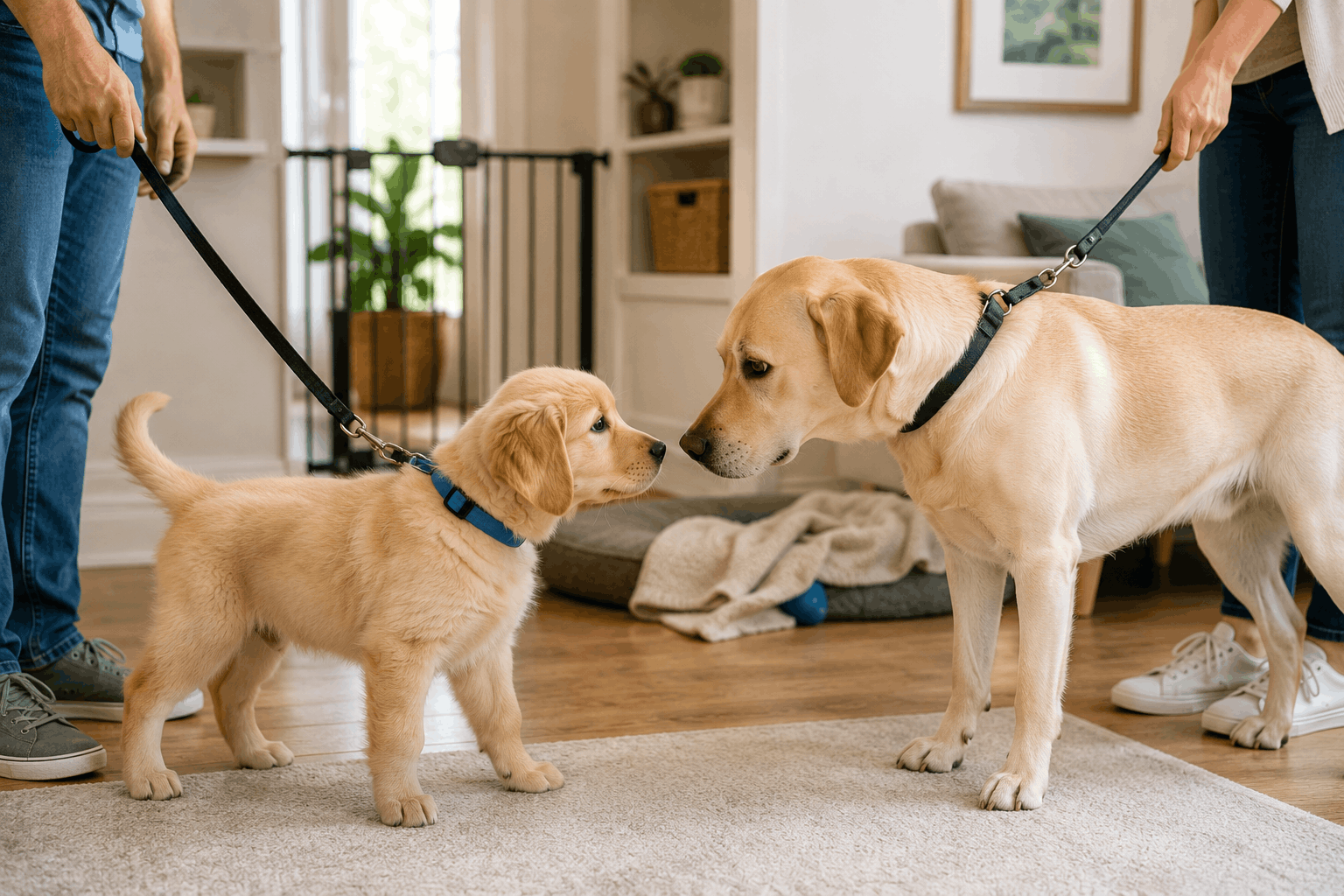
Introduce them on neutral ground, on leash, with one handler each, after both dogs have had a health check, and keep the first session short. That part is well covered everywhere and it is genuinely the easy part. The introductions that fail usually did not fail at the meeting. They failed somewhere in weeks two to eight, when the adult dog had been pestered without a break for long enough that it stopped being patient. Plan the resident dog's time off before the puppy arrives, and you will avoid most of what goes wrong.
Below is the meeting protocol, and then the part almost nobody writes about.
Before they meet at all
RSPCA guidance on introducing a new dog to an existing dog puts two things before the introduction itself, and both are easy to skip.
Health and vaccination status, both dogs. RSPCA advises making sure both dogs have had recent health checks and are up to date on vaccination, worming and parasite control. A puppy part way through its series is more vulnerable than an adult dog, which is one more thing worth raising at the appointment covered in our puppy vaccination schedule overview.
A separate retreat each, prepared in advance. RSPCA is specific: prepare separate retreats for the new dog and the existing dog, each with everything they need, including a comfortable bed, toys and water. The point is not decoration. It is that both dogs need somewhere the other one is not, from day one, before anybody is stressed.
Double up on everything that can be competed over. Two beds, two water bowls, feeding in separate rooms. Scarcity is what turns mild irritation into a fight, and it is cheaper to prevent than to fix.
How to introduce the puppy to your resident dog, step by step
Neutral territory, meaning somewhere the resident dog does not sleep, eat or patrol. RSPCA recommends starting supervised contact in an open area and specifically avoiding the places the existing dog normally uses.
One handler per dog, both on loose leashes. Walk them in the same direction with distance between them rather than face to face, and let the distance close only as both look relaxed. Reward calm behavior in both dogs, which is the approach RSPCA describes and which matches AVSAB's 2021 Position Statement on Humane Dog Training that only reward-based methods be used.
Keep it short and end it while it is still going well. Two good three-minute sessions beat one twenty-minute session that got tense at minute fifteen. RSPCA advises giving breaks if either dog becomes over-excited, upset or overwhelmed, and increasing supervised contact gradually.
Then go home separately if you can, and let the puppy into the house when the resident dog is already settled somewhere else.
The first forty-eight hours
Keep it boring on purpose. The resident dog's routine should change as little as possible: same walk time, same feeding place, same sleeping spot. Novelty is the puppy's job, not theirs.
Feed them apart, behind a closed door or in separate rooms, and supervise the whole sequence including preparation and the few minutes afterward. Feeding time is the single most common flashpoint in a new multi-dog home, and it is completely avoidable with a door. If either dog stiffens over a bowl or a chew, that is the moment to separate and read dog resource guarding around food rather than to intervene between them.
Do not leave them alone together. Not for a phone call, not for the school run. RSPCA is explicit that unsupervised contact waits until you are sure the dogs enjoy each other's company, and "sure" means weeks of evidence, not a good first day.
Weeks two to eight, where it actually goes wrong
Here is the pattern, and it is consistent enough to plan around.
Puppies pester. Relentlessly. A well socialized adult dog will usually tell a puppy to back off with a growl, a lip curl or a hard stare, and a young puppy frequently does not read it. Shelter and humane society guidance on this notes that before roughly four months of age, puppies often do not recognize the subtle body postures adult dogs use to signal they have had enough.
So the adult dog escalates, because the quiet signal did not work. And the household, watching an adult dog snarl at a baby, tells the adult dog off.
That is the mistake, and it is the one that turns an irritated dog into a dangerous one. The adult dog has just learned that the polite warning gets it in trouble. Some dogs then skip the warning next time.
What the adult dog actually needs is time off. Physical separation, several times a day, in a room or behind a gate where the puppy cannot follow. Not as punishment for either of them. As a scheduled break, in the calendar, from day one. Treat the adult dog's patience as a resource that depletes and needs refilling, because that is exactly how it behaves.
The growl is information
AVSAB's position statement on humane dog training states that only reward-based methods should be used for all dog training, including the treatment of behavior problems, and that aversive methods including electronic collars, prong collars, choke chains and other forms of physical or psychological punishment should not be used under any circumstances.
Applied to this situation it means something concrete. Do not punish, scold, roll or physically correct a dog for growling at a puppy. A growl is the dog telling you the truth about how it feels, in the most useful format available. Suppressing the message does not change the feeling, it just removes your warning system.
The right response to a growl is to increase the distance, end the interaction calmly, and give the adult dog its break. Then look at what put it in that position and manage it better next time. If your resident dog has a history of guarding sleeping places, that context matters here and is covered in when a dog is possessive of its bed or crate.
The flashpoints worth managing rather than training
Five predictable ones. Manage them with doors, gates and timing rather than with corrections.
Food and chews. Separate rooms, always, including high-value chews. Nobody gets a bone in a shared space in the first two months.
Doorways and narrow spaces. Hallways, stair tops and the gap by the back door create forced proximity. Let them through one at a time.
Beds and crates. The puppy does not get to climb into the adult dog's bed, and the adult dog's crate is off limits to the puppy permanently.
You. Greetings at the door and laps on the sofa are contested resources in many multi-dog homes. If your resident dog inserts itself between you and the puppy, that is worth understanding rather than scolding, and when a dog guards you from other dogs describes what it looks like.
Play that tips over. Puppies mount other dogs during over-arousal, and adult dogs vary enormously in how much of that they tolerate. It is usually about excitement rather than dominance, and how to stop a dog humping explains the reward-based way through it.
When to stop managing and call someone
Some situations are past the point where a checklist helps, and recognizing that early is the whole skill.
RSPCA advises that if persistent conflict occurs, get advice from a vet or veterinary behaviorist, because separation, behavior modification and potentially medication may be needed at least in the short term. Add to that any bite that breaks skin, any fight that requires physical separation, any stiff silent staring that does not resolve with distance, and any resident dog that has stopped eating, stopped sleeping normally or started hiding.
Ask your vet for a referral to a veterinary behaviorist, credentialed Dip ACVB, or a certified applied animal behaviorist, CAAB or ACAAB. This page does not publish a protocol for dog-to-dog aggression and no page should, because a plan for that has to be built by someone who has watched the two specific dogs. If tension between two dogs already sharing your home is where you are, dog aggression toward another dog in the house explains what the professional route looks like.
The honest part: they may not become friends
Plenty of resident dogs never do more than tolerate the newcomer, and that is a perfectly good outcome. Peaceful coexistence, with separate spaces and no conflict, is a success. A senior dog, a dog with pain, or a dog that has always preferred people to other dogs is not going to be turned into a playmate by good technique, and pushing for friendship is usually what damages the tolerance you already had.
Watch the older dog for what the change is costing it. Loss of appetite, restlessness, more sleeping, avoidance of shared rooms and a dog that stops asking for attention are all worth a vet visit, partly because a dog in pain has far less patience and pain is easy to miss in a dog that has learned to hide it.
FAQ
How long before I can leave them alone together?
Weeks at minimum, and the marker is evidence rather than a date. RSPCA frames it as waiting until you are sure both dogs enjoy each other's company. Until then, separate whenever you leave the room.
Should the first meeting happen at home if I cannot get to neutral ground?
If neutral ground is genuinely impossible, the usual compromise is the least-owned space you have, often a yard rather than the living room, with the resident dog brought out to the puppy rather than the puppy walked in. It is second best, so compensate with shorter sessions and more distance.
My adult dog snapped at the puppy. Is that aggression?
An adult dog correcting a puppy that ignored quieter signals is common and is not automatically a red flag. What matters is whether it resolves, whether it escalates over time and whether it causes injury. Persistent conflict is the point at which RSPCA advises involving a vet or veterinary behaviorist, and injury moves that up to now.
Do I need to let the older dog "put the puppy in its place"?
No, and letting an irritated dog handle discipline is how injuries happen. Manage the proximity so the correction is not needed. Dominance framing has no place in this, and AVSAB's position on training methods is unambiguous.
The short version
- Health check both dogs first, and prepare a separate retreat for each with its own bed, water and toys, per RSPCA.
- Neutral ground, one handler each, loose leashes, short sessions, ending while it is still going well.
- Feed apart and never leave them alone together until you have weeks of evidence.
- Schedule the adult dog's time off from day one. Puppy pestering depletes patience faster than anything else.
- Never punish a growl. AVSAB: reward-based methods only, aversive methods not at all.
- Manage the five flashpoints with doors and timing, not corrections.
- Persistent conflict, injury or a frozen stare go to a vet, a Dip ACVB or a CAAB, not to a checklist.