
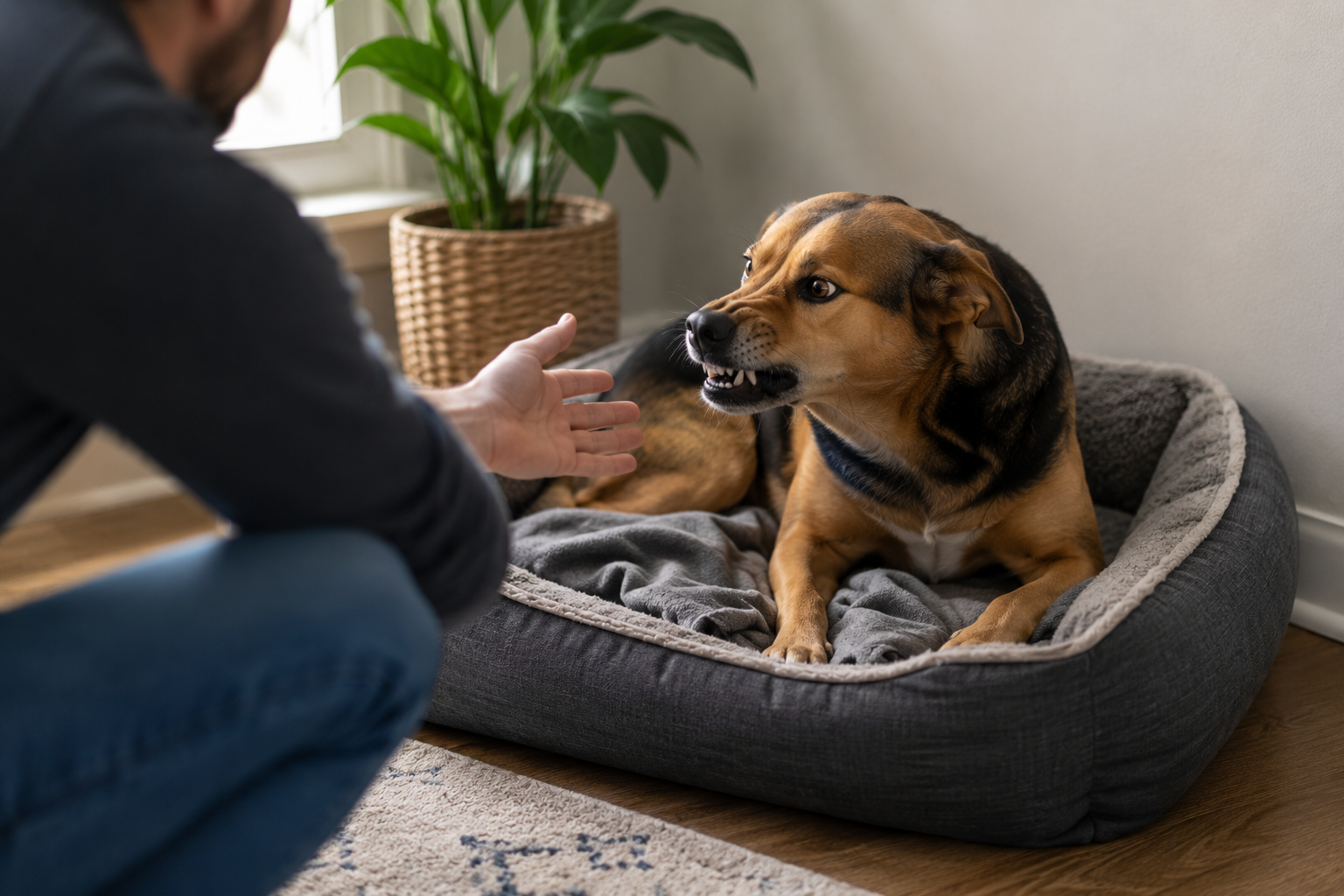
A dog that stiffens or growls when you approach its bed, its crate, or its spot on the couch is resource guarding, and the resource is a resting place. It is not a challenge to your authority and it does not need to be met with confrontation. The immediate fix is management: stop approaching the dog while it is settled, stop reaching into the crate for any reason, and call the dog out to you instead of going in. Never punish the growl. A growl is the warning that keeps a bite from arriving without one, and suppressing it produces a dog that skips straight to teeth. If your dog has snapped or made contact, or if children live in the house, this needs a professional in the room, not an article.
Bed and crate guarding is usually the mildest version of a behavior family that runs all the way up to serious bite risk, which makes it the best possible moment to handle it correctly. It is also the version most likely to attract bad advice, because a growl coming from a dog lying on your bed feels personal in a way a growl over a bone does not.
What is actually happening
Guarding is an animal protecting something valuable from something it expects to lose it to. Resting places qualify. A bed or a crate is warm, comfortable, safe, and hard to replace from the dog's point of view, and a dog that has learned that people approaching a resting place means being moved off it has a rational basis for the objection.
Two beliefs make this worse, and both are common.
The first is that the dog is asserting rank by taking the furniture. Current veterinary behavior guidance does not support that framing. The American Veterinary Society of Animal Behavior's 2021 Position Statement on Humane Dog Training addresses dominance, pack-hierarchy, and "alpha" myths directly and recommends reward-based methods for all behavior modification, and the Association of Professional Dog Trainers takes the same line in its statement on dominance. The height of the surface a dog is lying on is not a status contest.
The second is that the answer is to physically move the dog to prove you can. That is the specific action most likely to produce the bite, because it confirms exactly what the dog was worried about.
First, rule out the thing that is not guarding
Before you treat this as a behavior problem, check two possibilities that look identical from across the room.
Pain. A dog that growls when touched while lying down may be guarding, or it may hurt. Arthritis, back pain, an ear infection, and dental pain all make being approached or handled while settled unwelcome. Sudden onset in an adult dog that was previously relaxed is a veterinary appointment before it is a training project. No behavior plan works on a medical cause.
Sleep startle. This one is genuinely different from guarding, and most pages on this topic blur them together. A dog that is deeply asleep and gets touched can wake with a snap or a growl and then be completely normal a second later, oriented, relaxed, and apparently confused about what happened. That is a startle reflex, not a decision about a resource, and it is more common in older dogs, dogs with hearing loss, and dogs that sleep hard.
The distinction changes the fix entirely. Guarding shows up while the dog is awake and watching you approach, with a tense body before you arrive. Startle only ever happens from actual sleep, with no warning signs beforehand, and ends the moment the dog is awake. If it is startle, you do not need a counterconditioning protocol. You need a household rule: wake the dog with your voice from a few feet away, never with a hand, and teach children the same rule with no exceptions.
| What you see | Likely reading | First move |
|---|---|---|
| Growls when you walk toward the bed while awake | Guarding a resting place | Management plus the exchange work below |
| Snaps only when touched while deeply asleep, then normal | Sleep startle | Wake by voice, never by touch |
| New irritability when settled, in a dog that never had it | Possible pain or illness | Veterinary appointment first |
| Freezes, hard stare, whale eye as you approach the crate | Serious warning | Back off calmly, professional help |
| Any snap that made contact, at any pressure | Emergency | Prevent access, contact a veterinary behaviorist |
The crate rule that solves most of this
If the guarding happens in a crate, there is one change that does more than everything else combined: nobody reaches into the crate. Ever. Not for the dog, not for a toy, not for a blanket.
The crate is supposed to be the dog's safe place. That is the entire point of crate training, and a safe place stops being one the moment a hand can arrive in it. A dog that guards its crate is telling you that the crate has started to feel like a place it can be cornered in, and cornering is the condition that turns a warning into a defense.
What to do instead: open the door, step back, and call the dog out to you. Pay well for coming out. If the dog will not come, walk to the kitchen and make noise with the treat jar. If you need something the dog is lying on, get the dog out of the crate first and then retrieve it. If your crate setup makes this hard, our guide on how to crate train a puppy covers building the crate as a place a dog volunteers to enter and leave.
The same logic applies to a bed in a corner or a spot under a table. Give a guarding dog an exit and most guarding stays a warning.
Management for the next few weeks
Management is not the lesser option here. It removes rehearsal, and every successful guard makes the behavior a little more automatic.
Stop approaching a settled dog. No leaning over, no petting a dog that is asleep, no sitting down on the bed the dog is already on. This costs you nothing and it stops the incidents immediately.
Take furniture off the table for now. If the growls happen on the couch or your bed, those places go on hold for a few weeks. Frame this correctly in your own head, because the framing changes what you do next: you are removing the confined position that produces the growl, not demoting the dog. Give the dog a good bed of its own in a low-traffic corner where nobody has to walk past.
Teach an off-the-furniture routine that pays. Do not pull a collar, do not push. Toss a treat onto the floor a few feet away and say your cue as the dog moves. Done a few dozen times when nothing is at stake, it becomes the way the dog leaves furniture, and you never need to touch a settled dog again.
Route foot traffic away from the bed. Kitchens and hallways are bad places for a dog bed for exactly this reason.
Children get a hard rule, not a soft one. Nobody touches, approaches, or lies down with a dog that is in its bed or crate. Kids are the group most likely to be bitten in a guarding incident, because they move unpredictably toward the thing the dog is protecting, and they are at face height when they do it.
The training half: your approach predicts something good
The goal is that a person walking toward the bed reliably predicts something excellent, rather than being moved.
Start at a distance where your dog notices you and stays loose. Walk past at that distance, toss a great treat (chicken, cheese) near the bed, and keep going without stopping or making eye contact. Repeat over days. You are not asking for anything and you are not taking anything, so there is nothing for the dog to defend. Over many repetitions, shrink the distance only as fast as the dog stays relaxed and starts looking up for the food when it hears you coming. That look is the sign the association is changing.
Then build a cheerful come-off cue. Say the word from several feet away, toss the treat away from the bed, and let the dog get up on its own terms. Practice it when the dog is half-awake and nothing is at stake, so it is fluent before you ever need it. Our positive reinforcement dog training guide covers the timing and marking that make these clean.
Do not use leash corrections, prong collars, or shock collars for this. AVSAB's position statement says aversive methods should not be used and reports no evidence that they outperform reward-based methods. On a guarding behavior they add a second reason for the dog to dread your approach.
Why the growl must survive
This is the most important paragraph on this page.
A growl is not the problem. It is the safety system. A growling dog is telling you it is uncomfortable and would rather warn you than escalate. Punish that consistently and dogs learn precisely what you taught them, which is that growling brings something bad. The uncomfortable feeling is untouched. The warning disappears.
The dog you end up with goes from still to bite with nothing in between, which is far more dangerous to a household than the dog that growls. Owners in that position sincerely say the bite came out of nowhere, and from where they were standing it did, because the earlier signals were trained out rather than listened to.
In the moment, the correct response is undramatic. Stop, give the dog space, and let it settle. Then change the setup so it does not happen again while you work. You are not rewarding the growl by backing off. You are proving the warning worked, which is the thing keeping the ladder from climbing.
When to call a professional
Get in-person help if your dog has snapped, lunged, or made contact with teeth; if there are children or vulnerable adults in the house; if the guarding is spreading from the bed to other places or other people; or if you cannot safely get your dog out of a room when you need to.
Look for a board-certified veterinary behaviorist (DACVB), a Certified Applied Animal Behaviorist, or a trainer certified through a reward-based body such as the CCPDT or Karen Pryor Academy. Ask what they would do if your dog growled in a session. Any answer involving correction, dominance, or a device that works through discomfort is your cue to keep looking.
For the food and toy version of the same behavior, see resource guarding food and toys, and for the version where the resource is you, see when a dog guards you from other dogs or people. The full set of everyday problems is indexed on our hub, common dog behavior problems and their solutions.
Frequently asked questions
Should I stop letting my dog on the bed or couch?
For a few weeks, yes, but for the right reason. It removes the situation that produces the growl while you change the underlying feeling. It is management, not a lesson about rank, and the dominance framing that usually accompanies this advice is not supported by current veterinary behavior guidance.
My dog growls at me in bed but not at my partner. Why?
Guarding is contextual and often specific to a person, a position, or a time of day. The likely difference is what each of you does: reaching over, moving the dog, or getting into an already-occupied space. Compare your actual behavior in the ten seconds before the growl, and change the person's behavior first.
Is it sleep aggression or resource guarding?
Watch when it happens. Startle only occurs from deep sleep, with no tension beforehand, and the dog is normal a second later. Guarding happens while the dog is awake and watching you approach, with a tense body before you get there. Startle is handled with a household rule (wake by voice, never by hand), not a training protocol.
Can I fix bed guarding myself?
Mild cases, caught early, usually improve a lot with management and consistent counterconditioning. Anything involving snapping, contact with teeth, or children in the house needs a professional working in person. There is no honest way to tell from here which one you have.
This article is general owner guidance drawn from AVSAB, the APDT, the ASPCA, the AKC, Best Friends Animal Society, and Preventive Vet, verified at the time of writing. It is not veterinary advice and it is not a behavioral diagnosis. Guarding carries a real risk of injury. For any dog that has growled, snapped, or bitten, please work with your veterinarian and a certified trainer or veterinary behaviorist.