
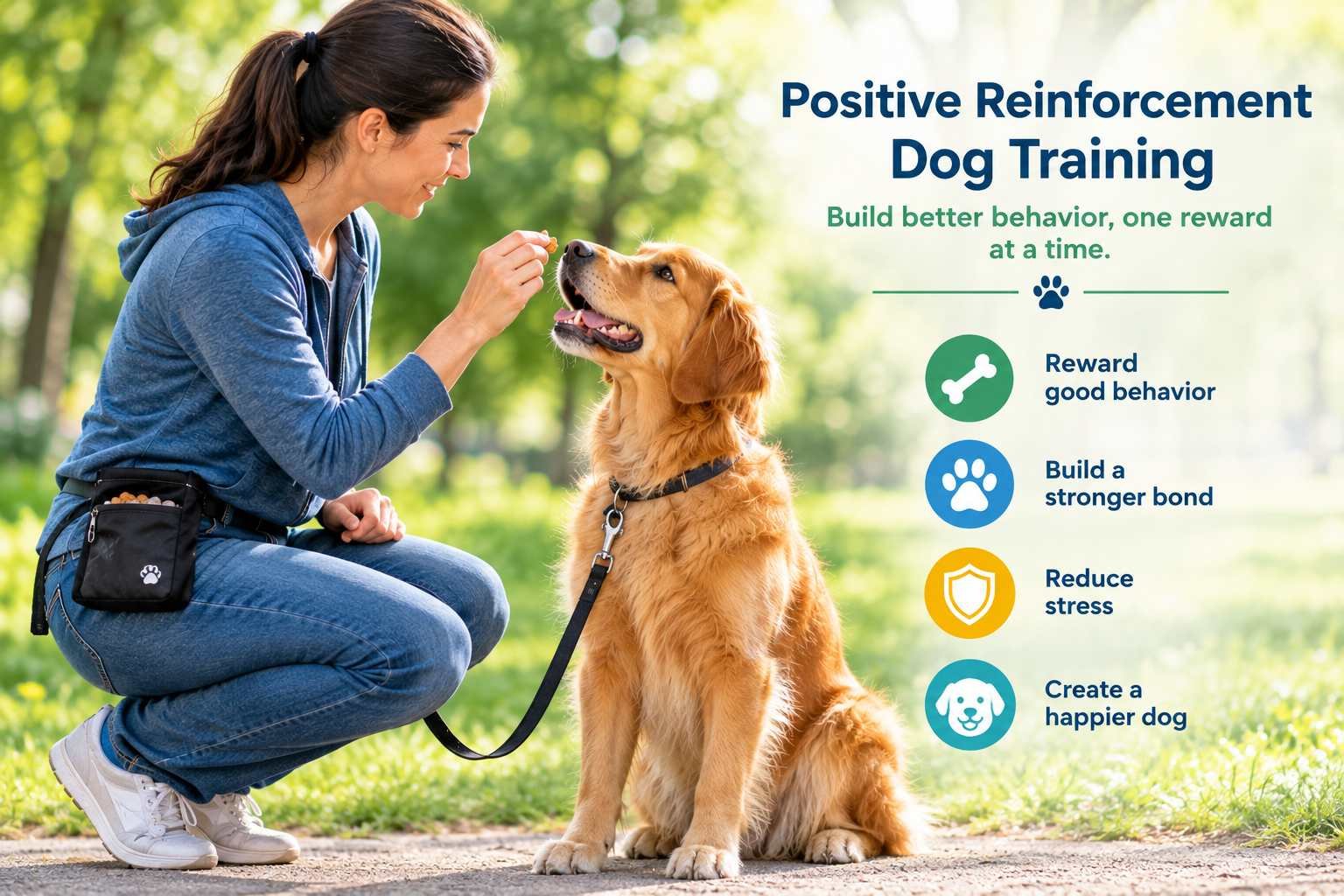
Positive reinforcement dog training means rewarding the behavior you want so your dog repeats it, instead of punishing the behavior you do not want. The dog sits, the reward follows, and sitting becomes more likely next time. That is the whole mechanism. It works because dogs, like most animals, do more of whatever pays off and less of whatever does not, so the fastest way to change behavior is to make the behavior you want the one that pays. No shock, no leash correction, no "showing the dog who is boss" is needed to get there, and the sections below explain why that matters as much as it does.
What Positive Reinforcement Dog Training Actually Means
The word "positive" here is not a judgment about kindness. It is a technical term borrowed from operant conditioning, and it means "added." Reinforcement means the behavior it follows gets stronger, meaning more frequent. Put the two together: positive reinforcement is adding something the dog wants right after a behavior, which makes that behavior happen more.
This matters because it is easy to confuse "positive" with "nice" and assume any friendly-sounding method qualifies. It does not. A treat handed out randomly, or a pat given after the dog has already wandered off to do something else, is not reinforcing the sit. It is reinforcing whatever the dog was doing at the moment the reward arrived. The mechanism only works when the timing connects the reward to the specific behavior.
Why the Method Works: The Behavioral Science
Dogs do not reason about long-term consequences the way people do. They learn through association: this action, followed closely by this outcome, means do it again. That is why timing and consistency carry more weight in training outcomes than the specific reward used.
Shaping is the technique built on this principle. Instead of waiting for a complete, polished behavior, you reward small steps toward it. Teaching a dog to lie down on cue might start with rewarding a lowered head, then a bent elbow, then a full down, each step reinforced before moving to the next. Breaking a goal into steps small enough that the dog succeeds often keeps the learning process moving and keeps the dog engaged rather than frustrated.
Why Reward-Based Training Is the Recommended Standard
This is not a matter of trainer preference. The American Veterinary Society of Animal Behavior states, in its position statement on humane dog training, that only reward-based methods should be used for all dog training, including the treatment of behavior problems, and that aversive methods carry welfare risks without evidence of superior effectiveness (read at avsab.org, 2026-09-18).
That distinction matters in practice. Aversive tools and techniques, including shock collars, prong or choke collars, leash jerks, yelling and alpha rolls, are not part of a welfare-first training plan and are not described here as a fallback option. Where a training article frames punishment as a "last resort," it is choosing convenience over the current professional consensus. Reward-based training is not the gentler alternative; it is the standard the field has settled on.
The Four Building Blocks of a Reward-Based Session
Every reward-based session rests on the same four elements, and skipping one is the most common reason a method that "should work" does not.
Timing. The reward needs to land within roughly a second or two of the behavior, or the dog cannot connect the two. A marker word ("yes") or a clicker solves this by pinpointing the exact moment, with the treat following a beat later.
Clear criteria. Decide what counts before you start. "Sit" that means fully seated is different training from "sit" that also accepts a half-crouch, and inconsistent criteria confuse the dog about what actually earned the reward.
High enough value. The reward has to be worth it to the dog, not to you. A dog distracted by a squirrel needs a better reward than the same dog in a quiet kitchen.
Consistency across the household. If one family member rewards jumping for attention while another ignores it, the dog is getting two different lessons about the same behavior, and progress slows for everyone.
Choosing Rewards Your Dog Actually Wants
The dog decides what is reinforcing, not the owner. Food is the most reliable starting point for most dogs because it is fast to deliver and easy to control in small pieces, but toys, play, praise, and access to something the dog wants, like sniffing on a walk or greeting a visitor, all function as rewards when the dog genuinely wants them.
A useful test: if the behavior is not increasing, the reward is not working as reinforcement, whatever it is meant to be. That is a signal to raise the value of the reward or check the other three building blocks, not a signal to add correction on top.
A Basic Session Walkthrough: Teaching a Reliable Sit
Start in a low-distraction room. Hold a treat near the dog's nose and move it slowly up and back over the head; most dogs fold into a sit as they follow it. The instant the hips touch the floor, mark it and deliver the treat.
Repeat five or six times in a short session, then add the word "sit" just before the motion once the dog is offering the behavior reliably. Once the dog sits on the verbal cue alone, start practicing in slightly more distracting settings, one variable at a time: a different room, then a family member walking by, then outdoors. Rushing straight to a busy sidewalk after one quiet-room success is the most common reason a "trained" dog seems to forget everything outside the house; the behavior was never generalized, so from the dog's point of view it is genuinely new.
Short sessions work better than long ones. Five focused minutes, two or three times a day, tends to hold a dog's attention better than one twenty-minute block, and ending on a success rather than pushing until the dog disengages keeps the next session easier to start.
Troubleshooting Common Sticking Points
The dog only listens with a treat in sight. This usually means the treat was used as a lure for too long without ever being faded into a hand signal or verbal cue backed by intermittent rewards. Practice showing an empty hand doing the same motion, then rewarding from a pocket or a bowl on the counter after the behavior, not before it.
Progress stalls in new places. As above, this is a generalization gap, not a failure of the method. Add one new distraction at a time rather than several at once.
The dog seems bored or checked out mid-session. Short, structured training sessions are themselves a form of enrichment, and a dog that disengages quickly may need the mental work spread through the day rather than concentrated in one block; the enrichment angle is covered in more depth in the boredom and destructive behavior guide.
Something that looked like defiance keeps happening. Before assuming the dog "knows better," check whether the behavior has actually been taught and reinforced consistently, or whether a young dog is simply going through a developmental stage; some behavior that looks like regression is explained in understanding puppy fear periods.
When to Bring in a Certified Trainer or Veterinary Behaviorist
Reward-based training at home is appropriate for everyday manners: sit, stay, loose-leash walking, coming when called. It is not the right starting point for a dog showing fear, aggression, or a sudden behavior change, because those situations can have causes a home training plan cannot address on its own, including medical ones.
If a dog is growling, snapping, or showing sustained fear responses, or if a previously friendly dog's behavior changes abruptly, the next step is a professional, not a home protocol. Look for credentials that indicate real training in this area, such as a CPDT-KA from the Certification Council for Professional Dog Trainers, which certifies trainers on ethology and learning theory as well as technique (see ccpdt.org, 2026-09-18), or a veterinary behaviorist for cases with a possible medical component. A sudden change in behavior alongside appetite, sleep, or energy changes is also a reason to check with a vet first; the signs worth watching for are covered in signs your dog should see a vet.
Building Reward-Based Training Into Daily Life
Training does not have to live in scheduled sessions. Rewarding calm behavior at the door, a check-in during a walk, or settling on a mat while you eat all use the same mechanism and add up over a day. Structuring when these moments happen, rather than leaving them to chance, keeps the routine consistent, and dogs that get formal instruction early tend to generalize faster; that is one reason it is worth knowing what to look for in a puppy class even for an adult dog starting late.
Frequently Asked Questions
Is positive reinforcement training slower than correction-based training?
Not based on the current evidence. Studies cited in AVSAB's position statement found obedience outcomes were highest in dogs trained exclusively with reward-based methods, not lowest, and the welfare cost of aversive methods is not offset by any speed advantage.
Do I have to use food forever?
No. Food is the easiest starting reward because it is fast and controllable, but most trainers move to intermittent rewards and add praise, play, and life rewards once a behavior is reliable, so the dog is not dependent on a treat being visible.
What if my dog does not seem motivated by treats or toys?
Try higher-value options, like small pieces of plain cooked meat instead of dry treats, and consider whether the dog is over-full, over-tired, or too stressed by the environment to eat, which are all reasons a normally food-motivated dog might not respond in a given moment.
Is it ever appropriate to say "no" to a dog?
Interrupting an unsafe behavior in the moment is different from training with punishment. A calm interrupt followed by redirecting to, and rewarding, the behavior you want teaches the dog what to do instead, which is the part a simple "no" leaves out.
My dog is reactive or aggressive. Can I fix this with the steps above?
Not on your own, and this article does not attempt to cover that ground. Reactivity and aggression are cases for a certified trainer or a veterinary behaviorist, because they can involve fear, pain, or medical causes that a general training plan will not identify.