
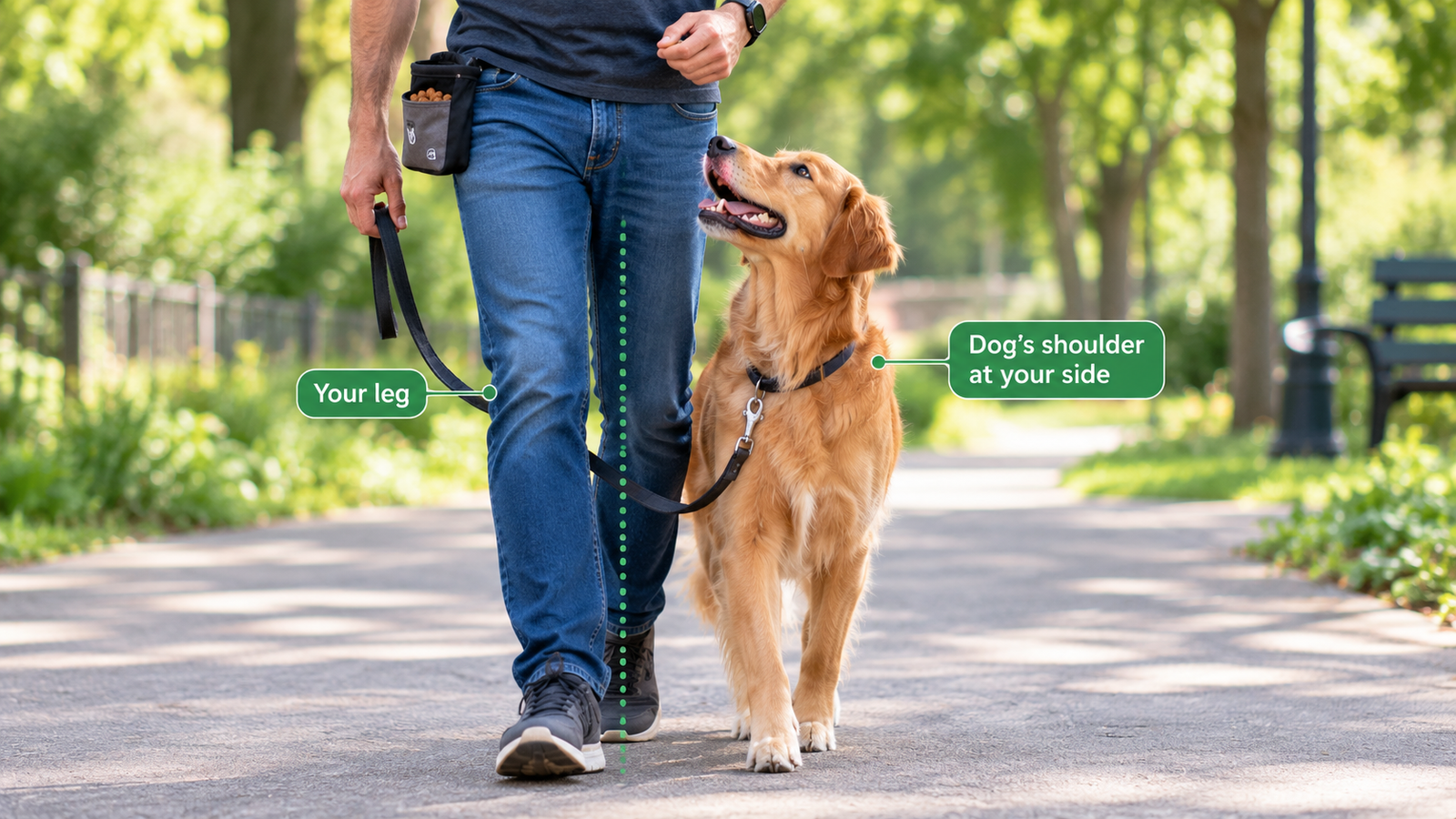
To teach a dog to heel, reward your dog for being in one exact spot beside your leg, first while you stand still, then for one step, then for a few steps, then through turns and changes of pace. Mark the moment your dog is in position with "yes," deliver the treat right at the seam of your pants on that side, and keep each heel short before releasing your dog with a word like "free." Add the cue "heel" only once your dog is finding the spot reliably. Heel is a precise, focused skill for short stretches, not how your dog should walk on every walk.
That last point is where many owners go wrong, so this guide starts with it.
Heel vs loose-leash walking: which one do you need?
These two skills are often confused, and they are not the same.
| Heel | Loose-leash walking | |
|---|---|---|
| Position | A set spot, usually with the dog's shoulder level with your leg | Anywhere, as long as the leash stays slack |
| Focus | Your dog pays close attention to you | Your dog can sniff and look around |
| How long | Short stretches | Most of the walk |
| Best for | Passing another dog, crowded sidewalks, crossing a road, tight spaces | Everyday walks, sniffing, relaxing |
| Effort for the dog | High | Low |
Most pet dogs need loose-leash walking far more than a formal heel. If your main problem is a dog who drags you down the street, start with our guide on how to stop a dog pulling on the leash, which covers the stop-and-reward and direction-change methods. Heel is the next layer: a short, precise cue for the moments when you need your dog right beside you.
Before you start
Choose a side and stick with it. Traditionally, dogs heel on the left, which is the side the American Kennel Club describes in its heeling guide, but either side is fine. What matters is that you always use the same one, so your dog is not guessing.
Pick a marker and a release word. A marker such as "yes" or a clicker tells your dog the exact moment they got it right. A release word such as "free" tells them heel is over and they can relax and sniff.
Use small, soft, high-value treats, kept in a pouch or pocket on your heeling side. Reward from the hand closest to your dog so they do not cross in front of you to get it.
Start somewhere quiet. A hallway, a living room or a quiet yard is ideal. Busy sidewalks come much later.
If you want the reasoning behind markers, timing and reward placement, our positive reinforcement dog training guide covers it.
How to teach a dog to heel in five stages
Stage 1: Find the spot while you stand still
Stand still with your dog nearby. Lure them into position at your side with a treat, or simply wait until they wander into it. The moment their shoulder is level with your leg, say "yes" and give the treat right at your leg. Repeat until your dog starts to hang around that spot, hoping for more.
Stage 2: One step
Take one step forward. If your dog moves with you and stays in position, mark and reward at your leg. If they surge ahead or fall behind, simply stop and wait for them to come back into position, then try again. One step is plenty for now.
Stage 3: A few steps
Build to two steps, then three, then five. Reward often. It is better to give many rewards for a few good steps than to wait for a long stretch that falls apart. If your dog starts drifting, go back to fewer steps.
Stage 4: Turns and changes of pace
Once your dog can hold position for a short straight line, add gentle turns, then a slower pace, then a faster one. Each change makes the skill harder, so reward more when you introduce one. Turns away from your dog are usually easier than turns into them.
Stage 5: Add the cue and distractions
When your dog is reliably moving into position as you start walking, say "heel" just before you step off. Then begin practicing in slightly busier places: the driveway, a quiet street, the edge of a park. Each new place is like starting over, so shorten the distance and raise the rewards again.
Keep heel short and release often
A heel asks a lot of your dog. They have to watch you, match your pace and ignore the world. That is tiring, and it is not much fun if it goes on too long.
- Heel for short stretches, then say your release word and let your dog sniff.
- Use the release as a reward. The chance to sniff a patch of grass can be as valuable as a treat.
- Keep sessions short overall. A few minutes of heel practice, spread through the day, beats one long drill.
This is also why heel works best as a tool for particular moments rather than the way you walk all the time.
Common problems and what to do
Forging ahead. Your dog keeps moving past your leg. Go back to fewer steps, reward right at your leg rather than in front of you, and stop moving whenever your dog is ahead. Our leash-pulling guide covers this pattern in more detail.
Crossing in front. Usually caused by treats delivered from the wrong hand or too far forward. Reward from the hand on your dog's side, at the seam of your leg.
Sniffing and drifting. The environment is more interesting than you. Practice somewhere quieter, raise the value of your treats, and release to sniff more often.
Lagging behind or refusing to move. This can be a sign of worry, tiredness or discomfort, not stubbornness. Ohio State University's Indoor Pet Initiative, on its page about warning signs of behavior problems in puppies (read September 11, 2026), notes that reluctance to sit or lie down in training is often due to pain, and that joint problems can show up early in some breeds. If your dog lags, seems stiff, or suddenly stops wanting to train, see your veterinarian before you push on.
The honest part: no corrections, and heel is not about rank
Traditional heel training often relied on leash "pops," choke chains or prong collars to snap a dog back into position. Those methods work through discomfort. The American Veterinary Society of Animal Behavior's guidance on reward-based training methods (read September 11, 2026) recommends reward-based methods only, names choke chains and electronic collars among the aversive tools it advises against, and cites risks that include fear, anxiety, stress and aggression. AVSAB's humane dog training statement, listed on its position statements page (read September 11, 2026), also names prong collars and leash corrections as aversive methods it opposes.
You may also hear that a dog must heel so it "knows you are the leader." AVSAB's position statement on dominance theory, on the same page, rejects that framing: most unwanted behavior comes from accidental rewards, not from a dog trying to rank above you. A dog walking ahead is not trying to lead the pack. They just walk faster than we do and want to get somewhere.
The trade-off, honestly: reward-based heel training can take longer to look polished than a harsh method. It teaches your dog to want to be at your side, and it does not put your dog's neck or your relationship at risk.
Safety: reactivity, chasing and children
If your dog lunges, barks or growls at other dogs or people on walks, that is leash reactivity, and a formal heel is not the first step. Our calm, safe plan for leash reactivity explains how distance and gradual exposure come first.
If your dog tries to chase moving things, a heel can help you get past a jogger or bike, but it will not hold on its own at first. Our guide on how to stop a dog chasing cars, bikes or joggers covers the management that keeps everyone safe while you train.
Children should not walk a strong or reactive dog alone, even one that heels well at home. A dog that suddenly lunges can pull a child over or into a road. The American Veterinary Medical Association's dog bite prevention guidance (April 2026 release, read September 11, 2026) is clear that children should never be left unsupervised with dogs, even familiar, well-trained family pets.
If your dog has growled at, snapped at or bitten a person, do not try to fix it with heel training. Start with your veterinarian to rule out pain and illness, then work with a board-certified veterinary behaviorist or a certified reward-based trainer. The American College of Veterinary Behaviorists (read September 11, 2026) is the certifying board for veterinary behaviorists and keeps a directory of its diplomates.
Frequently asked questions
What side should my dog heel on?
Traditionally the left, but either side works. Choose one and use it every time, so your dog knows exactly where to be.
How long does it take to teach a dog to heel?
It depends on your dog, your practice and how polished you want it. A short heel in a quiet room can come together over a few sessions; a reliable heel on a busy street takes much longer. Build slowly and keep sessions short.
Should my dog heel for the whole walk?
No. Heel is demanding and best used for short stretches, such as passing another dog or crossing a street. For the rest of the walk, loose-leash walking with time to sniff is kinder and more practical.
Can I teach an older dog to heel?
Yes. Older dogs can learn new skills well. Keep sessions shorter, choose a comfortable pace, and have your veterinarian check any stiffness or reluctance to move.
The short version
Heel is a precise position at your side, built one step at a time with rewards delivered right at your leg. Keep it short, release often, and save it for the moments that call for it. Skip corrections and "leader" ideas, get loose-leash walking in place first, and see your vet if your dog lags or seems sore.