
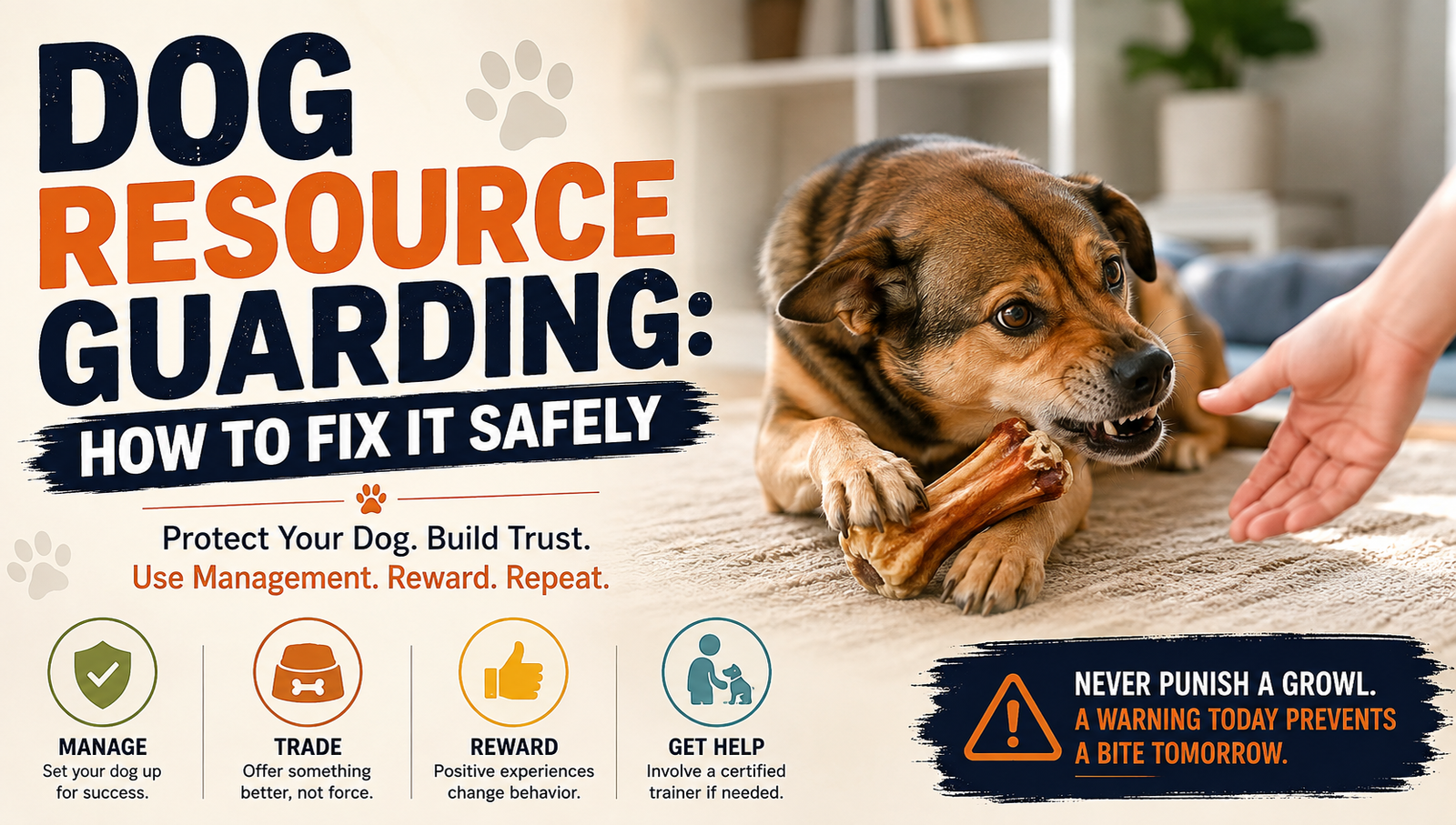
Resource guarding is when a dog protects food, a toy, a chew, or a resting spot from a person or another animal. It is normal dog behavior, not disobedience and not a bid for dominance, and the safest first move is management: stop taking things away, feed in a quiet separate space, and trade for something better instead of grabbing. Never punish a growl, because the growl is the warning that prevents a bite. Freezing, hard staring, snapping, or any bite means stop and contact a certified trainer or a veterinary behaviorist. This guide is general owner guidance, not a diagnosis.
If your dog went stiff over a bowl or curled a lip at you near a bone, that moment is worth taking seriously without panicking about it. Guarding is one of the most common things dogs do and one of the easiest to make worse by reacting badly. What follows is the reward-based approach that the ASPCA, the AKC, Best Friends Animal Society, and Preventive Vet all describe, plus an honest account of where owner guidance runs out.
What resource guarding actually is
Guarding is an animal protecting something it values from something it expects to lose it to. A dog who hunkers over a bowl is not making a statement about the household hierarchy. It is doing what a dog does when a valuable thing feels at risk, and the fact that the "threat" is a person who feeds it every day does not change how the dog feels in that second.
The list of things dogs guard is wider than food. Common ones include the food bowl, high-value chews like bully sticks and bones, stolen items (a sock, a tissue, a piece of trash), toys, a bed or crate, a spot on the couch, and sometimes a person. Some dogs guard one category and nothing else. A dog that is relaxed about kibble can be very serious about a rawhide, because the value of the item, not the dog's general character, is what drives the behavior.
Two things are worth naming early because they change how you read the rest of this article. First, guarding exists on a gradient, and where your dog sits on it decides your next step. Second, guarding is a communication system. Every rung below the bite is the dog telling you something before it has to act.
The guarding ladder: reading how serious this is
Most guides treat resource guarding as one thing. It is more useful to read it as a ladder, because the rung your dog is on is the difference between a management project and a phone call.
| What you see | Where it sits | What to do about it |
|---|---|---|
| Eats faster or turns slightly away when you walk past | Very mild, extremely common | Give space at mealtimes; nothing else required |
| Hunkers low over the bowl, body tense, eating stops | Mild guarding | Management plus trade-up work below |
| Freezes, stops chewing, hard stare, whites of the eyes showing ("whale eye") | Serious warning | Back away calmly, start management, get a certified trainer involved |
| Lip curl, growl, or teeth showing | Clear warning | Back away, do not scold, professional help |
| Snapping, lunging, or air-snapping as you approach | Bite risk | Manage the environment so it cannot happen again and contact a professional now |
| Any bite that made contact, at any pressure | Emergency | Stop all training, prevent access, contact a veterinary behaviorist |
Preventive Vet's guidance is blunt on the middle of that table, and it is worth repeating: anything more than eating a bit faster is a reason to bring in help rather than experiment, because the two most likely outcomes of experimenting are a worse guarding problem and a bitten hand.
There is no timeline in that table on purpose. How long any of this takes depends on the dog, the history, and the household, and nobody can honestly give you a number from the other side of a screen.
Why punishing the growl is the most dangerous thing you can do
Here is the part that most pages mention in a bullet and then move past, and it deserves a section of its own.
A growl is not the problem. A growl is the safety system. It is a dog saying, at some cost to itself, that it is uncomfortable and would rather warn you than escalate. When a dog is scolded, shouted at, or physically corrected for growling, it very often learns exactly what you taught it: that growling brings something bad. What it does not learn is that the underlying feeling was misplaced. The feeling stays. The warning goes.
The dog you end up with is a dog that goes from calm to bite with nothing in between, and that dog is far more dangerous to a family than the one that growls. Owners in that situation genuinely say afterward that the bite "came out of nowhere," and from their side it did, because the earlier signals were trained out of the dog rather than listened to.
The same logic rules out the whole family of old advice that still circulates: taking the bowl away to "show who is boss," sticking a hand into food while the dog eats, holding the dog down, or grabbing a guarded item out of its mouth. Each of these confirms the dog's original worry, which was that people approaching valuable things means losing them. The ASPCA and Humane World for Animals are both explicit that confrontation makes guarding worse rather than better. This site is reward-based, and this is one of the clearest cases of why.
If your dog growls at you today, the correct response in the moment is undramatic: stop moving toward it, give it room, and let it finish. Then fix the setup so the situation does not repeat while you work on it. You are not rewarding the growl by backing off. You are proving the warning worked, which is the one thing keeping the ladder from climbing.
Management first: what to change today
Management is not the lesser option. On a bite-risk behavior it comes before training, because it removes the rehearsal. Every time a dog successfully guards something, the behavior gets a little more practiced.
Feed in a space nobody has to walk through. A quiet room, a closed door, or a corner of the kitchen with a clear path away from it. If there are children in the house, this is not optional. Kids are the group most likely to be bitten in a guarding incident, because they move unpredictably toward the thing the dog is protecting.
Retire the high-value items for now. If bully sticks or bones produce a different dog, stop giving them out until you have a plan and someone helping you. A chew that ends in a growl every time is not worth the enrichment it provides.
Stop taking things away by hand. For stolen items, the answer is a trade, not a grab, and if the item is genuinely dangerous the fastest safe move is often to walk to the treat jar or the fridge and make noise about it, so the dog comes to you and abandons the item on its own.
Do not corner a guarding dog. Approaching, reaching over, or blocking the exit turns a warning into a defense. Give a dog a way out and most guarding stays a warning.
Feed dogs separately in a multi-dog house. Different rooms, or a crate for one and the kitchen for the other. The single most common household guarding incident is two dogs and one bowl.
Trading up: the reward-based exchange
The training half of this is built on one idea. Your approach should predict that something better arrives, not that something valuable disappears.
Start where the dog is comfortable. That means a distance at which your dog notices you but keeps eating normally, with a relaxed body. If your dog stops chewing when you enter the room, the room is already too close. Work from further away.
Toss, do not hand. Best Friends Animal Society describes the core exercise as staying several feet back and tossing something genuinely good (small pieces of chicken, cheese, or hot dog) in the dog's direction while it has its own food, then leaving. The dog is not asked to give anything up. It simply learns that a person nearby means chicken rains from the sky. Repeat this over many meals before anything changes.
Trade for stolen items, every time. Show a high-value treat, say your cue, and drop the treat away from the item so the dog moves off it, then pick the item up. Done consistently, this builds a dog that brings you contraband instead of running away with it, which is a much safer house to live in.
Teach the exchange when nothing is at stake. Practice swaps with boring objects on a normal afternoon, so the pattern is already fluent before it matters. Our positive reinforcement dog training guide covers the mechanics of marking and rewarding that make these exchanges clean.
Move slowly, and go backward when you need to. If your dog stiffens at any point, you moved closer or faster than it could handle. Return to the last distance where it stayed loose and stay there longer. There is no prize for speed and there is a real cost to rushing.
Desensitization near the bowl, done slowly
For food-bowl guarding specifically, the general shape of the work described by the ASPCA is a slow reduction in distance across many repetitions, always paired with something better arriving. You walk past at a distance and drop a treat into the bowl or nearby. Over sessions, the distance shrinks only as fast as the dog stays relaxed. The bowl is never taken, the hand never goes in, and the session ends while the dog is still calm.
Two cautions matter more than the technique. This work is easy to describe and easy to get wrong, and getting it wrong on a dog that has already growled has a physical consequence. And a dog that has snapped or bitten is past the point where a written protocol is the right tool. In both of those cases the honest recommendation is a certified trainer in the room with you, watching the body language you cannot see while you are the one holding the treats.
Guarding from other dogs in the house
Dog-to-dog guarding follows the same rules with one difference: you cannot explain anything to the other dog, so management does more of the work. Feed apart, behind closed doors if needed. Hand out chews in separate spaces or not at all. Pick up toys that reliably start something. Do not leave two dogs alone together with anything high-value until the pattern has been broken for a long stretch.
Multi-dog guarding also escalates faster than owner-directed guarding, because both animals are reading each other in real time. If your dogs are having anything beyond a brief stiff moment over a toy, treat that as a professional-help situation rather than a training project. A fight between housemates does damage to a relationship that takes far longer to repair than the injuries.
The honest part: where a blog post stops
This is one of two or three topics on this site where the responsible thing is to draw a line rather than keep writing.
Resource guarding sits on a spectrum that ends in a bite, and bites have consequences that are not reversible: injuries, insurance, and in bad cases a dog losing its home. A written guide can teach you the safety principles, the management, and the shape of the trade-up work. It cannot see your dog's body language, cannot tell whether that pause before the growl is getting shorter, and cannot adjust the plan in the moment. Those are exactly the things a good trainer does.
We are dog owners writing from reputable sources, not veterinarians or certified behaviorists. On a bite-risk behavior, the honest advice is not a longer article. It is a professional, and looking for one is not an admission that you failed at something.
When to call a certified trainer or veterinary behaviorist
Contact a professional if your dog has frozen, hard-stared, growled, snapped, or bitten over any item; if there are children or vulnerable adults in the house; if the guarding is spreading to new items or new people; or if it started suddenly in a dog that never did it before.
That last one is worth a separate note. A sudden change in behavior in an adult dog, including new irritability around food or a new unwillingness to be touched, is a reason to see your veterinarian first. Pain and illness can change how an animal responds to being approached, and no amount of training addresses a medical cause. Your vet can rule that out and can refer you onward.
When you look for behavior help, look for a board-certified veterinary behaviorist, a Certified Applied Animal Behaviorist, or a trainer certified through a body that requires reward-based methods. Ask directly what they would do if your dog growled during a session. An answer that involves correction, dominance, or any device that works by causing discomfort is your signal to keep looking.
Guarding is workable. Handled with management first and without confrontation, most households get to a calm place. For the wider picture of everyday behavior issues, our guide to common dog behavior problems and their solutions links the whole set together, and if your dog is also reactive on walks, leash reactivity toward other dogs uses the same distance-and-reward logic. For the stolen-food version of the same problem, see how to stop counter surfing. Puppy owners can head a lot of this off early with the mouth-and-handling work in our guide to stopping puppy biting.
Frequently asked questions
Is resource guarding a sign my dog is dominant?
No. Dominance is not a useful frame for this, and it leads owners toward confrontation, which makes guarding worse. Guarding is a dog protecting something valuable because it expects to lose it. The fix is changing that expectation, not winning an argument.
Should I take my dog's food bowl away to prove I can?
No. This is one of the most persistent pieces of bad advice about dogs. It confirms exactly what the dog is worried about and teaches it that people approaching food means food disappearing. The reward-based version does the opposite: your approach predicts that something better arrives.
My puppy growls over chews. Will it grow out of it?
Do not count on it, and do not punish it. Puppyhood is the best window to build a positive association with people near valuable things, using trades and tossed treats. If a puppy is already growling hard or snapping, get a certified trainer involved now, while the habit is young.
Can I fix resource guarding on my own?
Very mild guarding often improves with management and consistent trade-up work. Anything that has reached freezing, growling, or snapping is a situation where a professional working in person is the safer call. There is no honest way to tell from here which one you have.
Why did my dog suddenly start guarding after years of being fine?
A sudden onset in an adult dog is worth a veterinary visit before it is treated as a training issue. Pain, dental problems, and illness can all change how a dog responds to being approached. Rule out the medical side first, then work on the behavior.
This article is general owner guidance drawn from the ASPCA, AKC, Best Friends Animal Society, Preventive Vet, and Humane World for Animals. It is not veterinary advice and it is not a behavioral diagnosis. Resource guarding carries a real risk of injury; for any dog that has frozen, growled, snapped, or bitten, please work with your veterinarian and a certified trainer or veterinary behaviorist.