
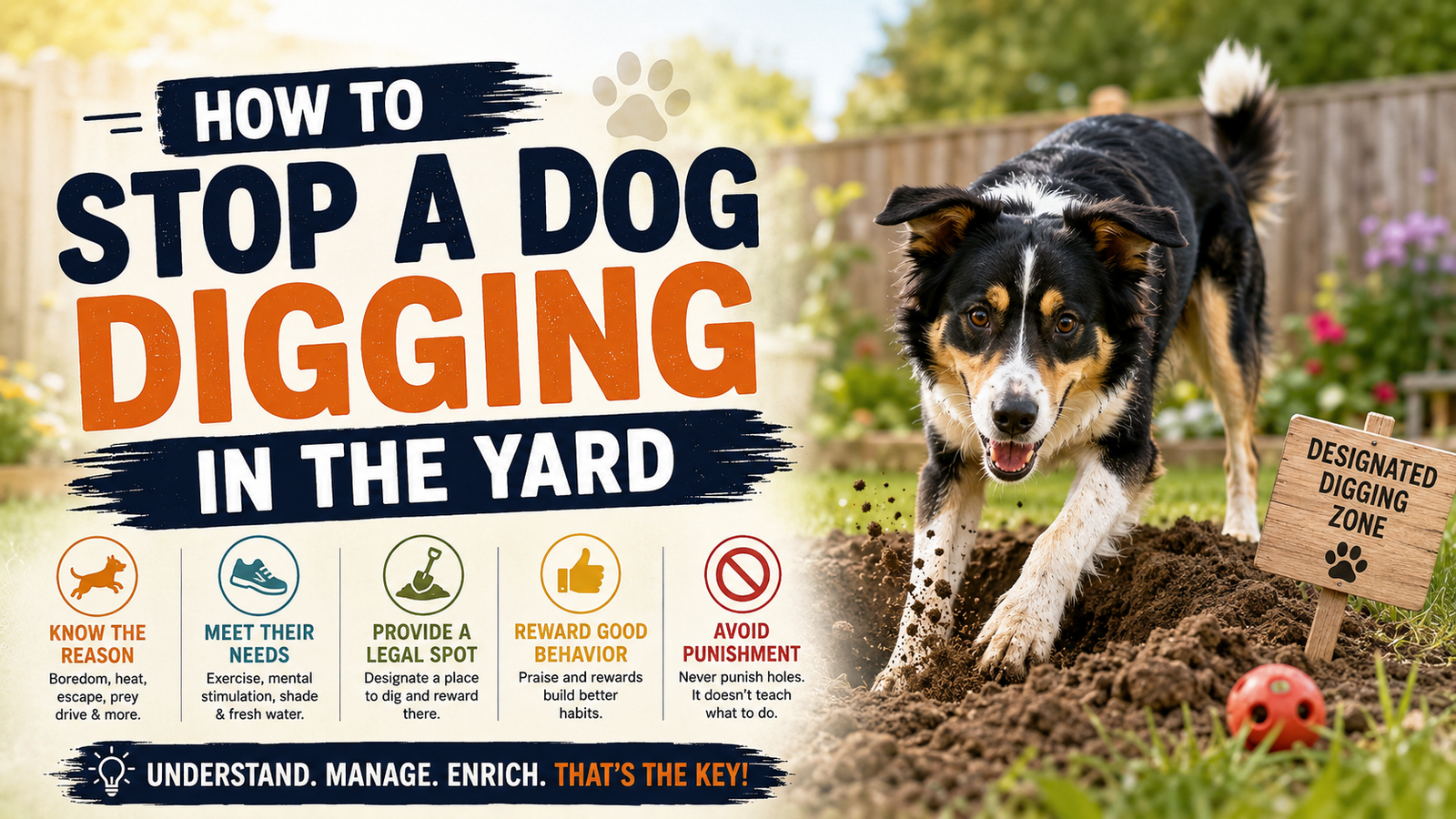
Dogs dig for a handful of specific reasons, and the fix depends entirely on which one you have. Boredom and unspent energy are the most common, and they respond to more exercise, scent games, and puzzle feeding. A dog digging shallow pits in the shade is trying to cool down and needs better shade and water. A dog digging along the fence line is trying to leave. Prey-driven digging follows the smell of something underground. Give a determined digger a legal place to dig and reward it there, and never punish the holes, because punishment does not tell a dog what to do instead.
Most advice on this topic starts with the fix and skips the diagnosis, which is why so many owners try three things that do not work before they find the one that does. Five very different motives produce holes that look identical from the kitchen window. Start with why.
Why dogs dig: the five real motives
Digging is not a defect. It is a normal, deeply built-in dog behavior, and every domestic dog has some capacity for it. Terriers and northern breeds tend to have more, which is a matter of what they were bred to do rather than a training failure on your part.
The reasons cluster into five groups:
- Boredom and unspent energy. The most common cause by a wide margin. A dog with nothing to do in a yard will invent a job, and digging is one of the most satisfying jobs available.
- Temperature. Soil a few inches down is cooler than the air. A dog that is too warm will excavate a shallow pit and lie in it.
- Escape. A dog trying to get to something (or away from something) works the perimeter rather than the middle of the lawn.
- Prey drive. Moles, voles, chipmunks, and insects live underground and smell like it. A dog with a good nose is not vandalizing your lawn, it is hunting.
- Instinct and stress. Some dogs dig to cache things, some dig a nest before lying down, and some dig as a stress outlet, particularly when left alone.
Attention-seeking is sometimes listed as a sixth. It is real but usually secondary: a dog learns that digging brings someone running out the back door, which is more interesting than the empty yard it was standing in.
Read your holes: where and when tells you why
This is the part that turns guessing into a plan. Before you change anything, spend two or three days noting where the holes appear and when.
| Where and when | Most likely motive | Where to start |
|---|---|---|
| Along the fence line, especially at a corner or gate | Escape | Address the reason for leaving, supervise outside, talk to your vet about neutering if the dog is intact and roaming |
| Shallow, wide pits in shade, on warm days, dog lies in them | Cooling down | More shade, fresh water, bring the dog in during heat |
| Focused holes in one spot, dog sniffs hard then digs, often near tree roots or lawn edges | Prey drive | Deal with the underground residents humanely, redirect and supervise |
| Scattered holes, middle of the lawn, dog is otherwise busy and restless | Boredom and energy | Exercise, enrichment, a legal digging spot |
| Only when you are out, often with other damage or vocalizing | Stress when alone | Read the wider picture before treating it as digging at all |
| Right in front of you, dog checks your reaction | Attention | Stop reacting to it, reward calm behavior instead |
That last-but-one row matters more than its size suggests. Digging that happens only in your absence, alongside destruction near doors, howling, or accidents from a house-trained dog, is not really a digging problem. Our guide to dog separation anxiety covers what that pattern means and what to do about it, and treating it as a lawn issue will not help the dog.
Boredom and energy: the most common cause, and the actual fix
If the holes are scattered and your dog is generally busy, restless, or under-exercised, this is your bucket. The fix is not complicated, but it is more than a walk around the block.
Physical exercise, matched to the dog. A young, working-bred dog and an elderly companion breed do not need the same thing, and there is no honest universal number of minutes. The practical test is whether your dog settles afterward. A dog that comes back in and sleeps got enough. A dog that comes back in and starts pacing did not.
Sniffing counts more than most owners think. A twenty-minute walk where the dog is allowed to stop and read every lamppost tires many dogs more thoroughly than a brisk march twice that long. Scent work is real mental effort.
Feed the meal instead of serving it. Puzzle feeders, snuffle mats, scattering kibble in the grass, and frozen stuffed chews all turn a thirty-second bowl into fifteen or twenty minutes of work. The Humane World for Animals guidance on digging leans hard on this, and it is one of the highest-return changes available to a busy owner.
Do not leave a bored dog alone in the yard for hours. A yard is not enrichment. It is a space. Most dogs left in one for long stretches with nothing to do will find something, and that something is often the flower bed.
For the indoor version of this same problem, the fixes overlap almost entirely. See how to stop a dog chewing furniture for the same principle applied inside the house.
Cooling off: a hole in the shade is a message about your yard
If the pits are shallow, wide, in the shadiest part of the yard, and your dog lies down in them, your dog is not misbehaving. It is thermoregulating with the tools it has.
Treat this as a welfare signal rather than a nuisance. The dog needs reliable shade that stays shade as the sun moves, water that does not run out or get hot, and, on genuinely hot days, to be indoors instead of outdoors. Digging in the heat is often the first visible sign that a yard setup is not adequate for the weather, and heat is dangerous to dogs in a way it is not to us. If your dog is panting heavily, drooling, unsteady, or seems distressed in the heat, that is a call to your veterinarian, not a training question.
Fix the temperature problem and this kind of digging usually stops on its own, because the motive is gone.
Escaping: the motive that is a safety problem
Holes at the fence line are a different category. This dog is not entertaining itself. It is leaving, and a dog loose near a road is at real risk.
Escape digging usually has one of three drivers. The dog is bored or lonely and there is more happening on the other side. The dog is frightened of something inside the yard, such as noise or another animal, and wants out. Or the dog is intact and roaming, which is a strong, hormone-driven pull that training alone rarely overcomes. Your veterinarian is the right person to talk to about that last one.
Until the underlying motive is addressed, the honest answer is supervision. Do not leave an escaping dog unattended in the yard, because the consequence of one successful escape is not a damaged lawn. Physical measures can buy you time while you work on the cause, but they are the seatbelt, not the fix. A dog that badly wants out will keep trying, and a dog that has escaped once has learned that it works.
Prey drive and the smell of something underneath
If your dog sniffs intently, freezes, and then digs hard in one specific place, there is very likely something living down there. This is one of the most satisfying activities available to a dog, which is why it is one of the hardest to interrupt with a treat.
Two things help. Deal with the underground residents humanely rather than with poison, which is a hazard to your dog as much as to the wildlife. And accept that while the smell is there, supervision does most of the work. A reliable recall and a strong "leave it" are genuinely useful here, and both are trainable with reward-based methods; our positive reinforcement dog training guide covers how to build cues that hold up against a distraction this strong.
Expect this to be a management job as much as a training job. Competing with a live scent is one of training's hardest asks, and pretending otherwise sets owners up to feel like failures.
Build a legal digging spot, and the honest limits of that advice
The standard recommendation, and it is a good one, is to give the dog somewhere it is allowed to dig. A child's sandbox, a corner bed of loose soil or sand, or a plastic tub works. Make it obviously different underfoot from the rest of the yard, bury toys and treats in it so the dog finds a payoff there, and reward enthusiastically the moment your dog uses it. If you catch your dog digging elsewhere, interrupt cheerfully with a name or a clap, then walk them to the legal spot and celebrate when they dig there.
Here is what most pages leave out. A digging zone only works when the motive is the digging itself. For a dog that digs because digging is fun, or because it needs a job, this is an excellent solution and often the whole answer. For a dog trying to escape, a sandbox is irrelevant. For a dog trying to cool off, it is irrelevant. For a dog hunting a mole under the hydrangea, it is irrelevant, because the mole is not in the sandbox.
That is why the diagnosis comes first. Owners who try the digging-zone advice on the wrong motive conclude that their dog is untrainable, when in fact they applied a good fix to the wrong problem.
What not to do
No punishment collars, shock, or spray devices. Best Friends Animal Society and Humane World for Animals are both clear that these do not teach an alternative behavior and can produce stress, fear, and in some dogs aggression. On a behavior driven by boredom or heat, they are also aimed at the wrong thing entirely.
Do not scold a dog for a hole you find later. A dog cannot connect your reaction now to a hole it dug three hours ago. All it learns is that you are sometimes frightening for no reason it can identify.
Skip the folk remedies that use the dog's own waste or discomfort. Burying feces in the hole, filling holes with water and holding the dog's head in them, and similar advice still circulates. It is unpleasant, unreliable, and on the water version genuinely dangerous.
Do not simply fill the holes and hope. Refilling without changing the motive teaches the dog nothing except that the ground gets refreshed.
When digging means something else
A few patterns are worth escalating rather than training.
If digging appears suddenly in an adult dog that never did it, look at what changed: new noise, a new animal nearby, a change in routine, a household member gone. Sudden behavior change in an adult dog can also have a medical component, and your veterinarian is the right first call when a change arrives with no obvious environmental explanation.
If digging is frantic rather than purposeful, especially at doors, gates, or the base of a fence, and especially when the dog is alone, that is a distress pattern rather than a hobby, and it belongs with the separation-anxiety material rather than here. If your dog is injuring itself, breaking nails or bloodying pads on concrete or fencing, stop and speak to your veterinarian and a certified trainer.
Most digging is ordinary and fixable. For the rest of the everyday problems this site covers, our common dog behavior problems and their solutions guide is the place to start, and if your dog also eats what it finds while it is out there, how to stop a dog eating poop covers the yard-hygiene side of the same routine.
Frequently asked questions
Will my dog grow out of digging?
Some puppies dig less as they mature and settle, but digging driven by breed, boredom, or heat does not resolve with age on its own. What changes it is meeting the need behind it. A dog bred to go to ground will likely always enjoy digging, which is why a legal spot works better than trying to eliminate the behavior.
Does a designated digging area really work?
It works well when the dog digs for the pleasure of digging or out of boredom, and it does nothing when the dog is trying to escape, cool down, or catch something. Diagnose the motive first, then decide whether the digging zone is your solution or a distraction from the real one.
Is my dog digging out of spite?
No. Spite is not how dogs work. Digging is either an unmet need, an instinct doing its job, or a behavior that has been accidentally rewarded. Reading it as spite pushes owners toward punishment, which makes most of these causes worse rather than better.
My dog only digs when left alone in the yard. What does that mean?
Most often it means the yard is boring and the dog has hours to fill. Sometimes it means the dog is distressed at being alone, particularly if there is also howling, destruction at doors, or escape attempts. The first is an enrichment problem, the second is not, and the difference is worth taking seriously.
Should I fill the holes with rocks or chicken wire?
Physical measures can stop one specific spot being reused while you work on the cause, and some owners use them as short-term management. They do not change why the dog is digging, and a dog with an unmet need will simply start somewhere else. Treat them as a stopgap, not the plan.
This article is general owner guidance drawn from the ASPCA, AKC, Humane World for Animals, Best Friends Animal Society, and Preventive Vet. It is not veterinary advice. For a dog digging in hot weather, escaping the yard, or injuring itself, please speak to your veterinarian or a certified trainer.