
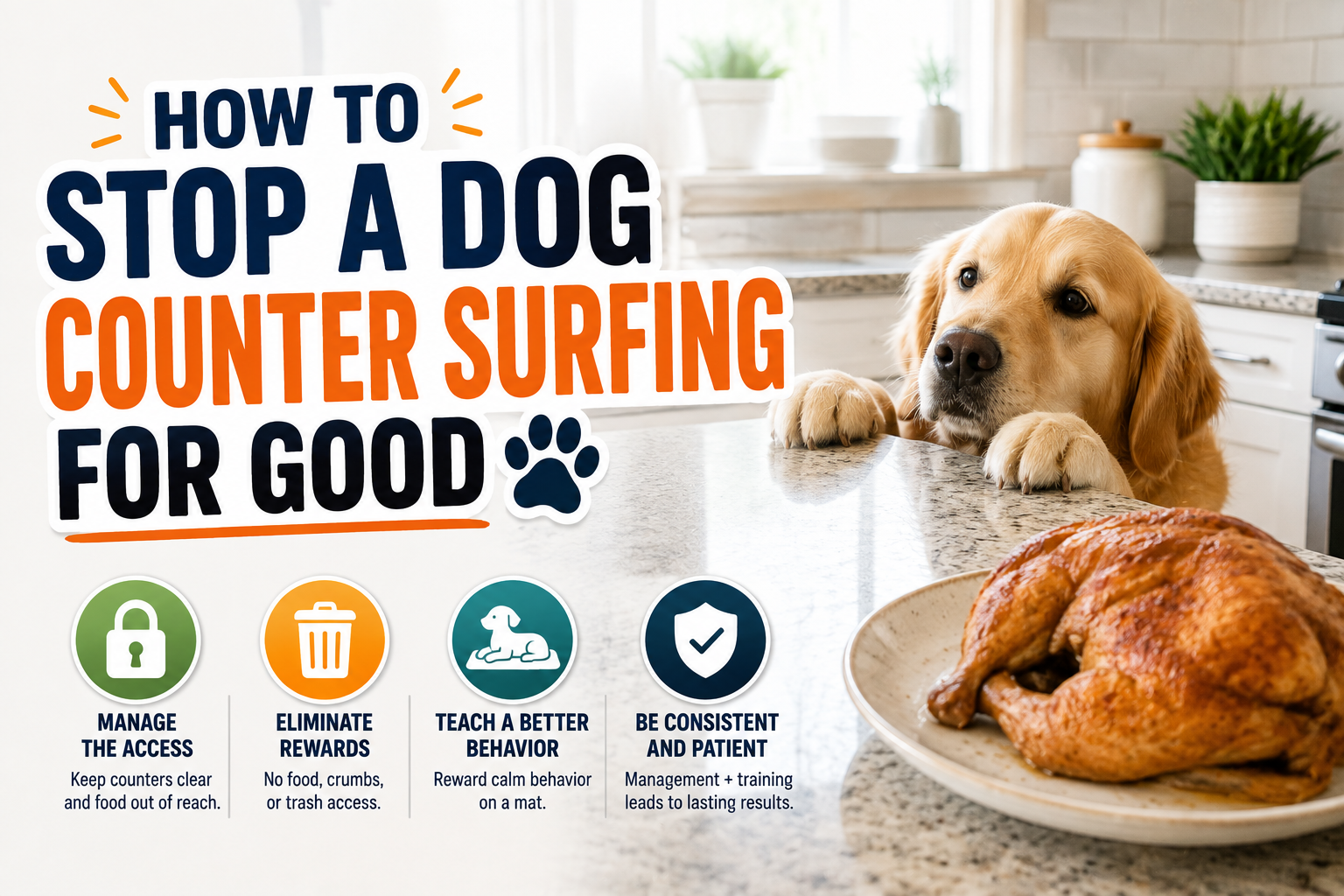
Counter surfing is a self-rewarding habit. The dog puts its paws up, finds food, and gets paid instantly, with no help from you at all. That is why it is so persistent and why management comes first. Clear the counters completely, store food out of reach, wipe up crumbs, and use a baby gate or a closed door when you cannot supervise. Then teach a behavior that cannot happen at the same time as surfing, such as settling on a mat while you cook, and reward it generously. Do not punish after the fact, because a dog punished for stealing learns only to steal when you are out of the room.
That is the short version. The longer version explains why the advice you have probably already tried did not hold, and what to do differently.
Why counter surfing is so hard to stop
Here is the piece that most guides leave out, and it changes how the rest of the plan reads.
Most behaviors we deliberately teach get rewarded every time at first, then less often once they are solid. Counter surfing is the reverse. It pays out unpredictably. The dog jumps up ninety-five times and finds nothing, and on the ninety-sixth it finds half a sandwich. In learning terms, that unpredictable payout is the schedule that produces the most persistent, hardest-to-extinguish behavior there is. It is the same principle that makes a slot machine more compelling than a vending machine.
Owners usually describe this as reassuring: "he only manages it once in a while." It is actually the bad news. An occasional jackpot is precisely what keeps a dog checking the counter every single day for months. And because the reward is the food itself, it arrives the instant the dog's nose reaches it, with perfect timing that no human trainer can match.
Two conclusions follow, and they organize everything below. First, your job is to make the payout rate zero, not low. Second, "he knows he is not allowed" is not a useful frame. A dog that gets fed for a behavior will keep doing the behavior, whatever it knows about your opinion.
Management first, and why it is not the lesser option
There is a habit in training advice of treating management as the cheap answer and training as the real one. On this behavior, that is backwards.
Management works immediately, works when you are asleep, and works on the visiting dog and the untrained dog and the elderly dog. Training is slower, needs upkeep, and, crucially, does not reliably survive an empty kitchen with a chicken on the side. Even a very well-trained dog left alone with an unattended roast is being asked something unreasonable. Best Friends Animal Society and Preventive Vet both put prevention at the top of their guidance for exactly this reason.
So use both, but be clear about who is doing what. Management stops the payouts. Training gives your dog something better to do in the kitchen while you are there. Expecting training alone to hold the line is how owners end up frustrated with a dog that was never given a fair setup.
Clear the counters: what "clear" actually means
Owners consistently underestimate this step, so it is worth being specific.
Nothing edible sits out, ever, unattended. Not the fruit bowl, not the loaf in its bag, not the butter dish, not the takeaway container waiting to go in the bin. If it smells of food it counts.
Crumbs count too. A dog that finds a crumb has been paid. Wipe down after prep and after meals, and pay attention to the back of the counter where things get pushed.
Check the whole perimeter, not just the main worktop. The stovetop, the dining table, the coffee table, the island, the top of the bin, and the sink with unwashed plates in it are all the same behavior with a different address. Many dogs learn one surface and generalize freely.
Secure the trash. The bin is the counter's most rewarding cousin. A lidded, latched, or under-sink bin removes a whole category of jackpot.
Close the gap when you cannot supervise. A baby gate at the kitchen door, or simply shutting it, means the dog is not practicing while you are in another room. This is the single highest-value change most households make.
Give this stage a few weeks of genuine consistency before you judge whether anything is working. A habit built on months of intermittent payouts does not stop the day the counters get tidy.
Teach a behavior that cannot coexist with surfing
Once the payouts stop, the dog needs something else to do with the time. The most reliable option is a settle: a mat, bed, or specific spot where the dog lies down while you are working in the kitchen. A dog lying on a mat by the door is not standing with its paws on the counter, which is what makes this work. It is not competing with the surfing, it replaces it.
Build it in small pieces. Start when nothing is cooking. Reward your dog for stepping onto the mat, then for lying down, then for staying there a few seconds while you take one step away. Deliver the treat to the mat rather than calling your dog to you, so the mat is where good things happen. Then add difficulty one element at a time: you moving around the kitchen, you opening the fridge, you handling food, you with your back turned.
The rate of reward is the part people get wrong. Early on, a dog holding a settle while you cook should be getting paid often, not once at the end. You are competing with a counter that used to hand out sandwiches. Be generous now and thin it out later. The mechanics of marking and timing are covered in our positive reinforcement dog training guide, and they make a noticeable difference to how quickly this lands.
If your dog cannot hold the settle while you cook, the answer is not more repetition at that difficulty. It is an easier version, or a gate, for now.
Leave it, and the trade
Two cues do most of the day-to-day work alongside the settle.
"Leave it" teaches a dog to disengage from something it wants when asked. Trained properly, with the dog paid handsomely for turning away, it becomes a genuinely useful safety cue rather than a scolding word. It is worth practicing on low-value items on ordinary afternoons so that it is fluent before you need it on a countertop.
The trade is what you use when the dog already has the item. Do not chase and do not grab. Go get something better, make it obvious, and drop it away from the dog so it moves off what it has. You get the item back, nobody is bitten, and your dog learns that bringing you contraband is profitable.
That second point is not a small one. Grabbing food out of a dog's mouth is a common way that resource guarding starts or gets worse, and it is the reason we recommend the trade even when it feels slower in the moment. If your dog already stiffens, freezes, or growls over stolen items, read how to stop a dog resource guarding food or toys before you try to retrieve anything by hand.
Getting the whole household on the same page
This is the step that quietly decides whether the plan works, and almost nobody writes about it.
Counter surfing is a household behavior, not a dog behavior. If four people live in the house and three of them clear the counters, the dog is still on an intermittent payout schedule, just a thinner one, which as we have seen is the most durable kind. The teenager who leaves a plate by the sink at midnight is not being difficult, but they are funding the habit everyone else is trying to end.
The conversation that works is usually a practical one rather than a rules-based one. Agree what "clear" means, agree who checks last thing at night, put the bin somewhere that does not rely on anyone's memory, and make the gate a habit rather than a decision. Guests and visiting relatives need a five-second briefing, especially the ones who think feeding the dog from the table is a kindness.
Expect a setback when the routine changes: holidays, a party, a house move, a new person. That is normal and it does not mean the training failed.
What not to do
Do not punish after the event. A dog cannot connect a telling-off now with a theft five minutes ago. What it can learn, quickly and reliably, is that stealing is safe when you are not in the room. Almost every experienced trainer flags this as the most common reason owners end up with a dog that surfs only in their absence.
Do not use startle traps. Stacked cans, mousetraps, motion-triggered sprays, and shaker devices are still recommended in some corners of the internet. They work by frightening a dog, which is not this site's method, and they carry real costs: some dogs become nervous of the kitchen, of noises generally, or of you. A frightened dog is not a trained dog.
Do not shout or physically correct. Beyond the welfare problem, the timing is impossible and the effect is to make you the unpredictable part of the environment.
Do not feed from the counter or the table, ever, not even once. A single handed-down scrap in a moment of weakness pays into exactly the schedule you are trying to empty.
Do not assume it is an ex-street-dog thing or a breed thing. Any dog that can reach food will investigate food. Height helps, but small dogs learn chairs.
If your dog stole something it should not have eaten
Sometimes counter surfing stops being a nuisance and becomes a phone call.
If your dog has eaten something you are not sure is safe, including foods that are fine for people but not for dogs, medications, wrappers, skewers, bones, or anything in quantity, contact your veterinarian right away. In the United States, the ASPCA Animal Poison Control Center is also available around the clock and is the right number when you do not know whether something is dangerous. Do not wait to see what happens and do not try to treat it at home. We do not publish guidance on what to do for a specific substance, because that is a veterinary decision and getting it wrong costs an animal.
The same goes for anything that could cause a blockage. That is a medical situation, not a training one.
Once everyone is safe, treat the incident as information about your storage rather than about your dog. Counter surfing is one of the everyday problems covered across our guide to common dog behavior problems and their solutions, and if your dog is also finding jobs for itself elsewhere in the house, the enrichment advice in how to stop a dog chewing furniture applies here too.
Frequently asked questions
Why does my dog only counter surf when I leave the room?
Usually because it has been told off for doing it in front of you. That teaches a dog when it is safe to steal, not that stealing is off limits. The fix is to stop relying on your presence as the deterrent: clear the surfaces so there is nothing to find, and gate the kitchen when you are not there.
Will my dog grow out of counter surfing?
Not on its own. Behaviors that produce food get stronger with practice, not weaker with age. What does change things is a long stretch with zero payouts plus a rewarding alternative behavior, and even then most households keep the management habits permanently.
Are motion-activated deterrents a good idea?
This site does not recommend them. They work by startling the dog, and the side effects can include a dog that is anxious in the kitchen or generally jumpy about sudden noise. Removing the reward and teaching a settle achieves the same outcome without that cost.
My dog is tall enough to reach everything. What do I do?
Management gets more important, not less. Use the fridge, cupboards, a microwave, or lidded containers rather than the back of the counter, and close the kitchen when food is out and unattended. A large dog with long reach is not a training failure, it is a different set of storage decisions.
How long does it take to stop counter surfing?
There is no honest number, because it depends on how many months of successful stealing came before. What is predictable is the shape: the behavior often gets briefly worse when the payouts stop, then fades if you hold the line. If you give in during that spike, the habit comes back stronger than it was.
This article is general owner guidance drawn from the AKC, Best Friends Animal Society, Preventive Vet, and the Anti-Cruelty Society. It is not veterinary advice. If your dog has eaten something that may be harmful, contact your veterinarian or the ASPCA Animal Poison Control Center immediately.