
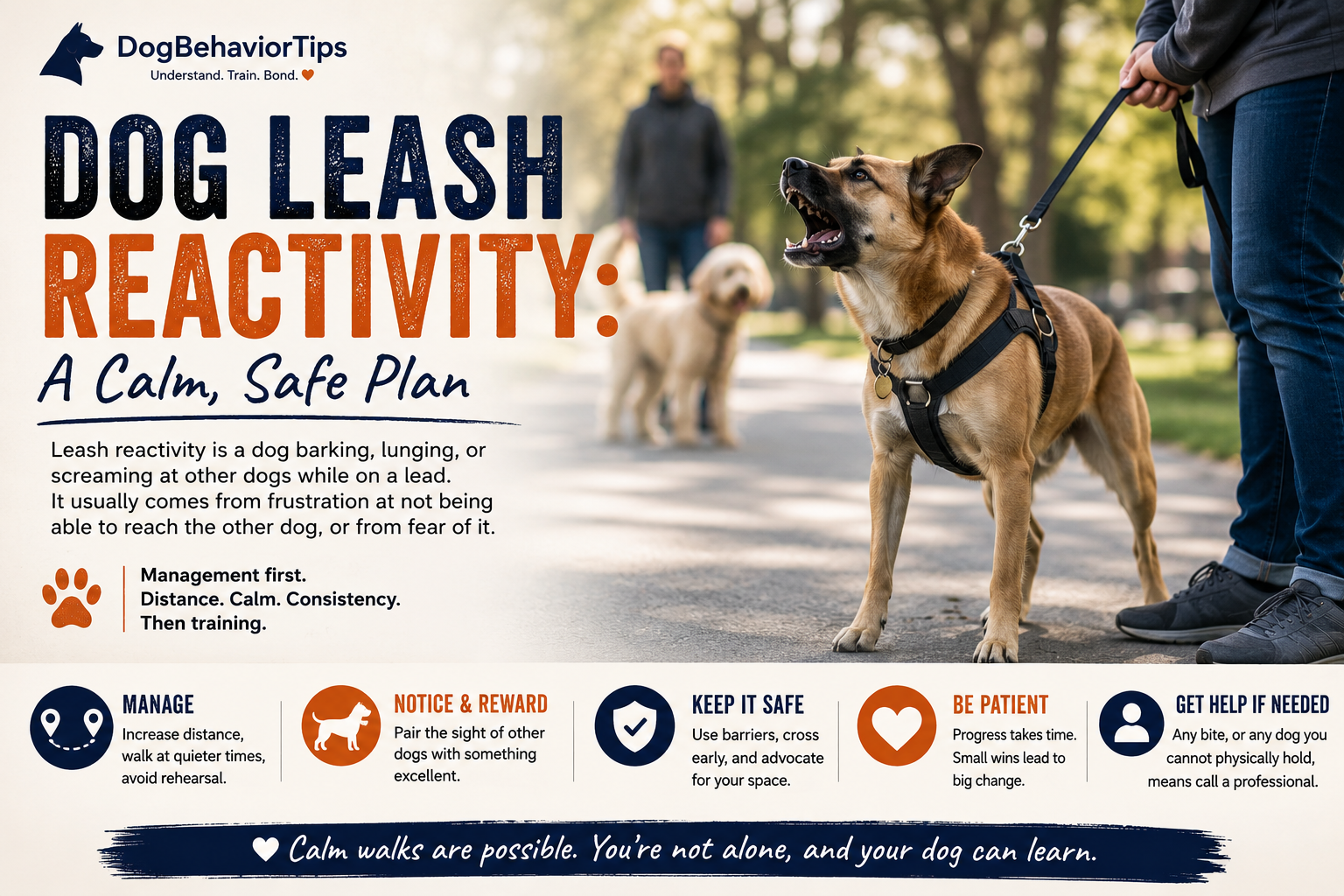
Leash reactivity is a dog barking, lunging, or screaming at other dogs while on a lead. It usually comes from frustration at not being able to reach the other dog, or from fear of it, and many leash-reactive dogs behave completely differently off lead. The first job is management rather than training: increase distance, walk at quieter times, and stop rehearsing the reaction. Then work at a distance where your dog can still notice another dog and take food, pairing the sight of a dog with something excellent. Never punish, yank, or use a prong, choke, or shock collar. Any bite, or any dog you cannot physically hold, means calling a professional.
If you have started avoiding your own neighborhood, or dreading walks, you are in extremely common company. This is one of the most frequently reported problems in pet dogs and it is workable. It is also one where the wrong advice does real harm, so the honest boundaries are marked throughout.
What leash reactivity is, and what it usually is not
A reactive dog is a dog reacting more strongly than the situation calls for. On a lead, that typically looks like barking, lunging to the end of the leash, spinning, screaming, or a hard stare that snaps into an explosion when the other dog gets close enough.
The important framing, which Best Friends Animal Society, PetMD, and most certified trainers all make, is that reactivity and aggression are not the same word. A great many leash-reactive dogs are perfectly sociable off lead, at a distance, or once introductions are over. The lead is a big part of the problem: it removes the dog's ability to move away, to arc around, to sniff and approach at an angle, and to do all the ordinary negotiation dogs use with each other. Take those options away from a worried or excited animal and what is left is noise.
That said, we are not going to tell you which category your dog is in. Two very different internal states can produce an almost identical display on the pavement, and telling them apart reliably takes someone watching your actual dog. What this article can do is describe the patterns, give you a management plan that is safe under either reading, and be clear about the point where you need a person rather than a page.
The two common drivers: frustration and fear
Frustration looks like a dog that desperately wants to get to the other dog. The body tends to be forward, the tail high and often wagging, the pulling relentless, and the whole display eases if the dogs are eventually allowed to meet. These are frequently dogs who had a lot of unrestricted greeting as puppies and learned that seeing a dog means going to say hello, and the lead now sits in the way of a strong expectation.
Fear looks like a dog trying to make the other dog go away. The display may start further out, the body may be lower or the weight shifted back, the dog may bark and retreat, and it usually does not want a greeting at all. Because the other dog does eventually pass by, the barking appears to work every time, which makes the pattern durable.
Some dogs are a mix, and some are neither. What matters practically is that both are treated with distance and reward, not with correction, and that both get worse when the dog is punished for the display.
Management first: making tomorrow's walk survivable
Management is not the consolation prize. Every reaction your dog rehearses makes the next one easier to trigger, so the fastest thing you can do is reduce how often it happens.
Change when you walk. Early morning, late evening, and the middle of a working day are quieter almost everywhere. This one change does more for most households than any technique.
Change where you walk. Industrial estates, quiet cul-de-sacs, cemeteries where permitted, large open fields with sightlines, and car parks after hours all offer space and visibility. What you want is the ability to see another dog coming from far enough away to do something about it.
Cross the road early, and without drama. Turning away calmly at fifty yards is a win. Standing your ground at ten yards to "work through it" is not.
Use parked cars, hedges, and corners. A visual barrier can drop a dog's arousal instantly. Stepping behind a van is a completely legitimate training decision.
Stop apologizing and start planning. Other owners will let their off-lead dog run up while calling that it is friendly. You are allowed to say, loudly and early, that yours is in training and to please call their dog. Practice the sentence, because it is much harder to produce in the moment.
None of this teaches your dog anything, and that is fine. It buys quiet in which the actual learning can happen.
Finding your dog's threshold distance
Everything below depends on one number, and it is a number you have to find rather than one anybody can give you.
Your dog's threshold is the distance at which it can see another dog and still function: still take food, still hear you, still move. Beyond it, the dog is aware but under control. Inside it, the dog stops being able to learn, because an animal in full arousal is not in a state where new associations form.
The practical test is food. Offer something genuinely good the moment your dog notices the other dog. If it eats, you are far enough away. If it takes the food and spits it out, or ignores your hand entirely, you are too close and you should increase distance rather than push on. This test is more reliable than judging by the barking, because a dog can be silently over threshold and about to explode.
Expect the number to be larger than you want it to be. For some dogs it is a hundred yards or across a field, and that is not a failure, it is a starting point.
Trigger stacking: why yesterday's progress vanished
This section exists because it explains the most demoralizing thing about this behavior, and almost nobody tells owners about it.
Arousal accumulates. A dog does not reset to zero between events. If your dog was startled by a bin lorry in the morning, then heard fireworks in the afternoon, then had a visitor arrive, it is carrying all of that when you go out at six. The same dog, at the same distance, from the same other dog, that coped fine on Tuesday can come apart on Wednesday, and nothing about your training got worse.
Trainers describe this as trigger stacking, and once you know about it the pattern in your own notes becomes obvious. It has three practical consequences.
First, an inconsistent day is information rather than evidence of failure. Second, on a day when your dog has already had a lot, the correct decision is a sniffing session in the garden instead of a walk. Third, rest genuinely matters. A dog that is short of sleep, that is sore, or that has had a stressful week has a smaller margin, and the threshold distance moves accordingly.
Keeping a short note of each walk, what you saw and how your dog handled it, turns this from a mystery into something you can plan around.
Permission to stop walking for a while
Here is the piece of advice that most pages will not give, and it is often the most useful one.
If every single walk produces a reaction, the walk is currently a rehearsal, not exercise. Continuing it because dogs "need walks" means your dog practices being over threshold once or twice a day, every day, while you try to teach it something else. That is a losing arrangement.
For a few weeks, it is entirely reasonable to stop walking in trigger-dense places altogether. Replace it with sniffing sessions in the garden or a quiet space, food puzzles and scatter feeding, short training games indoors, and long-line time in an empty field at an hour when nobody is around. Physical exercise is not the only need a walk meets, and for most dogs the sniffing and the mental work are the parts that produce a settled animal.
Owners describe this as giving up. It is closer to the opposite: it is removing the daily setback so the training has somewhere to build from. Some dogs need a genuine stretch of calm before they are capable of learning anything new at all.
The training: pairing the sight of a dog with something excellent
The core method is straightforward to describe and takes patience to run.
Position yourself at or beyond threshold distance, ideally somewhere you can see other dogs coming. The instant your dog notices another dog, start feeding something outstanding: chicken, cheese, sausage, whatever your dog would sell you for. Keep feeding while the other dog is in view. Stop the moment it goes out of sight.
The sequence matters. The other dog appears, then the food starts. Not the other way around. You are building a prediction, and the prediction only forms if the dog's arrival is what announces the chicken. Over many repetitions, a lot of dogs start to look at their handler when they spot another dog, which is the outcome you want and which you should pay generously the first hundred times it happens.
Two rules keep this honest. Reduce distance only when your dog is comfortably relaxed at the current one, and reduce it slowly. And end sessions early, while things are still going well, rather than pushing until something goes wrong. The technique here is standard reward-based counter-conditioning, and the mechanics of timing and marking are covered in our positive reinforcement dog training guide.
A loose-leash foundation makes all of this easier, because a dog already dragging you down the street has less capacity to notice anything you do. If your dog pulls generally, our guide to stopping a dog pulling on the leash is worth working on in parallel in quiet places.
The emergency U-turn
You need one behavior for the moments when management fails and a dog appears around a corner at close range.
Teach it with no dogs anywhere. Say a cheerful phrase, turn on your heel, and jog a few steps in the other direction, then pay well. Repeat until the phrase alone produces a dog spinning around with you happily. Then use it in real life the moment you spot a problem, before your dog has locked on.
Practiced properly, this is not a correction and it does not feel like one to the dog. It is a fun, well-rewarded pattern that happens to move you both out of a bad situation. It is worth more than any other single skill on a reactive dog's walk.
Equipment, strictly as escape prevention
This is a safety note, not a gear review.
A dog that lunges hard can back out of a flat collar, and a loose reactive dog on a road is a genuinely dangerous situation. A well-fitted harness, ideally one the dog cannot reverse out of, is worth having for that reason alone. A front-clip attachment gives many owners better physical control than a back clip. A leash of a few feet gives you steering; a retractable leash does not, and it also lets a dog reach a trigger before you can act.
What is not on the list, at all: prong collars, choke or check chains, slip leads used to correct, and electronic collars. Best Friends Animal Society, the ASPCA, and the broader reward-based training community are consistent on the reason, and it is not squeamishness. These tools apply something unpleasant in the presence of another dog. For a dog that is already worried about other dogs, that pairs the sight of a dog with pain or discomfort, which is precisely the association you are trying to undo. Suppressing the barking without changing the feeling can also remove the warning display, which makes a dog less predictable rather than safer.
What not to do
Do not punish the reaction. Yanking, shouting, alpha rolls, or any correction adds a bad experience to the exact moment another dog appears.
Do not let them meet and sort it out. On-lead greetings between an aroused dog and a stranger dog are how bites happen. If a meeting is ever appropriate for your dog, it should be planned, off-lead or on loose long lines, in a neutral space, and ideally with professional guidance.
Do not take a reactive dog to a dog park to socialize it. It is the highest-arousal, lowest-control environment available.
Do not tighten the leash when you see a dog coming. Tension travels down the lead and many dogs read it as a warning. Practice breathing out and keeping your hand soft, because your body is part of the picture your dog is reading.
Do not push through a reaction to "prove" something. Nothing is learned above threshold except that the pavement is a frightening place.
Watch out for redirection. A dog at the peak of a reaction may turn and bite whatever is nearest, which is often the handler, the leash, or another dog in the household. This is not malice and it does not mean your dog wants to hurt you, but it is how owners get injured. Keep your hands and face away from a lunging dog, use the leash and your feet to create distance, and treat any redirected bite as a reason to get professional help immediately.
The honest part, and when to call a professional
There is a limit to what a written guide can do here, and it is worth stating plainly rather than burying at the bottom.
An article can teach you the principles, the management, and the shape of the counter-conditioning work. It cannot see the moment your dog's body changes two seconds before the bark, cannot judge your threshold distance for you, and cannot adjust the plan when your dog has a bad week. Those are the things a good trainer does, and on a behavior with a bite risk attached they are worth paying for.
Call a certified trainer or a board-certified veterinary behaviorist now if your dog has bitten another dog or a person, if it has redirected onto you or a household member, if you cannot physically hold your dog during a reaction, if the reactions are getting worse rather than better, or if this appeared suddenly in a dog that was previously relaxed.
That last case deserves a veterinary appointment first. Pain is a common and under-recognized contributor to a dog becoming less tolerant on walks, and no training plan addresses a sore joint or a dental problem. Your vet can rule that out and refer you onward.
When choosing help, look for someone who works with food and distance and who will tell you, when asked directly, that they do not use corrections, prong collars, or e-collars. If the answer is vague, keep looking. The same vetting advice applies to any behavior work involving a bite risk, including resource guarding, and to fear at the front door, which is covered in how to stop a dog barking at the doorbell.
We are dog owners writing from reputable sources, not veterinarians or certified behaviorists. For the wider set of everyday problems, our hub of common dog behavior problems and their solutions ties this cluster together.
Frequently asked questions
Is my leash-reactive dog aggressive?
That is not a question an article can answer, and it is worth resisting the label. Many reactive dogs are sociable off lead and are reacting to restraint, frustration, or fear rather than intending harm. Some are not. Only someone assessing your particular dog in person can tell you which, and the management plan in this guide is safe either way.
Will my dog grow out of leash reactivity?
Generally not on its own. Reactivity is practiced every time it happens, and practice makes it more automatic rather than less. What changes it is fewer rehearsals plus a new association with the sight of other dogs, and for many dogs professional help alongside that.
Should I let my dog say hello to calm dogs to build confidence?
Not while your dog is reactive on lead. An on-lead greeting between an aroused dog and a stranger is a high-risk situation for both animals. If controlled introductions are appropriate for your dog at some point, a professional should set them up.
Why does my dog only do this on the leash?
The lead removes almost all of a dog's normal options: moving away, curving around, approaching slowly, or leaving. A dog that is worried or over-excited and cannot do any of those things has very few responses left. That is why so many leash-reactive dogs are different animals off lead.
Can I fix this on my own?
Some owners make real progress with consistent management and counter-conditioning, particularly with a frustrated dog and a lot of space to work in. Anything involving a bite, a redirection onto a person, or a dog that cannot be safely held is a situation for a professional, and looking for one is the responsible move rather than an admission of failure.
This article is general owner guidance drawn from Best Friends Animal Society, the ASPCA, AKC, and PetMD. It is not veterinary advice and it is not a behavioral diagnosis. Leash reactivity carries a real risk of injury to dogs and people; for any dog that has bitten or redirected onto a handler, please work with your veterinarian and a certified trainer or board-certified veterinary behaviorist.
1 thought on “Dog Leash Reactivity: A Calm, Safe Plan”