
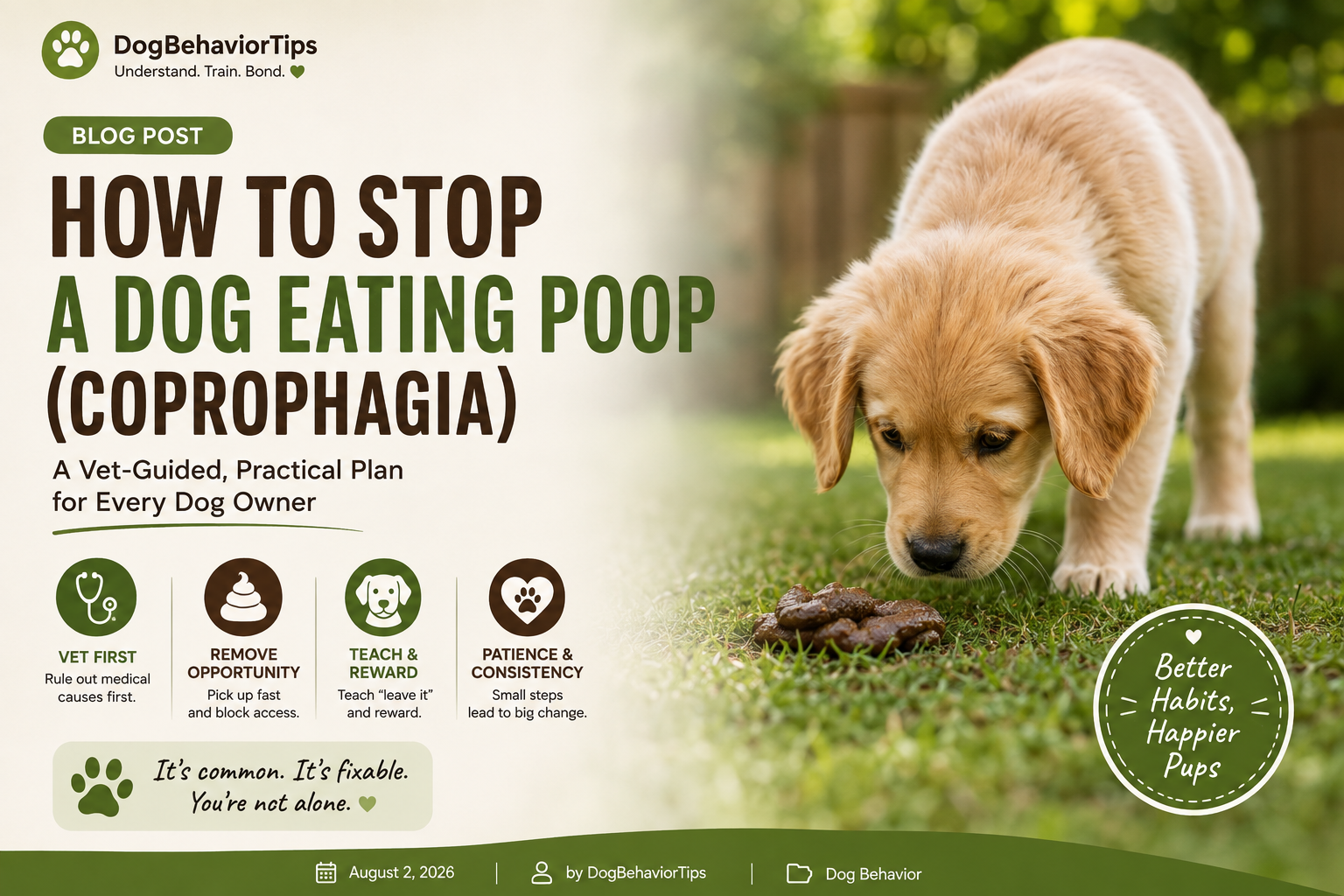
Eating poop is common, usually not dangerous to the dog, and almost always fixable with management rather than a product. Start with your veterinarian, because parasites, diet problems, and several medical conditions can drive it, and no amount of training fixes a medical cause. Then remove the opportunity: pick up immediately, supervise outside, and block access to litter boxes. Teach a solid "leave it" and reward your dog for coming to you the moment it finishes toileting. Never punish or chase, which teaches secrecy and speed rather than restraint. The popular home remedies are unreliable and do nothing at all about a medical or a boredom cause.
Coprophagia is the technical name and it is one of the least glamorous things dogs do. It is also extremely ordinary, it is not a sign that you have failed as an owner, and in most households it is solvable within a few weeks of consistent routine.
The quick answer, and why the vet comes first
Almost every list you will read starts with home remedies. The order should be the other way round, because several of the causes are medical and no behavioral plan touches them.
Book a veterinary appointment if this is a new or regular habit. Your vet will want to look at parasites, at whether your dog is absorbing its food properly, and at conditions that increase appetite or change how a dog processes nutrients. Bring a stool sample if your practice asks for one and be straightforward about what your dog is doing; veterinary staff have heard it many times a week and nobody is judging you.
We are not going to list which conditions cause it or what any of them look like, because that is diagnosis and it belongs to a veterinarian who can examine your dog. What we can say clearly is that "he just does it because he is gross" is a conclusion, not a starting point, and it is worth ruling out the medical side before accepting it.
Whose poop is it?
This question sorts the problem faster than anything else, and most guides skip it entirely. Four different sources mean four different problems.
| What your dog is eating | What it usually means | Where to start |
|---|---|---|
| Its own stool | Classic coprophagia. Medical causes, boredom, anxiety, or a learned puppy habit | Vet first, then the management routine below |
| Another dog's stool, in the house or yard | Often learned and opportunistic, sometimes attraction to a different diet | Vet check, then rigorous immediate pickup |
| Cat litter box contents | Not really coprophagia. Cat food is high in protein and the leftovers are appealing | A management problem: move or cover the box, block access |
| Livestock, horse, goose, or wildlife droppings on walks | Extremely common and largely an instinct-and-taste issue | Leash management and a strong "leave it" |
That third row saves people a lot of wasted effort. A dog raiding the litter box does not need a coprophagia supplement, it needs a box the dog cannot get into, which usually means height, a covered box, a baby gate with a cat-sized gap, or a different room. Treating it as a behavior disorder rather than a door problem is why some households fight it for years.
The fourth row is worth a word about risk. Droppings from other animals can carry parasites, and pasture can carry residues from treatments given to livestock. If your dog does this regularly on walks, mention it to your vet, who can advise on a parasite-prevention schedule appropriate for your dog and your area. We do not publish product or dosing guidance, because that is a veterinary decision.
Puppies versus adult dogs
The two are not the same problem and the difference changes how worried to be.
In puppies, exploratory poop-eating is common and normal in the sense that it is expected, not that it is desirable. Puppies investigate the world with their mouths, they copy what they see, and mother dogs clean up after very young litters, so the behavior is not alien to them. Most puppies stop as they mature, particularly if the opportunity is removed rather than made into a dramatic event.
In an adult dog that has never done it before, a new habit deserves a vet visit rather than a supplement. Sudden behavior change in a mature dog is a signal, and this one has a longer list of possible medical contributors than most.
Either way the management routine is identical. The difference is how quickly you escalate to the vet and how much you expect time alone to help.
The behavioral causes worth knowing about
Once the medical side is clear, the usual suspects are unglamorous and familiar from every other behavior on this site.
Boredom. A dog left in a yard with nothing to do will investigate what is available. This is the same root cause as most digging and most destructive chewing, and it responds to the same fixes: sniffing walks, food puzzles, scatter feeding, and short training sessions. Our guide to stopping a dog digging in the yard covers that enrichment work in more detail, and it applies almost unchanged here.
Anxiety. Some dogs do this when stressed, particularly dogs confined for long stretches or in kennel environments.
Attention. If picking up a stool reliably produces a human sprinting across the lawn shouting, some dogs will file that away as an excellent trick.
Habit. A behavior that has been practiced for months continues on momentum long after the original reason has gone.
Taste. It is unappealing to say and it is part of the picture. Undigested material in stool is more interesting to a dog than it is to us, particularly stool from an animal on a different diet, which is why cat boxes are such a strong draw.
The one nobody mentions: punished house-training accidents
This is the piece worth knowing even if the rest of the article does not apply to you.
A dog that has been shouted at, rubbed in it, or otherwise punished for an accident indoors does not learn to hold on. It learns that a person plus a stool equals trouble. Some dogs respond by going somewhere hidden. Some respond by removing the evidence, and that is a documented route into coprophagia in dogs that were never inclined to it.
Behavior sources have described this pattern for a long time, and it is a good illustration of why this site does not recommend punishment for anything. The owner's frustration is completely understandable. The result of acting on it is a dog with two problems instead of one, and the second is harder to fix than the first.
If house training is where you are, the fix is the same as everywhere else: clean thoroughly with an enzymatic cleaner so the spot does not smell like a toilet, take the dog out more often than you think you need to, and reward heavily outdoors. Nothing at all happens indoors except a quiet cleanup.
What actually works: management and the after-toilet routine
The plan is boring, which is a good sign.
Pick up immediately, every time. In the yard, that means going out with your dog rather than letting it out. Indoors, it means a litter box the dog cannot reach. On walks, it means bagging it there and then. Removing the opportunity does most of the work, because a habit that cannot be practiced fades.
Supervise, do not just observe. A dog alone in the yard for twenty minutes is unsupervised regardless of whether you can see it through a window.
Build the after-toilet routine. This is the single most effective active technique. The moment your dog finishes, call it to you cheerfully and pay well. Done consistently for a few weeks, many dogs start trotting straight to their owner after they toilet, because that is where the chicken is. You clean up while they eat. The AKC and a number of trainers describe this as the core reward-based fix, and it works because it gives the dog something better to do in exactly the window where the problem occurs.
Teach a real "leave it." Not a shouted word, but a trained cue that means turn away from that and something good happens. Build it on boring objects indoors before you need it on a walk. The timing that makes cues like this reliable is covered in our positive reinforcement dog training guide, and the same cue does duty against stolen food, as described in how to stop a dog counter surfing.
Keep the leash on where the temptation is high. Fields with livestock, parks with goose droppings, and other people's yards are not places to test a work-in-progress recall.
Feed on a predictable schedule. A dog whose meals arrive at reliable times, and who is not hungry at the moment of temptation, has one fewer reason.
Do pineapple, supplements, and deterrents work? An honest answer
A large share of the pages ranking for this topic exist to sell something, so here is the version without that motive.
The classic home remedies are pineapple, meat tenderizer, pumpkin, and a range of commercial chews sold specifically as coprophagia deterrents. They all work on the same idea: make the stool taste bad on the way out. Veterinary sources that discuss them describe the results as inconsistent, and there are two structural reasons why.
First, they only work on the dog's own stool, and only if you treat every dog in the household. They do nothing about the cat's litter box, another dog's stool at the park, or anything found on a walk, which is a large share of real cases.
Second, and more importantly, they do not address a single one of the underlying causes. If a dog is eating stool because of a medical issue, a bad taste does not change the medical issue. If it is doing it because it is bored in an empty yard for six hours, a chew does not fill the six hours.
None of them is dangerous in the small amounts usually suggested, and if you want to try one alongside proper management, that is a reasonable choice to make with your vet. What is not reasonable is buying a tub of something instead of picking up the yard, which is what a lot of this content is quietly encouraging.
Is it dangerous, for the dog or for the household?
For most dogs eating their own fresh stool, the honest answer is that the risk is low. The bigger concerns are parasites and bacteria, particularly from other animals' droppings, and those are a reason for a conversation with your veterinarian about a suitable prevention routine rather than a reason to panic.
For the household, ordinary hygiene covers most of it. Wash your hands, do not let a dog that has just done this lick faces, and be more careful where young children, elderly people, or anyone with a weakened immune system is involved. If someone in the home is immunocompromised, ask your own doctor as well as your vet, because that is a human health question and not one we are qualified to answer.
Do not brush your dog's teeth immediately in a panic either. Water, a chew, and a normal dental routine are enough, and turning it into a stressful event teaches the dog that the whole sequence ends badly.
What not to do
Do not punish, shout, or rub your dog's nose in anything. It is the fastest way to turn one problem into two, as described above.
Do not chase your dog to get it back. Chasing is a wonderful game and it teaches a dog to swallow quickly and run first. Trade for something better instead, and if your dog stiffens or guards what it has picked up, read how to stop a dog resource guarding food or toys before reaching for anything by hand.
Do not add products to the food without asking your vet, particularly if your dog has any medical condition or is on medication.
Do not use aversive devices or startle deterrents. They do not tell the dog what to do instead, and this site does not recommend them for anything.
Do not assume it means the food is bad. Diet is one possible factor among several, and switching food repeatedly on that theory can upset a dog's digestion without fixing anything. Change food on veterinary advice, not on a hunch.
When to call your veterinarian
Call your vet if this is new in an adult dog, if it is frequent rather than occasional, if your dog also has diarrhea, weight loss, a change in appetite, or seems unwell in any way, if your dog is eating other animals' droppings regularly, or if you have run consistent management for several weeks with no change.
Also call if the behavior is clearly tied to distress rather than opportunity, particularly in a dog that is anxious when alone or confined. In that case the poop-eating is a symptom, and your vet can refer you to a certified behaviorist who works with the underlying anxiety.
We are dog owners writing from reputable sources, not veterinarians. On anything with a medical component, and this topic has more of one than most behavior problems, the vet is the first call rather than the last resort.
For the rest of the everyday issues covered on this site, our hub of common dog behavior problems and their solutions ties the whole cluster together.
Frequently asked questions
Why does my dog eat poop but seem perfectly healthy?
Plenty of dogs that do this are in good health, which is why boredom, habit, taste, and learned puppy behavior are all on the list. That does not remove the value of a vet check, because some of the medical contributors are not obvious from the outside and a stool test is quick and inexpensive.
Will my puppy grow out of eating poop?
Many puppies do, especially if the opportunity is removed and nobody makes a drama of it. Puppies that get a lot of attention for it, or that have hours of unsupervised yard time, are the ones most likely to carry the habit into adulthood.
Does pineapple really stop dogs eating poop?
It is the most repeated remedy on the internet and one of the least reliable. It only affects the dog's own stool, it does not work for every dog, and it does nothing about the reason the dog started. Consistent pickup plus the after-toilet reward routine is a far better use of your effort.
My dog raids the cat's litter box. Is that the same problem?
Not really. That is usually about the appeal of cat waste rather than a coprophagia issue, and it is solved with access rather than training: a covered box, a raised location, a gate with a cat-sized opening, or a room the dog cannot enter. Keep the box scrupulously clean too.
Is it dangerous for my dog to eat poop?
The risk from a dog's own fresh stool is generally low. Other animals' droppings carry more risk, mainly parasites, which is a good reason to keep your dog's prevention routine up to date with your vet and to mention the habit at your next appointment.
This article is general owner guidance drawn from the AKC, ASPCA, VCA Animal Hospitals, and Preventive Vet. It is not veterinary advice and it does not diagnose anything. Please see your veterinarian before treating poop-eating as a purely behavioral problem, and do not add supplements or treatments to your dog's diet without veterinary guidance.