
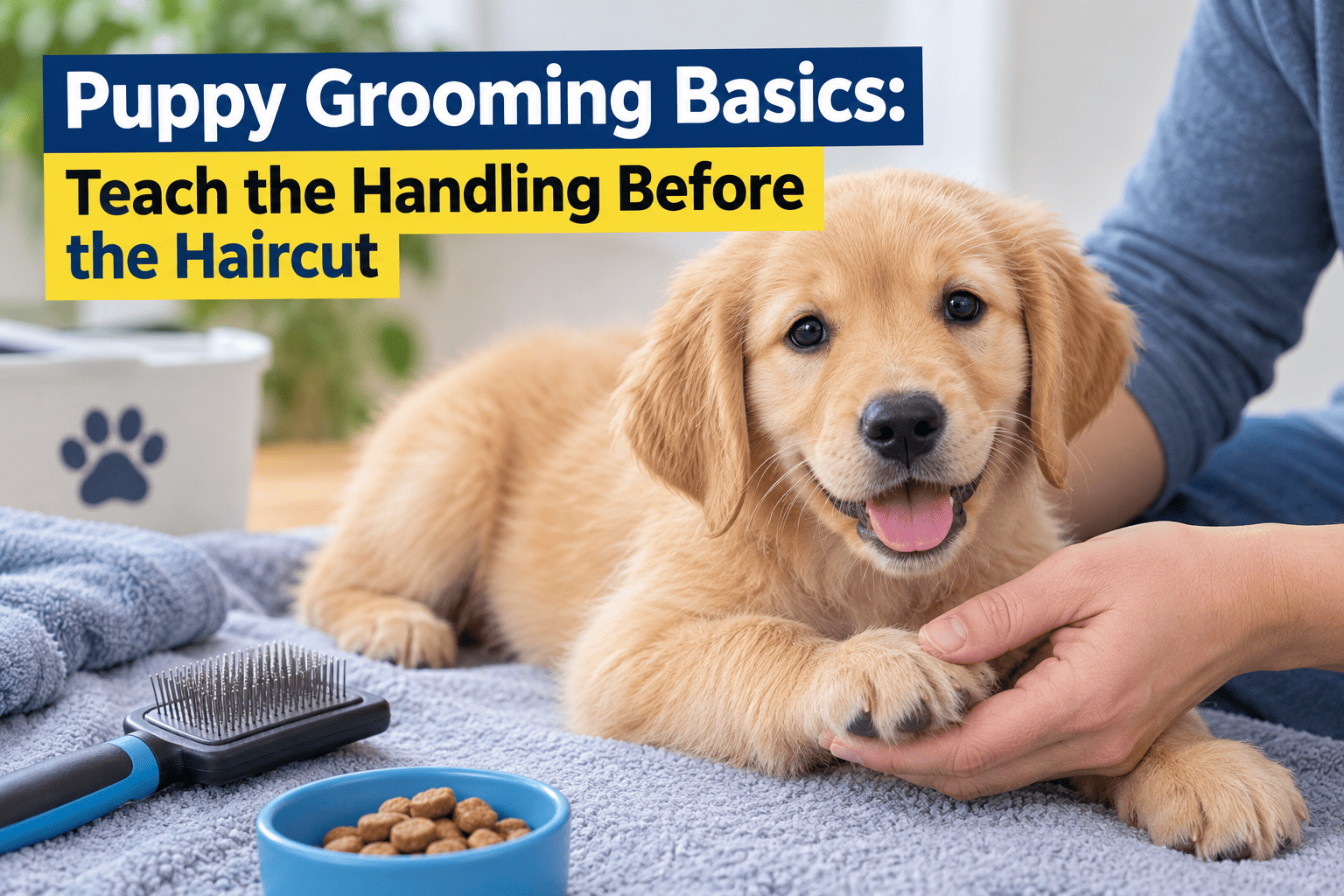
Almost every adult dog that hates being groomed was a puppy that was held still for it.
That is the point of this page. The physical part of grooming is not difficult. The part that decides whether it will still be possible in three years is what the puppy learns about being handled, and that is a training project rather than a grooming one.
This page is the behavior half. It does not describe how to cut a nail, does not name products, and does not cover coat types, skin or anything clinical. Those belong to a groomer and to your vet.
Start before you need to
The mistake is beginning when the nails are already long or the coat is already matted, because then the first experience is a long, uncomfortable, unavoidable one.
Begin with sessions that accomplish nothing. Touch a paw, give a treat, stop. That is the entire session. It takes ten seconds and it is doing the work.
Handling comes before tools. A puppy that is comfortable having its feet held, its ears touched, its mouth looked at and its body brushed by hand is a puppy for which the tools are a small additional step. A puppy that is not comfortable with any of that will not be made comfortable by introducing clippers.
The principle underneath all of it
Let the puppy choose to stay, and stop before it wants to leave.
Restraint is what creates the problem. A puppy that struggles and is held until it stops has learned that struggling does not work, which looks like acceptance and is not. Restraint teaches a dog that its objections are ignored, and the next objection is bigger.
Short and frequent beats long and thorough. Five ten-second sessions in a week teach more than one ten-minute session.
Stop while it is still going well. Ending on a good moment is what makes the next session easy, and pushing for one more nail is what undoes a week.
And reward the tolerance, not the outcome. You are paying for the puppy standing still, not for a finished job.
Brushing
The easiest one to start with and the best place to begin, because it is comfortable for most dogs.
Start with your hand. Then the brush, held but not used. Then one stroke, then a treat, then stop. Build from there.
Watch for the spots that are not the back. Most puppies accept brushing along the body and object to the legs, the tail, the belly and behind the ears. Those are the areas that mat and they are the ones to spend the patience on, early, before there is anything to remove.
Do not work through a mat. Pulling at one is painful and it is the single most reliable way to make a dog hate brushing. A mat is a groomer's or a vet's problem, and how a coat should be maintained is a question for whoever knows that coat type.
Nails
The one people dread, and the one to build up to most slowly.
Handling the feet is a training project of its own and it is worth doing well before any tool appears. Hold a paw for a second, treat, release. Then two seconds. Then touch a nail. Then hold the clipper near the paw without using it.
We do not describe how to cut a nail on this page, and that is deliberate. There is anatomy involved, it hurts and bleeds if it goes wrong, and one painful experience can undo months of handling work. Have your vet or a groomer show you on your dog, once, in person. That is a five-minute ask at an appointment and it is worth far more than any written description.
A dog that will not have its nails done is a common reason for sedation later in life, which is the argument for the slow version now.
Bathing
Less frequently needed than people assume, and how often depends on the coat and on the dog, which is a question for your vet or groomer rather than for a schedule on a page.
The behavior work is the same shape. The bath before the water: the puppy stands in the empty tub, gets a treat, leaves. Then a little water. Then the rest.
Non-slip footing is the underrated part. A great deal of bath fear is a puppy sliding, and it is entirely preventable with a mat.
Careful with ears, eyes and water temperature, and use whatever your vet recommends for a puppy rather than whatever is in the shower.
What not to do, in any framing
No restraint as a method, no scruffing, no holding down, no scolding, and nothing that startles. The American Veterinary Society of Animal Behavior, on its own position statements page, states that its Humane Dog Training statement recommends only reward-based training methods for all dog training, including the treatment of behavior problems. (Read at avsab.org, 28 August 2026.)
Do not push through a puppy that is telling you no. Freezing, turning away, lip-licking, yawning and trying to leave are all communication, and ignoring them is how a dog that used to tolerate grooming becomes a dog that growls during it.
And if a puppy does growl or snap during handling, stop and get help rather than escalating. A punished warning goes away while the fear stays, which produces a dog that skips the warning next time. That reasoning is on what to do when a dog growls at strangers, and it applies identically to handling.
When to involve someone else
Your vet, for: anything on the skin, in the ears, in the eyes or on the paws that looks unusual; matting close to the skin; nails you cannot manage; any lameness after handling; and a first demonstration of nail trimming on your own dog. We are a dog behavior site, not a veterinary clinic, and we diagnose nothing.
A groomer, for: the coat type, the schedule appropriate to it, and the tools that suit it. Meet one early, before a first appointment that is also a long one, because a short, cheerful, uneventful first visit is worth a great deal.
A qualified behavior professional, for: any growling, snapping or panic around handling. Ask for a certified applied animal behaviorist or a veterinary behaviorist, because "dog trainer" is not a regulated title.
Frequently asked questions
My puppy growled while I was brushing it. What should I do?
Stop, and get help rather than escalating. Growling, snapping or panic around handling is what a qualified behavior professional is for, and the article's advice is to ask for a certified applied animal behaviorist or a veterinary behaviorist, because "dog trainer" is not a regulated title. The reason not to correct the growl is that a punished warning goes away while the fear stays, which produces a dog that skips the warning next time.
My puppy squirms. Can I just hold it still and get it over with?
Restraint is what creates the problem this page is about. A puppy that struggles and is held until it stops has learned that struggling does not work, which looks like acceptance and is not, and it teaches the dog that its objections are ignored, so the next objection is bigger. Let the puppy choose to stay, keep sessions short and frequent, stop while it is still going well, and reward the tolerance rather than the finished job.
Why does this page not explain how to cut a nail?
Because there is anatomy involved, it hurts and bleeds if it goes wrong, and one painful experience can undo months of handling work. The better version is to have your vet or a groomer show you on your own dog, once, in person, which is a five-minute ask at an appointment. In the meantime the handling work, holding a paw for a second and releasing, then two, then touching a nail, is the part you can build.
There is a mat in my puppy's coat. Should I brush it out?
Do not work through a mat. Pulling at one is painful and it is the single most reliable way to make a dog hate brushing. A mat is a groomer's or a vet's problem, and matting close to the skin is on the list of things to take to your vet. The preventable version is spending the early patience on the legs, tail, belly and behind the ears, which are the areas that mat.
How often should I bathe my puppy?
This page publishes no bathing frequency. Bathing is needed less often than people assume, and how often depends on the coat and on the dog, which makes it a question for your vet or groomer rather than a schedule on a page. What does transfer is the behavior shape: the empty tub with a treat first, then a little water, then the rest, with non-slip footing, because a great deal of bath fear is a puppy sliding.
What this page does not publish
No nail-cutting technique or anatomy, no bathing frequency, no coat-type guidance, and no product names of any kind.
No medical or skin guidance. That is your vet's.