
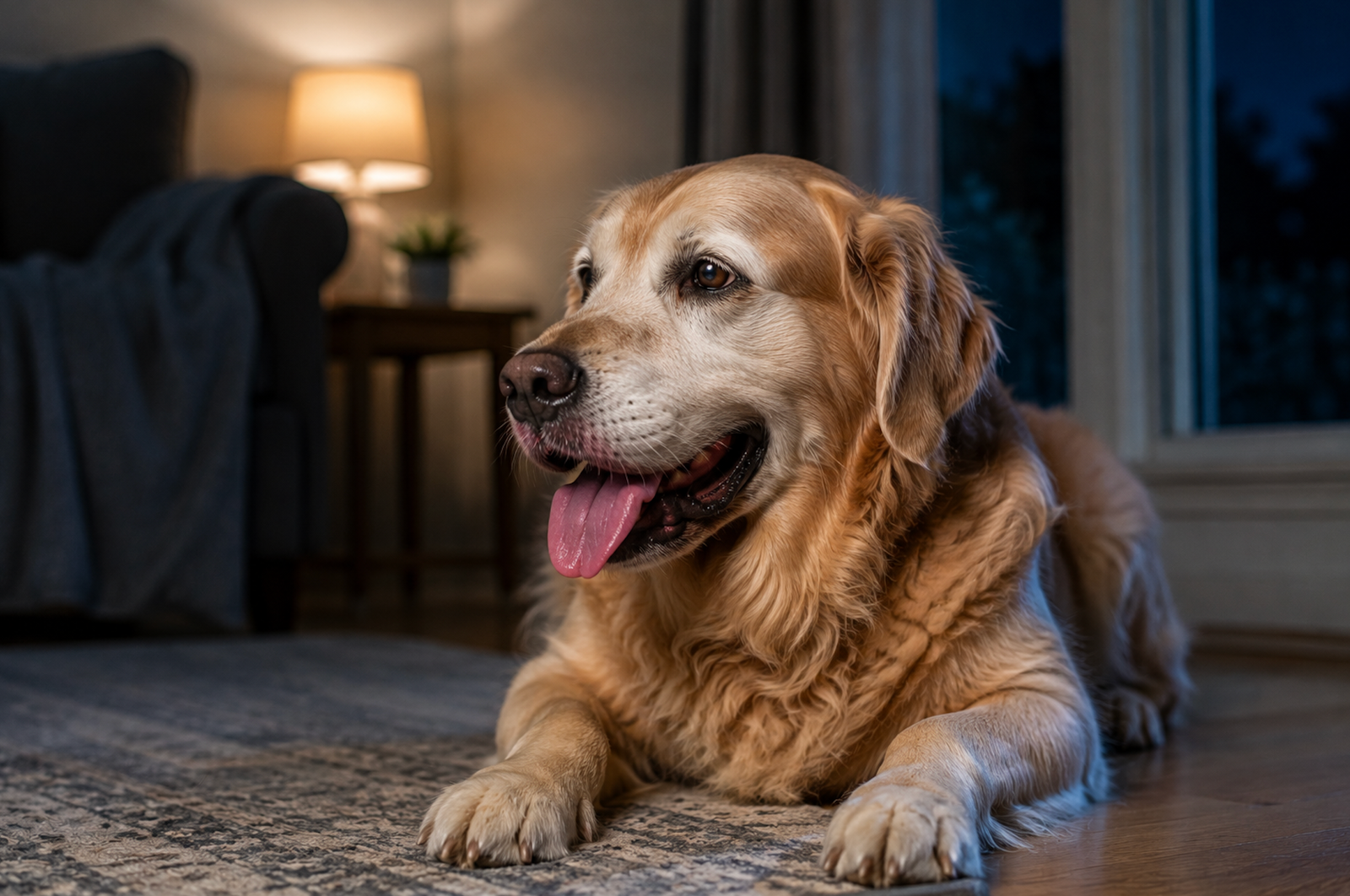
If your dog is panting hard while resting in a cool room, and you also see pale, blue, or gray gums, labored or noisy breathing, collapse, or restlessness that will not settle, that is an emergency: stop reading and call a veterinarian or emergency animal hospital now. Short of that, panting without heat usually means normal excitement, stress or fear, pain, a medication side effect (steroids especially), brachycephalic airway anatomy, or an underlying illness such as heart, respiratory, or endocrine disease including Cushing's disease, as reported by VCA Animal Hospitals and the Merck Veterinary Manual. This guide explains why each cause actually produces panting, not just that it can, and when it is worth a call to your vet.
Call a vet now if you see this
Read this section first. Panting itself is rarely the emergency; what surrounds it is.
- Gum color that isn't pink. Pale, white, gray, or blue-tinged gums point to poor oxygen delivery or blood loss and need emergency care immediately. Lift your dog's lip and check.
- Labored or noisy breathing. Elbows pushed outward, neck stretched forward, belly working hard with each breath, or audible wheezing or rasping.
- Collapse or extreme weakness, even briefly.
- Panting at rest with no heat and no exertion, especially if it started suddenly and does not ease.
- Restlessness that will not settle, pacing that continues no matter what you try, particularly paired with any of the above.
- A swollen or hard abdomen, drooling, or repeated unproductive retching, which in a large or deep-chested dog can point to a life-threatening emergency.
None of this list is a diagnosis. It is a filter: if any of it is true right now, the next step is a phone call, not more reading.
How panting normally works
Dogs cool themselves very differently from people. They have only a limited number of functional sweat glands, mostly in the paw pads, so sweating barely touches their overall temperature. Panting is the real cooling system: rapid, shallow open-mouth breathing moves air across the moist surfaces of the tongue, mouth, and upper airway, and evaporation there pulls heat out of the body. That is the baseline the whole topic sits on, and it is why "is my dog hot" is always the first question to rule out before anything else.
Panting is also a completely normal response to exercise, excitement, and mild arousal, and dogs pant during and shortly after all three even in a cool house. The question this article answers is what is happening when none of that fits: your dog is not hot, has not just been running around, and is panting anyway.
Why dogs pant without being hot
Each of these produces panting through a different mechanism. Knowing which one you're likely looking at helps you describe it to your vet accurately, which is worth more than a guess at a label.
Excitement and normal arousal
A dog greeting you at the door, watching a squirrel, or anticipating a walk often pants in short, quick bursts, sometimes with a whine. This is a mild version of the same arousal response that drives exercise panting: heart rate and breathing rate rise together, and it settles on its own within a few minutes once the excitement passes. This is the one cause on this list that needs no action at all.
Stress, fear, and anxiety
Fear and stress activate the sympathetic nervous system, the same "fight or flight" response that raises a person's breathing and heart rate under pressure. In a dog that response often shows up as panting, paired with other signals such as pacing, yawning, lip licking, a lowered body, or trying to leave the situation. This is why a dog can pant heavily during a vet visit, a thunderstorm, or a car ride in a cool, air-conditioned vehicle. If you want the full picture on storm and firework fear specifically, our guide on dogs afraid of thunderstorms covers the comfort steps and the long-term plan, and our guide to separation anxiety covers the version of this that shows up when a dog is left alone.
Pain
Pain triggers the same stress-hormone response as fear, so a dog in discomfort often pants for the same physiological reason an anxious dog does, sometimes before any other sign is obvious. Watch for panting paired with reluctance to lie down or get comfortable, stiffness, licking at one area repeatedly, a hunched posture, or general restlessness. Pain-driven panting tends not to resolve the way excitement-panting does; it lingers because the underlying cause is still there.
Medication side effects
Certain drugs change panting directly rather than through stress or discomfort. Steroids, prednisone in particular, are well documented to increase panting and thirst as a direct pharmacological effect, essentially by mimicking the body's own stress hormone, cortisol, at a dose higher than the body makes naturally. Some pain medications and other prescriptions can do the same. If panting started or worsened around the time a new medication began, that timing is exactly the detail your vet needs, not something to wait out.
Brachycephalic airway anatomy
Flat-faced breeds such as pugs, French bulldogs, boxers, and English bulldogs have a shortened skull that narrows the nasal passages and airway. As reported by VCA Animal Hospitals, that anatomy means the same amount of cooling and oxygen exchange takes more physical effort, so these dogs pant more heavily and more often than a longer-nosed dog doing the exact same activity, and they overheat faster. In these breeds, panting that sounds unusually loud, wheezy, or effortful, or that does not ease with rest, is worth a veterinary airway evaluation rather than being written off as "just how the breed is."
Underlying illness, including Cushing's disease
Heart disease and respiratory disease can each make normal breathing less efficient, so the body compensates with faster, harder breathing, sometimes at rest. Fever raises the body's internal thermostat the same way heat does, so the dog pants to cool down even though the room is not warm. Cushing's disease (hyperadrenocorticism), a hormonal condition involving excess cortisol, lists panting among its recognized clinical signs, as reported by the Merck Veterinary Manual, usually alongside increased thirst, increased urination, increased appetite, a pot-bellied look, and coat changes over time. None of these can be told apart from the couch. They are the reason persistent, unexplained panting belongs in front of a veterinarian rather than a search engine.
What the pant itself is telling you
Most articles on this topic stop at a list of causes. It helps just as much to know what to actually look at while it's happening, because the pattern itself carries information.
Tongue shape. A relaxed dog panting from mild arousal or normal heat usually has a wide, loose, almost spoon-shaped tongue. A tight, narrow tongue, pulled back at the corners of the mouth, more often goes with stress or discomfort than with easy contentment.
How fast it resolves. Excitement-panting calms within a few minutes once the trigger is gone and the dog settles. Panting that continues for twenty or thirty minutes after everything has quieted down, or that is still going once your dog is lying still, points away from simple arousal.
Whether it happens at rest or in sleep. Panting that starts while your dog is lying down doing nothing, or that wakes them from sleep, is a different picture from panting that follows a burst of activity or excitement. This is one of the more reliable signals that something other than a normal trigger is involved.
What else is happening at the same time. Panting alongside drinking more water, eating more, a change in the abdomen's shape, coughing, or a new stiffness is more informative than the panting alone. Note the combination, not just the panting.
None of this replaces an exam. It does make you a far better historian when you're on the phone with your vet's office deciding how soon to come in.
Nighttime panting and pacing
If what you're actually seeing is panting combined with pacing or restlessness after dark, especially in an older dog, that combination has its own considerations around sleep, cognition, and age-related conditions that are worth reading on their own. Our guide to dog panting and pacing at night covers what to record before you call the vet and walks through the age-related causes in more depth than fits here.
What not to do
Do not wait out red-flag signs to "see if it passes." Pale or blue gums, labored breathing, and collapse do not resolve on their own.
Do not give any medication, including over-the-counter or human products, without asking your vet first. Some common pain relievers are dangerous for dogs, and masking a symptom before a diagnosis can delay finding the real cause.
Do not assume it's "just the breed" in a brachycephalic dog without ever having the airway checked. Heavy panting being common in flat-faced breeds doesn't mean every instance of it is fine to ignore.
Do not treat this article, or any list like it, as a diagnosis. Several of the causes above look identical from across the room and are told apart by a physical exam, not by reading.
The honest limit of this page
We are dog owners writing from named veterinary sources, not veterinarians, and clinical interpretation of your dog's panting belongs to your vet, not to this page or any other search result. What this guide can do is help you notice the pattern, describe it accurately, and know when "keep an eye on it" is no longer the right answer. For the wider set of everyday behavior questions, our hub on common dog behavior problems and their solutions links the full set together.
Frequently asked questions
Is it normal for a dog to pant a little even in a cool house?
Yes. Mild, short-lived panting during excitement, right after play, or during a stressful moment like a car ride is normal and usually settles within a few minutes on its own. What's worth attention is panting that doesn't fit an obvious trigger, doesn't ease, or happens at rest.
Can anxiety alone cause heavy panting?
Yes. Fear and stress trigger the same physiological stress response that drives panting during pain or illness, which is exactly why panting alone can't tell you which one you're looking at. Other anxiety signals, pacing, yawning, lip licking, trying to leave, help build the fuller picture; if it's tied to noise specifically, our guide on dogs afraid of thunderstorms goes into that pattern.
My dog just started a new medication and is panting more. Is that a problem?
Tell your vet about the timing rather than deciding on your own. Steroids and some other medications are known to increase panting as a direct, expected effect, but your vet needs to confirm that's actually what's happening rather than something else coinciding with the timing.
Should I be more worried if my dog is a pug, bulldog, or other flat-faced breed?
Somewhat, yes. Brachycephalic breeds work harder to move the same amount of air, so they pant more heavily under normal circumstances, but that also means loud, wheezy, or effortful panting in these breeds deserves an airway evaluation rather than being assumed normal for the breed.
What's the single fastest thing to check if I'm not sure whether this is an emergency?
Lift your dog's lip and look at gum color, and watch whether the breathing looks labored (elbows out, neck stretched, hard belly movement) rather than just fast. Pink gums and effortless (if fast) breathing usually buys you time to call during business hours; anything else is an emergency call now.
This article is general owner guidance drawn from PetMD (Dr. Sophia Catalano, DVM, Cornell University), VCA Animal Hospitals, the Merck Veterinary Manual, and Purina, verified at the time of writing. It is not veterinary advice, it is not a diagnosis, and it is not a substitute for an examination. Panting without heat can indicate a medical emergency. If you are worried about your dog's breathing, contact a veterinarian immediately.