
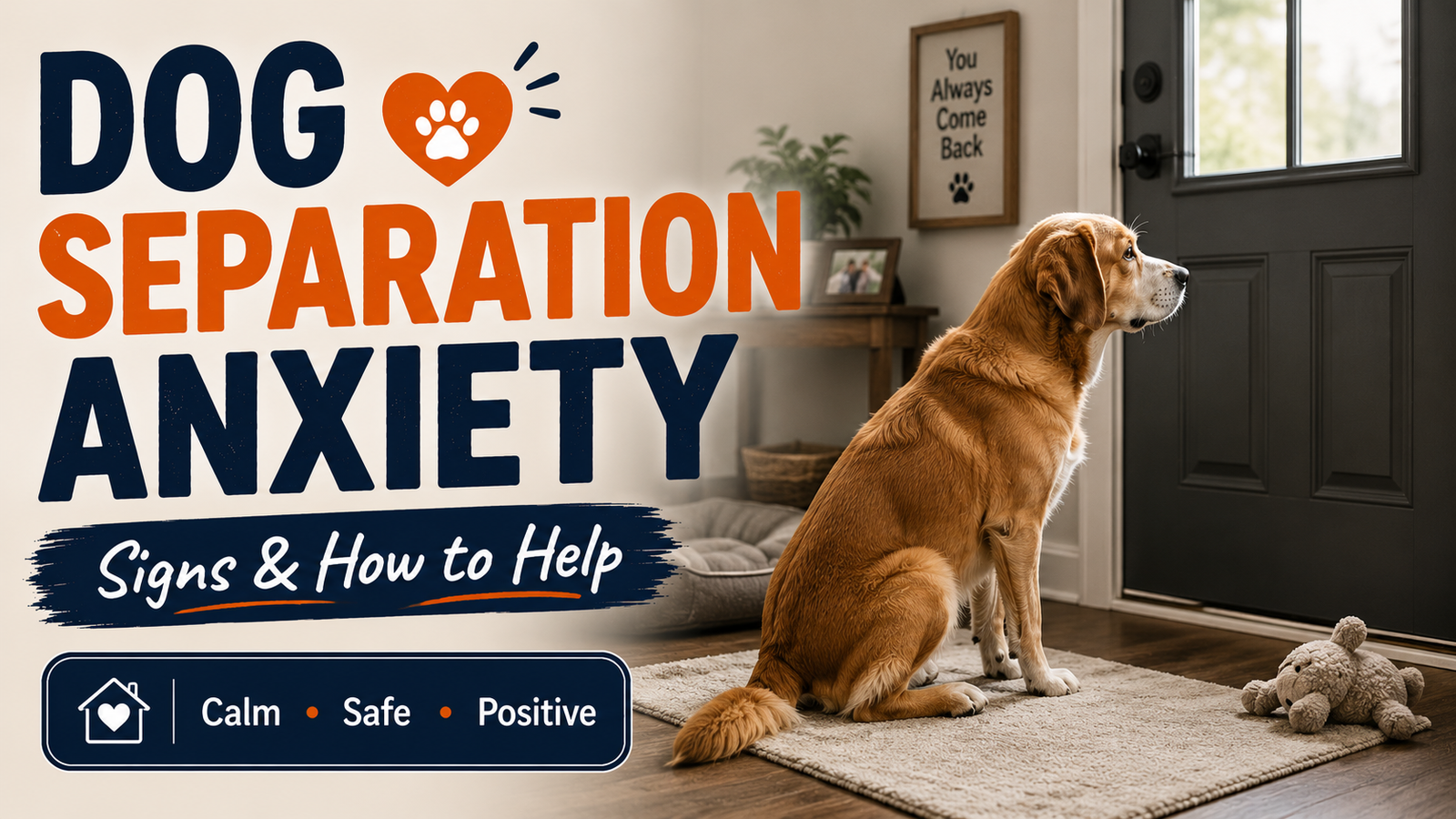
Separation anxiety is real distress a dog feels when left alone, and it looks different from boredom. The signs (pacing, drooling, howling, destruction aimed at doors and windows, or accidents from a house-trained dog) happen only when the dog is alone, and they often start while you are still getting ready to leave. Mild cases can improve with more exercise, calmer departures, and slowly building up alone-time. Severe cases, where a dog panics or hurts itself, need a veterinarian or a certified behaviorist. This guide explains how to tell the difference and where to start. It is not a substitute for professional care.
If you came home to a chewed door frame or got a note about barking, you are not a bad owner and your dog is not being spiteful. Separation anxiety is a treatable behavioral health issue, not disobedience. The first job is figuring out what you are actually dealing with.
Anxiety vs boredom vs under-exercise: a quick triage
Most of what looks like "bad behavior when I leave" falls into one of three buckets, and the fix is different for each. Reading the pattern matters more than reading the mess.
| What you notice | Likely cause | First move |
|---|---|---|
| Distress starts as you pick up keys or shoes; pacing, drooling, panting, whining before you even reach the door | Separation anxiety | Calmer departures, gradual alone-time, and get a professional involved if it is severe |
| Damage aimed at exits (doors, windows, the crate); escape attempts; accidents only when alone | Separation anxiety | Same as above, plus video to confirm |
| Dog is calm as you leave, sleeps a while, then chews random objects out of restlessness | Boredom | More mental and physical enrichment |
| Young or high-energy dog with too little exercise; chewing, digging, general busyness | Under-exercise | More real exercise and structured activity |
A useful rule of thumb reported by trainers and behavior groups: if the barking, whining, and destruction are severe within roughly the first 30 minutes after you leave, that points toward distress on separation. If your dog settles, sleeps, and only later wakes up and chews, that points more toward boredom. The single best way to know is to record your dog while you are out. A phone propped on a shelf or a pet camera showing panic in those first minutes tells you far more than the state of the room when you get home.
The signs of dog separation anxiety
According to the ASPCA, AKC, VCA Animal Hospitals, and Best Friends Animal Society, the common signs of separation anxiety include:
- Pacing, often in a fixed path or pattern
- Excessive drooling, panting, or trembling
- Barking, howling, or whining that starts soon after you leave
- Destructive behavior directed at exits (doors, window frames) or at objects that carry your scent
- House soiling from a dog who is otherwise reliably house-trained
- In some dogs, vomiting or refusing to eat while alone
The key thread is that these behaviors show up only when the dog is alone, and often they begin during your pre-leaving routine. A dog who chews a shoe while you are home on the couch is telling you something different from a dog who only destroys the door the moment you are gone.
The signs that mean "get help now"
Some presentations are not a training project you should take on by yourself. Contact a veterinarian promptly if your dog:
- Has a full panic attack when alone (frantic escape efforts, breaking through windows or crate walls)
- Injures itself trying to get out (broken teeth, torn nails, cut paws or gums)
- Will not eat, drink, or settle at all when left, even briefly
- Is getting worse despite your efforts
In severe cases, a dog can genuinely hurt itself, and that is a welfare emergency, not a stubbornness problem.
What you can try this week
You do not have to fix everything at once. A few gentle changes can lower the daily temperature while you build a longer plan.
Exercise before you leave. A meaningful walk or play session before a departure helps many dogs settle. A tired, sniffed-out dog has an easier time resting than a wound-up one. Enrichment counts too: puzzle feeders, a stuffed and frozen chew, or a scatter of kibble to hunt for gives the mind something to do.
Keep departures and homecomings boring. Big, emotional goodbyes and excited reunions can raise the stakes of your leaving. Aim for calm. The ASPCA suggests ignoring your dog for the first several minutes after you get home until they have settled, so that calm, not frenzy, is what earns your attention.
Make the alone space feel safe. A comfortable spot, a piece of clothing that smells like you, and background sound help some dogs. Do not lock an anxious dog somewhere it is trying to escape from. That leads to the crate question, which is genuinely two-sided.
For some dogs a crate is a cozy den that lowers stress. For others it is a trap that turns panic into injury. If you are working through crate comfort as a puppy, our guide on how to crate train a puppy walks through building a positive association step by step. If your dog claws, bites the bars, or hurts itself in a crate, stop crating and talk to a professional instead.
The long game: desensitizing departures
The core behavioral treatment for separation anxiety is gradual desensitization, and it is slow work by design. The goal, as behavior sources put it, is to teach your dog that being alone is not a bad thing, one small step at a time.
1. Break the link to your leaving cues. Dogs learn that keys, shoes, and coats predict your exit. You can soften those signals by doing them at random times when you are not going anywhere: pick up your keys and sit back down, put on your shoes and make dinner. Over many repetitions, the cues stop meaning "she is leaving."
2. Practice tiny absences. Step to the other side of a door and come right back, before your dog has time to get upset. The trick is to return while your dog is still calm, not after distress starts. You are building a track record that you always come back.
3. Stretch the time very gradually. Seconds become a minute, a minute becomes a few, and so on, only moving up when your dog stays relaxed at the current step. If a longer absence triggers distress, you went too fast. Drop back to a duration your dog can handle and build again.
This is also where independence-building helps day to day. If your dog shadows you from room to room, you can quietly reward settling on a mat a short distance away, so that being a few feet apart feels normal and safe. Progress is measured in weeks, not days, and setbacks are part of it.
What not to do
This section matters as much as the how-to, because the wrong moves make separation anxiety worse.
Do not punish. Scolding a dog for chewing the door or having an accident does not teach calm. The ASPCA is direct about this: anxious behaviors are distress responses, not spite, and punishment tends to raise anxiety and make future departures worse. Coming home angry teaches your dog that your return is something to dread.
Do not "flood" your dog. Forcing a fearful dog to endure long absences to "get used to it" can deepen the fear rather than resolve it. Desensitization works precisely because it stays under the threshold where panic kicks in. Overwhelming a dog does the opposite.
Do not assume it is stubbornness or a phase. Waiting it out rarely helps, and a dog that is injuring itself needs support now.
The honest part: what a blog post cannot do
Here is what a lot of pages skip. You cannot fix severe separation anxiety by reading an article, and no owner should feel like a failure when home management is not enough. Separation anxiety is a genuine behavioral health condition. Moderate to severe cases often need a structured, professionally guided plan, and they can take months of patient work.
This guide also does not, and cannot, cover medication. Whether medicine has a role alongside behavior work is a medical decision that only a veterinarian can make after examining your dog. We do not name drugs or doses, because that is not owner territory. What we can say honestly is that for many dogs, the behavior work is the foundation, and a vet decides if anything else belongs alongside it.
We are dog owners writing from reputable sources, not veterinarians or certified behaviorists. On a welfare issue like this one, the responsible move is to point you toward the people qualified to build a treatment plan.
When to call a veterinarian or certified behaviorist
Reach out to your veterinarian if the signs are moderate to severe, if your dog is hurting itself, or if your own efforts are not moving the needle after a few weeks of consistent work. Your vet can rule out medical causes (some issues that look behavioral are not), and can assess whether medication alongside behavior modification is appropriate for your dog. Ask for a referral to a board-certified veterinary behaviorist or a Certified Applied Animal Behaviorist, the specialists the ASPCA recommends for designing and running a separation anxiety plan.
Separation anxiety is treatable. With the right help and a realistic timeline, most dogs can learn that being alone is safe. For related everyday behavior questions, you might also like our guides on why your dog licks you and how to stop puppy biting.
Frequently asked questions
Does crating help or hurt a dog with separation anxiety?
It depends on the dog. Some dogs feel safer in a familiar, comfortable crate. Others panic and can injure themselves trying to escape. If your dog is calm and relaxed in a crate, it can be part of a safe space. If your dog claws, bites the bars, drools heavily, or tries to break out, stop crating and speak to a professional.
Do calming products and pheromones work?
Some owners find calming aids like pheromone diffusers or anxiety wraps take a little edge off, and they are low-risk to try. They are not a cure on their own, and they do not replace the behavior work or a vet's guidance for a distressed dog. Treat them as one small support, not the plan.
Can dog separation anxiety be cured?
Many dogs improve a great deal, and mild cases often resolve with consistent management and gradual alone-time training. Severe cases are usually managed rather than instantly cured, and they respond best to a professionally guided plan over time. Patience and consistency matter more than speed.
How long does it take to see progress?
Think in weeks and months, not days. Gradual desensitization is slow on purpose, and setbacks are normal. If you see no improvement after a few weeks of steady effort, that is a signal to bring in your veterinarian or a certified behaviorist.
Is separation anxiety the same as my dog just being naughty?
No. It is a distress response, not disobedience, and it is not something your dog chooses to do to get back at you. Treating it as misbehavior, especially with punishment, tends to make it worse.
This article is general owner guidance drawn from the ASPCA, AKC, VCA Animal Hospitals, and Best Friends Animal Society. It is not veterinary advice. For a dog in real distress, please consult your veterinarian or a certified veterinary behaviorist.