
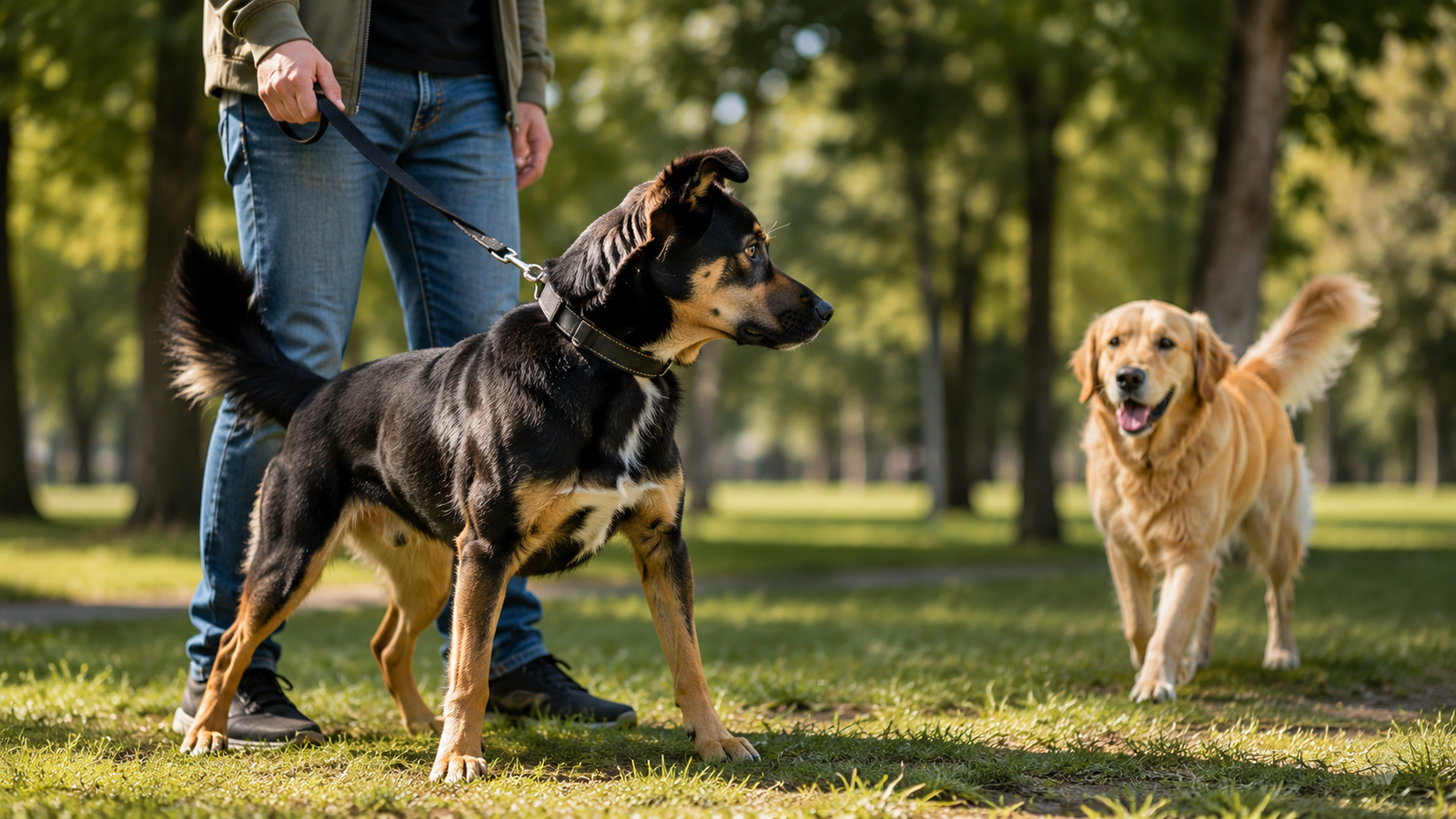
If your dog growls, stiffens, or lunges when another dog or a person comes near you, that is resource guarding, and the resource is you. It is not jealousy and it is not your dog defending you out of loyalty. The safest first step is management: stop the situations that trigger it, keep your dog off your lap and off the furniture for now, and separate the dogs when you cannot supervise. Never punish the growl, because the growl is the warning that stops a bite from happening without one. Any dog that has snapped or bitten, or that guards you from a child, needs in-person professional help.
This one confuses owners more than almost any other behavior problem, partly because it looks flattering. A dog that positions itself between you and the world looks devoted. What is usually happening underneath is closer to worry than to devotion, and the way you respond in the first few weeks decides whether it stays a manageable quirk or turns into a household with a bite risk in it.
What owner guarding actually is
Guarding is an animal protecting something valuable from something it expects to lose that thing to. Dogs guard food bowls, chews, beds, doorways, and people. The mechanism is identical in every case. Nothing about the list changes because the valuable thing happens to be a human being.
Two beliefs get in the way here, and both are worth naming before anything else.
The first is that this is dominance. It is not, and the framing itself causes harm because it pushes owners toward confrontation. The American Veterinary Society of Animal Behavior's 2021 Position Statement on Humane Dog Training specifically addresses myths about dominance, pack hierarchy, and the need to be "alpha," and recommends reward-based methods for all training and behavior modification. The Association of Professional Dog Trainers takes the same position in its own statement on dominance. Current veterinary behavior guidance does not support the alpha model, and neither does this site.
The second is that a guarding dog is a confident dog. Usually it is the opposite. Trainers who work with this behavior describe most owner-guarding dogs as dogs low on confidence that feel safest near one particular person, and defend that safety when it feels crowded. That distinction matters because it changes the fix from "assert yourself" to "make the approach of other dogs and people predict something good."
Protective, or anxious? Reading which one you have
| What you see | What it usually means | What it changes |
|---|---|---|
| Dog moves to sit between you and a visitor, loose body, no vocalizing | Preference for proximity, not guarding | Nothing required; watch it |
| Stiffens or freezes when another dog approaches you | Early guarding | Management now, before it escalates |
| Low growl from your lap, the couch, or the bed | Guarding, context-specific | Remove the context, start the work below |
| Barks, snaps, or lunges at an approaching dog while touching you | Serious guarding | Professional help, and full separation meanwhile |
| Guards you from a child, or has made contact with teeth | Emergency | Stop all training, prevent access, contact a veterinary behaviorist |
The pattern nearly every owner reports is contextual. The dog is fine in the yard and dangerous on the sofa. It is fine on a walk and difficult in the doorway. That is useful news, because a context-specific behavior can be switched off almost entirely by removing the context while you work on the underlying feeling.
The two seconds before the growl: run a context audit
This is the part most pages skip, and it is where the fastest progress lives.
Owner guarding almost never happens at random. It happens in a small number of repeatable setups, and if you write yours down you will usually find three or four. The common ones: the dog is in your lap, the dog is on the couch or the bed next to you, you are holding the dog, the dog is under your chair or between your feet, you are in a doorway or a hallway with the dog beside you, or you are petting the dog when the other dog walks in.
Notice what those have in common. In each one, the dog is in a confined position it cannot leave without pushing past the approaching dog or person. A dog that cannot move away has one remaining option, which is to make the thing that is coming closer stop coming closer. Growling does that job well, which is exactly why it gets repeated.
So before you train anything, list your setups and end them for now. Not forever, and not as a punishment. You are removing the situations where the dog gets to practice, because every successful repetition makes the behavior more automatic.
Move the person, not the dog
Here is the single most useful thing to change about the moment itself.
When a dog guards you and you react by grabbing its collar, scolding it, pushing it off your lap, or scooping it up, you have confirmed the dog's read of the situation: another dog approached, and something unpleasant immediately followed. You have also put your hands next to a mouth that is already aroused. Comforting the growling dog while it is in your arms is not much better, because you are holding the resource in place while the perceived threat gets closer.
The cleaner move is to stand up and walk away, calmly, and let the dog reorganize itself on its own. The resource leaves. Nobody is corrected, nobody is grabbed, and the whole situation dissolves without a confrontation for the dog to learn from. If you need the dogs apart afterward, call the other dog away with a treat or use a baby gate rather than reaching into the space between them.
This is unglamorous and it works. It also keeps your hands out of the one place they should not be.
Management first: what to change this week
Management is not the weak option on a behavior that ends in bites. It comes before training because it removes rehearsal.
Furniture and laps go on hold. If the growling happens on the couch, in bed, or in your arms, those places stop being available for a few weeks. This is not a status lesson. It is removing the confined position that produces the growl.
Feed and rest the dogs separately. Two dogs and one person on a small couch is the classic setup. Use crates, gates, or different rooms at the times of day it happens.
No unsupervised access. If a household has a guarding dog and another dog or a child in it, the two do not share unsupervised space until a professional has assessed the situation.
Have visitors ignore the dog on arrival. No reaching, no leaning over, no eye contact. Let the dog approach or not.
Never let anyone test it. The advice to "provoke it and correct it" is how people get bitten in their own living rooms.
The training half: make approaches predict good things
The goal is simple to state and slow to build. Another dog or person moving toward you should reliably predict that something excellent arrives for your dog.
Start at a distance where your dog notices the other party but stays loose and keeps taking food. If your dog stops eating, you are too close. From that distance, the moment the other dog or person appears, food starts. When they leave, food stops. Nothing is asked of your dog, no cue, no sit. You are changing an association, not testing obedience. Our positive reinforcement dog training guide covers the marking and timing that make this clean.
Work on the floor rather than on furniture, with the dog free to move away, and keep sessions short. Shrink the distance only when your dog looks toward you for the food before it looks at the other dog. That look is the signal the association is forming.
Do not use a prong collar, shock collar, or leash corrections for this. AVSAB's position statement says aversive methods should not be used and notes there is no evidence they outperform reward-based methods. On a fear-driven behavior they carry a particular risk, since a dog that is corrected while another dog approaches has just been given a reason to like that approach even less.
Never punish the growl
A growl is the safety system, not the problem. It is a dog saying, at some cost to itself, that it would rather warn you than escalate.
Punish it consistently and dogs learn the specific lesson you taught, which is that growling brings something bad. What they do not learn is that the underlying feeling was unwarranted. The feeling stays and the warning disappears. What you are left with is a dog that goes from still to bite with nothing in between, and owners in that position genuinely experience the bite as coming from nowhere, because the earlier signals were trained out rather than listened to.
The same logic rules out alpha rolls, holding a dog down, staring it out, and forcing it off furniture in a confrontation. Each confirms the dog's original worry, which is that other individuals coming near its person means something bad for it.
Where a written guide stops
We are dog owners writing from reputable sources, not veterinarians or certified behaviorists, and this is a topic where the honest advice is not a longer article.
A guide can teach you the safety principles, the management, and the shape of the counterconditioning. It cannot see your dog's body language, judge whether the pause before the growl is shortening, or adjust the plan in the moment. Those are the things a professional in the room does.
Get help now, rather than after another incident, if your dog has snapped, lunged, or bitten; if the guarding involves a child or a vulnerable adult; if it is spreading to new people or new rooms; or if it appeared suddenly in a dog that never did it before. That last one goes to your veterinarian first, because pain and illness change how an animal responds to being crowded, and no training plan addresses a medical cause.
Look for a board-certified veterinary behaviorist (DACVB), a Certified Applied Animal Behaviorist (CAAB or ACAAB), or a trainer certified through a body that requires reward-based methods, such as the Certification Council for Professional Dog Trainers (CCPDT) or Karen Pryor Academy (KPA). Ask what they would do if your dog growled during a session. An answer involving correction, dominance, or any device that works through discomfort is your signal to keep looking.
For the wider picture, our hub on common dog behavior problems and their solutions links the whole set together. The food-and-toy version of this behavior is covered in resource guarding food and toys, the household version between two dogs in dog-to-dog aggression in the home, and the stranger-directed version in when a dog growls at strangers.
Frequently asked questions
Is my dog guarding me because he loves me?
Not in the way it looks. Guarding is a dog protecting access to something it values against something it expects to lose it to. Affection is not the driver, and most dogs doing this are anxious rather than confident. The good news is that anxiety responds well to changing what approaching people and dogs predict.
Should I show my dog I am the alpha?
No. AVSAB's 2021 humane training statement addresses dominance and pack-hierarchy myths directly and recommends reward-based methods instead. Confrontation on a guarding behavior tends to escalate it and puts your hands close to a mouth that is already aroused.
My dog only guards me from our other dog, never from people. Is that different?
The mechanism is the same, but management does more of the work, since you cannot explain anything to the second dog. Feed and rest them apart, gate the couch, and do not leave them alone together in situations that have produced a growl. Anything beyond a brief stiff moment is a professional-help situation, not a training project.
Can I fix this myself?
Mild, early guarding often improves a lot with management and consistent counterconditioning. Anything involving snapping, lunging, contact with teeth, or children in the house needs a professional working in person. There is no honest way to tell from here which one you have.
This article is general owner guidance drawn from AVSAB, the APDT, the AKC, the ASPCA, Best Friends Animal Society, and Preventive Vet, verified at the time of writing. It is not veterinary advice and it is not a behavioral diagnosis. Guarding carries a real risk of injury. For any dog that has frozen, growled, snapped, or bitten, please work with your veterinarian and a certified trainer or veterinary behaviorist.