
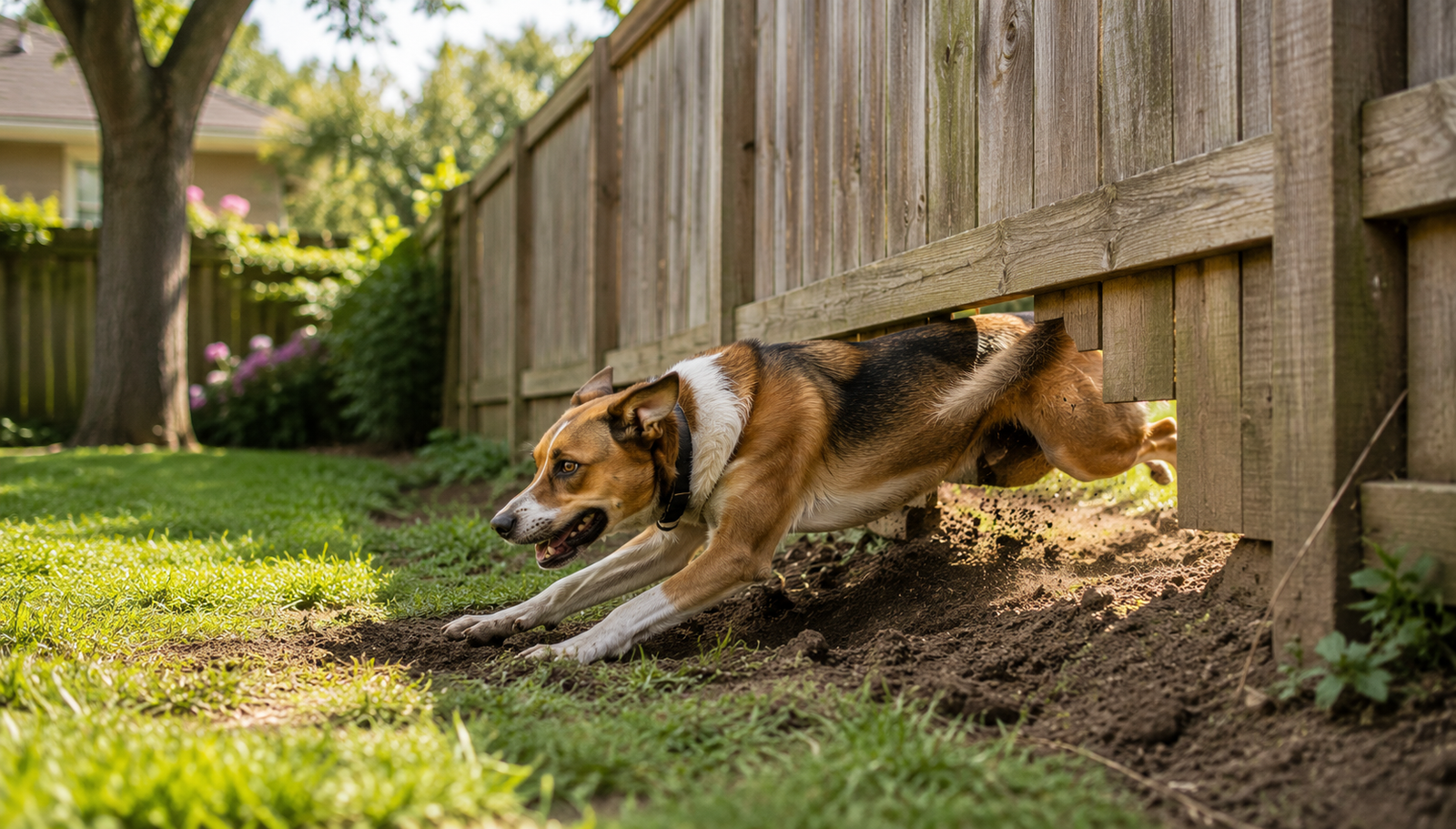
An escaping dog is a safety problem first, so start there: supervise yard time instead of leaving your dog out alone, and check that the microchip details and ID tag are current today. Then work out the motive, because the escape route usually tells you what it is. Dogs get out for boredom and under-exercise, for social contact, because an intact dog is roaming, because prey went past, or because something frightened them. Each of those has a different fix, and a taller fence solves none of them. A dog that panics and escapes is a different problem from a dog that is bored and escapes, and treating them the same is why owners end up rebuilding fences twice.
Escaping is one of the few behavior problems where the consequence is not embarrassment or a chewed sofa. It is traffic, other people's dogs, and a dog nobody can find. That is worth saying plainly at the top without making it dramatic. Most escaping dogs are ordinary dogs with an unmet need and an exit.
Do these two things today
Before any training, two things reduce the actual risk while you work.
Stop unattended yard time. Escape artists work when nobody is watching. Best Friends Animal Society and the AKC both make the same point in their escape guidance: the fix that works from day one is supervision, because a dog cannot rehearse an escape you are standing next to. Yard time becomes something you do with your dog for a while, not somewhere you put your dog.
Update the identification. A collar tag with a current phone number, and a microchip registered to a phone number you still use. Microchips are only as good as the contact details in the registry, and a chip registered to a number from two houses ago finds nobody.
Neither is a solution. Both buy you the time to build one.
The escape route tells you the motive
This is the part most pages leave out, and it saves weeks of guessing. Where and when a dog leaves is diagnostic.
| Where the dog gets out | When it usually happens | Most likely motive |
|---|---|---|
| Digging under the fence line, often the same spot | Middle of the day, alone | Boredom, under-exercise, or something interesting on the other side |
| Digging at the perimeter shortly after you leave | Within the first 30 minutes of being alone | Distress at being left, not mischief |
| Over the fence, from a launch point (bin, woodpile, chair) | Any time, often when something passes | Access to a trigger: dogs, joggers, cats, wildlife |
| Straight through or over during storms or fireworks | Only during noise events, often frantic | Fear, and this one carries injury risk |
| Gate, door, or gap, at speed, whenever it opens | Whenever a human gives an opening | Opportunistic door-dashing, a training issue |
| Wandering, persistent, often long distances | Any time, mostly intact males | Roaming to find a mate |
Read your own evidence before you read anyone's advice. Fresh dirt at one post is a different story from claw marks on the gate, and both are different from a dog that only ever goes during a thunderstorm.
The three motives worth most of your attention
Boredom and unmet needs
This is the common one, and it is the least interesting fix, which is probably why the internet prefers to talk about hardware. A dog with nothing to do in a yard it has already sniffed a thousand times will invent a project, and the fence is the most interesting object out there.
What actually changes it is structured activity before yard time, not more yard time. Real walks where the dog gets to sniff rather than march. A short session of fetch or a sprint if your dog is built for it. Food delivered through work rather than a bowl: scatter feeding in grass, a stuffed frozen toy, a puzzle feeder, a simple find-it game with kibble hidden around the yard while you are out there. Sniffing tires dogs in a way that pacing a fence line does not.
If your dog is also digging, the motive overlap is almost total, and our guide to stopping a dog digging in the yard works through the same causes in more depth.
Distress at being alone
If the digging or the escaping starts within the first half hour after you leave, and especially if it comes with barking, howling, drooling, scratching at doors, or damage focused on exits, you are probably not looking at boredom. That pattern points to distress at being left, and it does not respond to enrichment toys or to more exercise.
That has its own plan, and it starts with not leaving the dog in the situation that produces the panic. See dog separation anxiety: signs and how to help for the distinction between boredom and genuine distress, which is the single most consequential fork in this whole topic.
Fear-driven escapes, and why hardware backfires here
Here is the thing almost nobody says out loud.
A dog that goes over a five-foot fence because it is bored will be slowed down by a six-foot fence. A dog that is trying to escape a thunderstorm or a firework is not making that kind of decision. Panicking dogs climb, scramble, and force gaps they would never attempt calmly, and the injuries that happen at a fence line during a noise event happen because a frightened animal keeps going regardless of what is in the way.
So if your dog only escapes during storms, fireworks, or construction noise, raising the fence is not the intervention. Bringing the dog indoors before the event, giving it an interior space with no windows and some sound cover, and building a real desensitization plan is. Our guide on dogs afraid of thunder and fireworks covers both the in-the-moment part and the longer plan. Severe noise phobia is also worth a veterinary conversation, because it is a welfare problem in its own right and there are medical options a vet can discuss.
The intact-dog conversation, honestly
Roaming to find a mate is a real and well-documented driver, and neutering is the standard advice you will find on nearly every escape page, including the AKC's.
The honest version is that it is a veterinary decision, not a training one. Timing and the decision itself depend on the individual dog, its breed, its age, and its health, and current veterinary guidance on timing is not one-size-fits-all. If your dog is intact and roaming, that is a conversation to have with your veterinarian, who can weigh it properly for your dog. Be aware, too, that neutering reduces roaming driven by mating but does nothing for the dog that is leaving because it is bored, and a dog with an established escape habit may keep the habit after the hormonal driver is gone.
Training that actually earns its place
Two skills are worth building for this specific problem.
A recall that works outdoors. Not a recall that works in the kitchen. Build it on a long line, in the yard, paying well every single time for weeks before you rely on it. The most common way a recall gets broken is being used to end fun, so call your dog, pay, and release it back to what it was doing most of the time.
A door and gate routine. For the dog that bolts through openings, teach a station: a mat or a spot several feet back from the door where standing still is what gets paid, practiced when nobody is arriving. Door-dashing is a rehearsed habit, and habits are replaced rather than forbidden. Our positive reinforcement dog training guide covers the mechanics.
Skip the electronic containment systems. AVSAB's 2021 Position Statement on Humane Dog Training says aversive tools, naming electronic collars among them, should not be used, and notes there is no evidence they outperform reward-based methods. There is also a practical problem specific to this topic: a boundary that works by discomfort does not keep anything out, and a sufficiently motivated dog will take the correction going out and then refuse to cross back in.
What a yard cannot fix
An honest limit, because this article is not going to end with "and then the problem is solved."
Some dogs are built to travel. Sighthounds, scent hounds, and several working breeds were selected for exactly the behavior you are trying to stop, and enrichment and training make them safe and manageable rather than uninterested. For those dogs the realistic answer is a permanent management layer: supervised yard time for life, a long line in unfenced spaces, and no reliance on a recall in the presence of a running rabbit. That is not failure. It is knowing the animal you have.
The same goes for chasing. If your dog leaves the yard specifically to chase cars, bikes, or joggers, treat that as its own hazard, covered in how to stop a dog chasing cars, bikes, or joggers.
When to get help
Talk to your veterinarian first if the escaping started suddenly in a dog that never did it, if it comes with other changes such as restlessness, disorientation, or new anxiety, or if your dog injures itself during escape attempts. Sudden behavior change in an adult dog is a medical question before it is a training one.
Bring in a certified trainer or a veterinary behaviorist if the escapes are driven by panic, if your dog has been injured or nearly hit by a vehicle, or if you have worked consistently for weeks without change. Look for a board-certified veterinary behaviorist (DACVB), a Certified Applied Animal Behaviorist, or a trainer certified by a reward-based body such as the CCPDT or Karen Pryor Academy.
For the wider set of everyday problems, our hub on common dog behavior problems and their solutions links them together.
Frequently asked questions
How high does a fence need to be to stop a dog jumping?
There is no single number that holds for every dog, and height is the wrong variable to optimize first. A motivated athletic dog clears more than most people expect, and a panicking dog will try regardless. Removing launch points, supervising yard time, and fixing the motive changes more than height does. For the structural side of a yard, a fencing professional is the right person to ask.
My dog only escapes when I am not home. Is that boredom or anxiety?
Timing separates them. Damage or escape attempts concentrated in the first half hour after you leave, with vocalizing and exit-focused effort, point toward distress. Escapes that happen later, in a relaxed dog that just found something to do, point toward boredom. The two need different plans, so it is worth watching before you choose.
Will neutering stop my dog escaping?
It can reduce escaping that is driven by roaming to find a mate, which is why it appears on nearly every escape guide. It does nothing for boredom, fear, or prey drive, and an established habit can outlast the hormones. Whether and when to neuter is a decision for your veterinarian, who can weigh your individual dog.
Are invisible fences or shock collars a reasonable option here?
AVSAB's humane training position statement says aversive methods including electronic collars should not be used, and reports no evidence that they work better than reward-based training. For containment specifically, they also do not stop anything entering your yard, and a determined dog can take the correction on the way out and then be unwilling to come back in.
This article is general owner guidance drawn from the AKC, Best Friends Animal Society, AVSAB, and Preventive Vet, verified at the time of writing. It is not veterinary advice. Decisions about neutering, sedation, or medication for noise phobia belong with your veterinarian. This guide covers your dog's behavior, not the design or construction of fencing.