
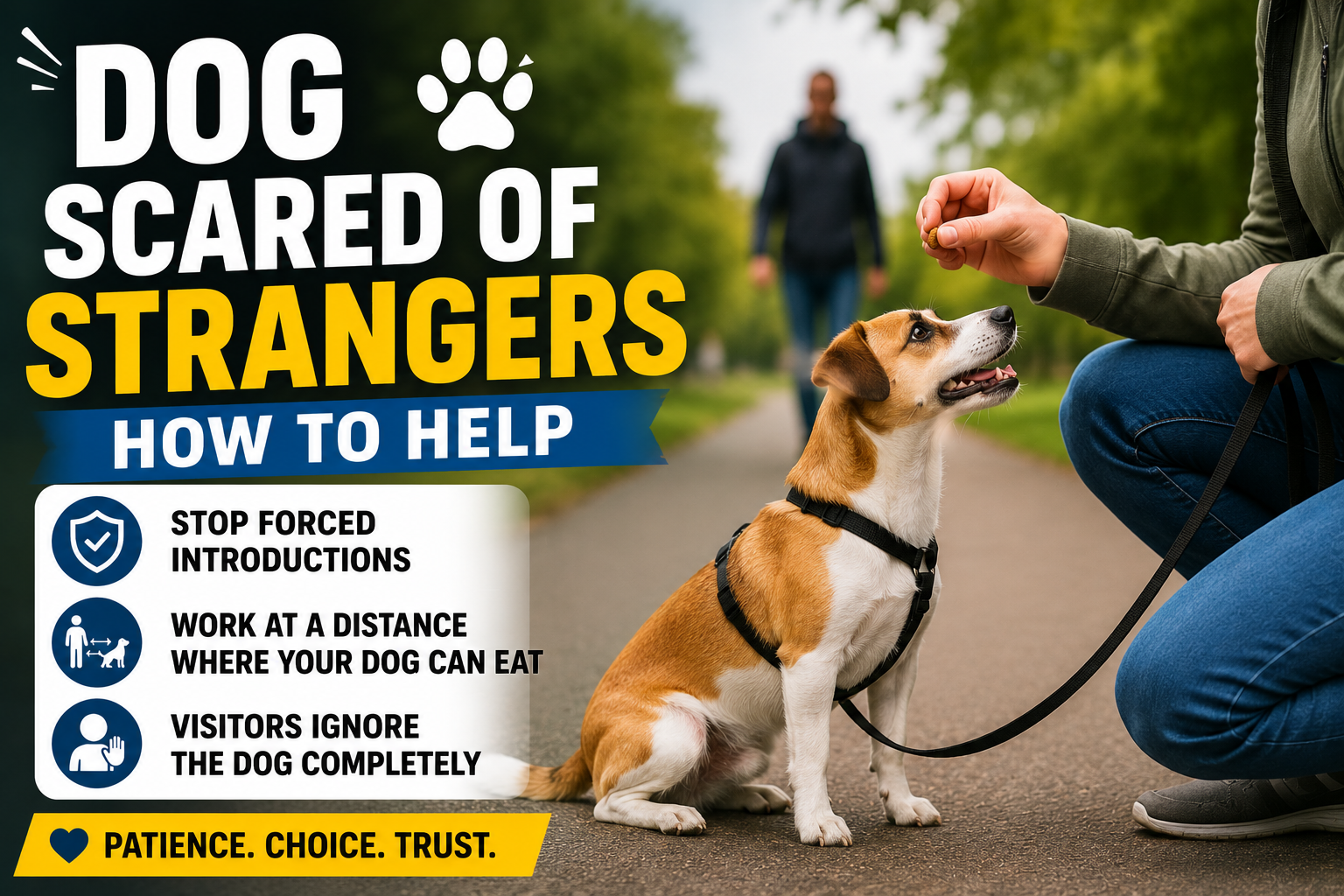
The fastest way to help a dog that is scared of strangers is to stop introducing it to strangers. Fear does not fade through exposure the dog cannot handle, and pushing an uncomfortable dog into greetings is how frightened dogs end up biting. Instead, work at a distance where your dog can notice a person and still eat, and pay generously the whole time that person is visible. Visitors should ignore the dog completely: no eye contact, no reaching, no calling it over. Let the dog approach or not, and let it leave whenever it wants. If your dog has growled, snapped, lunged, or bitten at a person, that is a different situation and needs a professional in the room, not a plan from a screen.
Fear of unfamiliar people is common, and it is not a character flaw in your dog or a sign you did something wrong. Some dogs missed early socialization, some had a bad experience, some are genetically cautious, and plenty of dogs are simply more suspicious as adults than they were as puppies. What matters is what happens next, because the way most people instinctively help makes it worse.
Fear or aggression? They need different pages
Two dogs can both be frightened of visitors and need different handling.
A fear-and-avoidance dog moves away. It hides behind furniture or your legs, goes still, turns its head away, licks its lips, yawns when nothing is boring, shows the whites of its eyes, tucks its tail, and would rather be somewhere else. This article is for that dog.
A dog whose fear has become defensive moves forward. It barks, growls, lunges, or snaps to make the person go away, and it may do that from behind you or from the end of a leash. That version is covered in what to do when a dog growls at strangers, and it carries a real bite risk that changes the priorities.
The two are the same emotion with different strategies, and dogs can switch between them, usually when the avoidance option has been taken away. Which is the single most important reason to leave your dog an exit at all times.
The treat-lure trap
Here is the mistake, and it appears on a lot of well-meaning pages about fearful dogs.
The advice is to have the stranger hold out a treat, or to toss treats halfway between the person and the dog, so the dog comes over. It works in the sense that the dog moves closer. It also creates a specific and dangerous situation: a dog that badly wants the food and badly wants to avoid the person now has both motivations pulling at once. It gets drawn in past its comfort distance by the food, and then arrives beside a person it did not choose to be near.
The dogs that bite in this scenario are often described afterwards as having bitten "for no reason, when they were being friendly." What happened is that the food overrode the distance the dog needed, and when the food ran out, the dog was suddenly too close with no way out.
Do it the other way around. Treats come from you, not from the stranger. Throw them away from the person, so eating moves your dog to a comfortable distance rather than into a person's space. The person stays boring and pays nothing, and the dog gets to make its own decisions about how close is close enough. Once a dog genuinely chooses to approach, a stranger can drop food on the floor without reaching, but that comes much later and only from the dog's initiative.
The plan, in order
1. Manage first, so nothing gets rehearsed
Every frightening encounter your dog cannot cope with sets progress back. Management is what protects the work you are doing.
Walk at quiet times and in quiet places for a while. Cross the road rather than pass someone on a narrow sidewalk. Put your dog behind a gate or in a quiet room with something to chew before visitors arrive, so the dog is not part of the door scene at all. Tell people in advance, and be blunt about it: do not greet my dog, do not offer your hand, do not look at him. Most people will comply if you say it first and say it clearly.
2. Work at a distance where your dog can still eat
This is the working definition of "far enough away." If your dog will not take food it usually loves, the person is too close, and nothing useful is being learned at that distance.
Find a spot where people pass at a distance your dog can notice without reacting. A park bench well back from a path is ideal. When a person comes into view, start feeding, one treat after another. When the person disappears, stop completely and say nothing.
You are not asking for sits or eye contact. You are building one association: unfamiliar person means good things from my human. Over sessions, the sign that it is working is your dog looking to you when it spots a person, instead of staring or freezing. That look is what tells you when you can reduce the distance, and only by a little.
Our positive reinforcement dog training guide covers the timing and marking that make this clean. The same distance-and-reward structure is used on walks in our guide to leash reactivity.
3. Set up visitors properly
The house version has its own choreography.
The visitor comes in and ignores the dog completely, sits down, and talks to you. No eye contact, no leaning down, no "let him sniff my hand," no reaching over the head. Battersea and the AKC both describe the same core idea in their guidance on stranger fear: let the dog approach in its own time and reward calm rather than staging an introduction.
Your dog is loose, with an easy route out of the room and somewhere it likes to go. You pay it for any calm, and you pay it for choosing to leave as well as for choosing to come closer. Leaving is a good decision, not a failure.
If your dog does approach and sniff, that is not permission to touch. Use the consent test that force-free trainers use: pet for about three seconds, stop, and take your hands back. A dog that wants more will push in or nudge for it. A dog that stays still, moves away, or looks away has answered, and the answer is no. It is worth teaching every visitor this in one sentence, because it prevents more bites than anything else on this page.
4. Build confidence away from the fear
Fearful dogs benefit from things unrelated to strangers: predictable routines, sniffing walks, food delivered through work rather than a bowl, simple trick training, and a place in the house nobody disturbs. A dog with more autonomy and more successful problem-solving generally copes better when something worrying happens.
What not to do
Do not flood. Taking a frightened dog to a busy market to "get used to it" is the classic mistake. Exposure at an intensity the dog cannot handle tends to deepen fear rather than reduce it.
Do not punish the growl, the bark, or the retreat. A growl is a warning, and a warning that gets punished is a warning that disappears while the fear stays. That produces a dog that goes straight to teeth with nothing in between, which is far more dangerous for everyone.
Do not use aversive tools. AVSAB's 2021 Position Statement on Humane Dog Training says aversive methods including electronic collars, prong collars, choke chains and leash corrections should not be used, notes that there is no evidence they outperform reward-based training, and warns that punishment-based methods can increase fear, anxiety and aggression. On a fear case specifically, a correction delivered while a stranger approaches gives the dog a reason to feel worse about strangers.
Do not drag your dog toward a person, ever, on leash or by the collar. Removing the escape option is what turns avoidance into defense.
Do not let people insist. "Dogs love me" is not a qualification. You are allowed to say no on your dog's behalf.
Do not worry that comforting your dog reinforces fear. You cannot reinforce an emotion with kindness. If your dog seeks you out when it is scared, let it, and stay calm.
Honest expectations
This is the section most pages skip, and it matters.
A dog with significant stranger fear usually does not become a dog that loves strangers. What is realistic is a dog that can be around unfamiliar people without panic, that can walk past someone on a path, that can be in the room while you have visitors, and that recovers quickly afterwards. That is a good life, and it is a very different life from where these dogs often start.
Progress is not linear either. Fearful dogs have bad weeks, and a single frightening encounter can undo visible progress for a while. That is normal and it does not mean the work failed.
Also, some of the fix is permanent management. Some dogs will always need a quiet room when the house is full, and using it is good handling, not giving up.
When to get professional help
Get in-person help now if your dog has growled, snapped, lunged, or bitten at a person; if children are involved; if your dog cannot recover for hours after an encounter; if the fear is generalizing to more people and more places; or if the fear appeared suddenly in a dog that was previously relaxed. Sudden change goes to your veterinarian first, because pain and illness change how a dog tolerates being approached.
Ask for a board-certified veterinary behaviorist (DACVB), a Certified Applied Animal Behaviorist (CAAB or ACAAB), or a trainer certified through a reward-based body such as the Certification Council for Professional Dog Trainers (CCPDT) or Karen Pryor Academy (KPA). Ask what they would do if your dog growled during a session. Any answer involving correction, dominance, or a device that works through discomfort is your signal to keep looking. A veterinary behaviorist can also discuss whether anti-anxiety medication is appropriate, which for severely fearful dogs can be what makes the training possible at all.
For the wider picture, our hub on common dog behavior problems and their solutions links the whole set together.
Frequently asked questions
Should I ask strangers to give my dog treats?
Not at first. Food from a stranger's hand pulls a frightened dog closer than it wants to be, and the bite risk is highest at the moment it arrives and realizes it is too close. Treats should come from you, thrown away from the person, so eating moves your dog to a comfortable distance. Later, once a dog approaches by choice, a visitor can drop food on the floor without reaching.
Will my dog grow out of being afraid of strangers?
Adolescent dogs often go through wary phases and some do settle. Established adult fear generally does not fade on its own, and it can deepen if the dog keeps having encounters it cannot cope with. Working at a comfortable distance is what changes it.
My dog is fine outside but terrified of visitors at home. Why?
Indoors your dog cannot leave, the person is inside its resting space, and the encounter lasts hours rather than seconds. Give the dog somewhere else to be, with a gate and something to chew, and let it opt in rather than being present by default.
Is it too late to socialize an adult dog?
The early socialization window is a puppy thing and it does not reopen, but adult dogs change their associations all the time. The goal shifts from "meets everyone happily" to "feels safe and can cope," which is achievable at any age with distance, food, and patience.
This article is general owner guidance drawn from AVSAB, the AKC, Battersea, the ASPCA, and Preventive Vet, verified at the time of writing. It is not veterinary advice and it is not a behavioral diagnosis. Fear-based behavior can escalate to biting. For any dog that has growled, snapped, or bitten at a person, please work with your veterinarian and a certified trainer or veterinary behaviorist.