
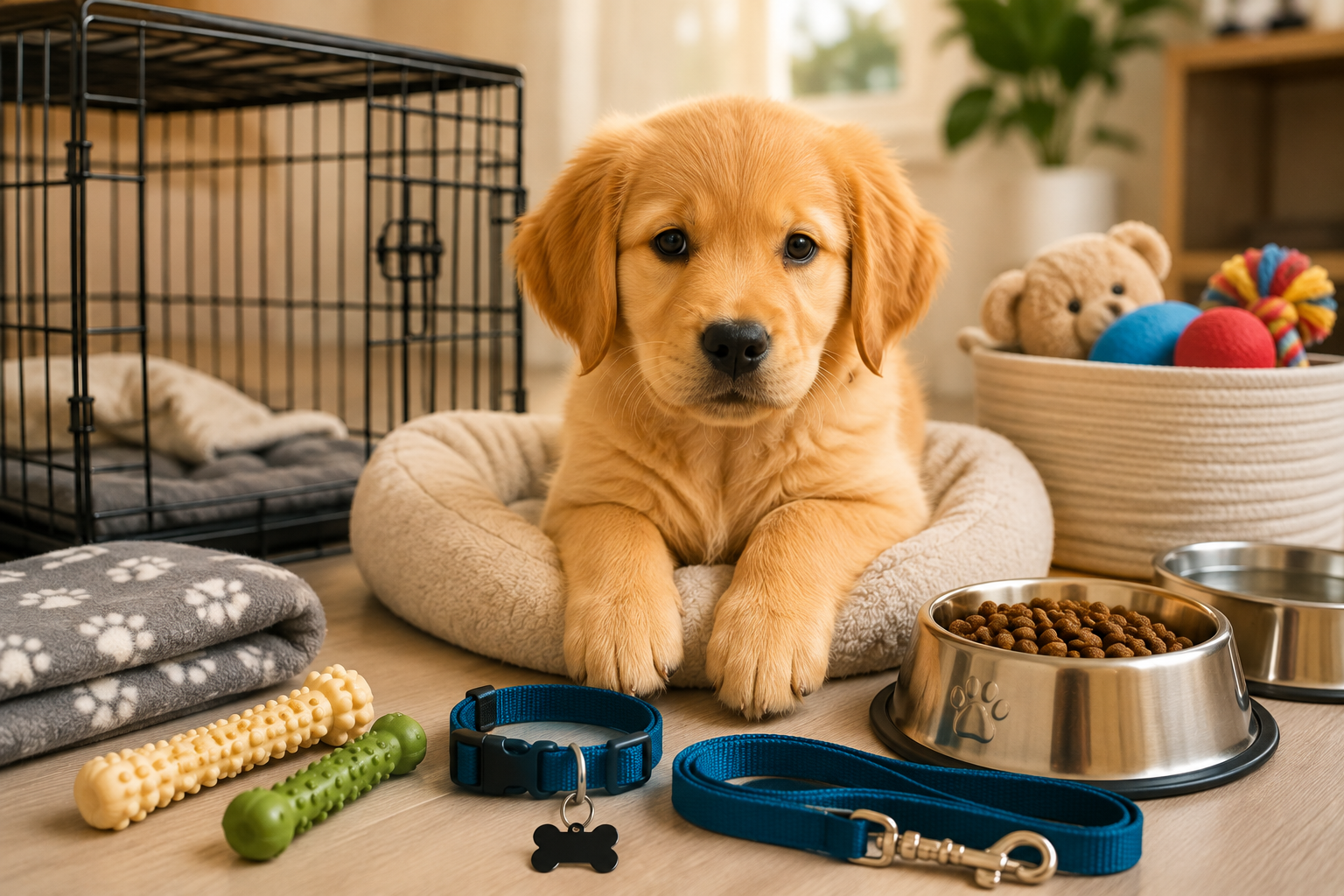
No brands are named on this page and nothing is recommended for purchase. What follows is what a puppy needs in its first week, what can wait, and where each thing should go, because placement causes more first-week problems than equipment does.
If you want the behavioral side of the same period, what to expect day by day and why week three often goes backwards, that is a separate guide: the new puppy first week. This one is the physical setup that guide assumes you already have.
The Short List: What You Actually Need on Day One
Seven things. Everything else can be bought later, once you know the specific dog.
A crate or a pen, or a puppy-proofed room. One confined, safe space. This is the single most useful item and the one worth getting right.
Food, the same food the puppy is already eating. Whoever you got the puppy from is feeding it something. Get that, in the same form, for at least the first two weeks. A house move, a new family and a diet change all at once is how you get an upset stomach in week one, and an upset stomach during house-training sets everything back.
Two bowls, one for food and one for water, heavy enough or wide enough not to tip.
A flat collar and a lead. A plain flat collar and a plain lead. Everything else, including harnesses and any training equipment, is a decision to make once you have met the dog walking.
An ID tag, and whatever identification is legally required where you live. Requirements vary by country, so check yours rather than assuming.
Bedding you do not mind losing. Something washable and cheap. First-week bedding gets chewed, soiled or both, and replacing an expensive bed in week two is a common and avoidable annoyance.
Two or three chew items of different textures. Not a basket of toys. Two or three, so you can see what this particular puppy actually likes before buying more.
What Can Wait, and Why It Is Better That It Does
A harness. Fit depends on the dog's shape, and a puppy's shape changes quickly. Buying before the dog arrives usually means buying twice.
Grooming equipment beyond a basic brush. Coat type determines what you need, and you can see the coat properly once the dog is home and settled.
A large collection of toys. Puppies show clear preferences within a week or two. Buying a lot up front mostly produces a pile of ignored objects.
Training equipment of any kind. Whatever you might eventually want depends on the individual dog. There is no equipment a puppy needs in week one that is not on the list above.
A bigger crate for later. Buy it later. See the sizing section, which is the reason.
Crate Sizing, Which Is the One Specification That Matters
A crate should be big enough for the puppy to stand up without ducking, turn around comfortably, and lie down fully stretched out. Not bigger.
That last part surprises people, and it is the part that matters for house-training. Dogs are reluctant to soil where they sleep, and that instinct is what makes crate training work. Give a puppy a crate with room to spare and it will simply use one end as a bed and the other end as a toilet, which teaches exactly the opposite of what you wanted and is very hard to undo.
The practical approach is either a crate sized to the puppy now, or an adult-sized crate with a divider panel that you move as the dog grows. A divider costs less than two crates and solves the problem cleanly.
How to introduce the crate so the dog wants to be in it, rather than tolerating it, is a whole subject on its own and it is covered in how to crate train a puppy.
Where Things Go, Which Matters More Than What You Bought
Most first-week setup problems are placement problems.
Keep the three zones apart. Sleeping, eating and toileting should be in three different places, as far apart as the space allows. Put a food bowl next to a crate and you have made the sleeping area a busy area. Put the toilet spot near either and you are working against the instinct that makes house-training possible.
Put the crate where the family is, at least at first. A crate in a spare room at the end of the hall produces a puppy that cries all night, because being alone is the thing it is least equipped to handle. Start it in a room where someone is, and move it gradually if you want it somewhere else eventually.
Decide the toilet spot before the puppy arrives and use only that spot. Consistency of location does more for house-training speed than anything else, and randomly chosen spots in the first week teach the dog that anywhere outside is equally fine, which is a harder position to correct later.
Puppy-proof at floor level, on your knees. Get down to the height the puppy actually lives at and look along the floor. Cables, shoes, low houseplants, anything small enough to swallow, and gaps behind furniture that a small dog can get into and not out of. This looks silly and it finds things that standing up does not.
Use gates rather than closed doors where you can. A gate confines the puppy while letting it see and hear you, which is much easier on a dog that has just left its litter than a solid closed door.
Two Things Worth Sorting Before Day One
Register with a vet, and know where the nearest emergency service is and when it operates. Do this before you need it rather than during. Vaccination timing, parasite treatment and neutering are all veterinary decisions specific to your dog and your area, so they belong in that first conversation rather than on a checklist from the internet.
Agree the house rules with everyone in the house, in advance. Whether the dog is allowed on the sofa, who feeds it, what the word is when it does something right. A puppy getting different answers from different people learns nothing, and this is by far the most common reason a well-equipped household still has a confused dog in week three. The approach the rest of this site is built on is set out in positive reinforcement dog training.
What Nobody Tells You to Buy, and Should
Cleaning supplies, more than you think. Accidents in week one are certain, not possible. An enzymatic cleaner made for pet accidents is worth having before you need it, because ordinary household cleaner can leave scent traces that mark the spot as a toilet in the dog's judgment even when it smells clean to you.
A spare set of everything washable. One bed cover in the wash and no second one is the situation you want to avoid at eleven at night.
The Behaviors That Start in Week One
Two things begin immediately whether you plan for them or not, and both are easier if the setup above is already in place.
Mouthing starts on day one. It is normal, it is not aggression, and how you respond in week one shapes it. How to stop puppy biting is the guide, and it is worth reading before the puppy arrives rather than after the first sore hand.
Being alone has to be taught deliberately. A puppy that is never alone in the first weeks does not learn that being alone is survivable, and that is the root of a great deal of later trouble. What that trouble looks like is in dog separation anxiety, and starting short, calm absences early is much easier than treating it later.
Chewing is coming. Furniture is at risk from roughly the point teething starts, and having appropriate chew items already established makes the redirection far easier. How to stop a dog chewing furniture covers it.
The Short Version
- Seven things on day one: confinement space, the same food, two bowls, flat collar and lead, ID, cheap washable bedding, two or three chews.
- A crate should be just big enough to stand, turn and stretch out. Bigger breaks house-training.
- Separate sleeping, eating and toileting by as much distance as the space allows.
- Put the crate where people are for the first weeks.
- Buy the harness, the grooming kit and the toy collection later, once you have met the actual dog.
- Agree the house rules with everyone before the puppy arrives. Inconsistency teaches nothing.