
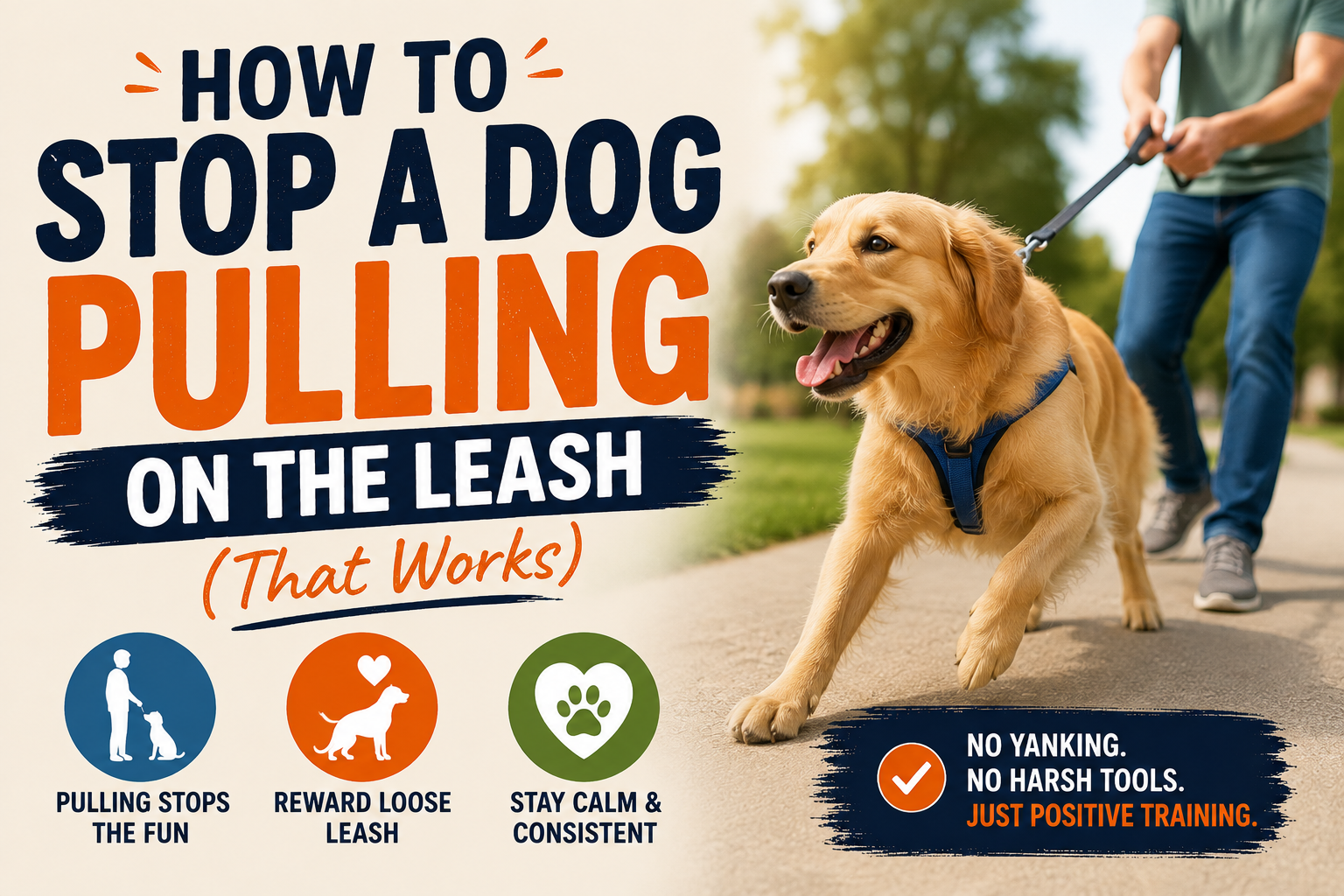
Dogs pull because pulling works: it gets them to the interesting thing faster. To stop it, make pulling never pay off. The moment the leash goes tight, stop walking or turn away, and only move forward again when the leash is loose. Reward your dog for walking near your side with small treats and with "life rewards" like a chance to sniff. Start somewhere quiet, keep sessions short, and stay consistent on every walk. A front-clip harness can make pulling harder, but the training is what teaches your dog to walk on a loose leash.
That is the whole method in a paragraph. The rest of this guide explains why it works, how to run it step by step, and the honest parts that most articles skip.
Why your dog pulls in the first place
Two simple things are working against you, and neither one is your dog being stubborn.
First, dogs walk faster than we do. Their natural pace is a trot, so a loose, dawdling human walk feels frustratingly slow to them. Leaning into the harness is just a dog trying to move at a comfortable speed.
Second, the outside world is thrilling. Every walk is a stream of smells, other dogs, squirrels, and people, and your dog wants to get to all of it. When pulling makes the exciting thing arrive faster, pulling gets rewarded. Do that a few hundred times and you have a committed puller.
So the fix is not about dominance or "showing them who is boss." It is about changing the math: pulling has to stop working, and staying near you has to start paying off.
Pick ONE method and stay consistent (this is where most people fail)
Here is the honest reason so many owners never fix leash pulling: they mix methods. One day they stop and wait, the next day they yank the leash back, the day after they just let the dog drag them because they are in a hurry. From the dog's point of view, pulling works sometimes. And a behavior that works sometimes is the hardest kind to get rid of, because the dog keeps trying, hoping this is one of the times it pays off.
So before anything else, choose one of the two methods below and commit to running it the same way on every single walk for a couple of weeks. Both are force-free and both are used by mainstream trainers and humane organizations. Neither is magic on its own. Consistency is the magic.
Method A: Stop-and-reward (be a tree)
This is the method the American Kennel Club and Best Friends Animal Society both describe, and it is the simplest to run.
- Start walking. The instant the leash pulls tight, stop moving completely. Do not tug, do not scold. Just stand still and become boring, like a tree.
- Wait. Your dog will eventually ease the tension, look back, or step toward you. The moment the leash goes slack, say "yes" or "good," give a small treat at your side, and start walking again.
- Repeat. Every tight leash means the walk pauses. Every loose leash means the walk continues and good things happen near you.
The rule your dog learns is short and clear: if you pull, we do not move. Best Friends Animal Society notes that consistency matters here more than anything. If you stop four times out of five and let the fifth pull slide, your dog learns that pulling still works if they keep at it.
Method B: The direction change (turn and go)
Some dogs plant and wait you out, and some owners find standing still too slow. The turn-around technique keeps things moving while still making pulling pointless.
- Walk forward. When your dog surges ahead and the leash tightens, calmly turn and walk the other way.
- Your dog now has to catch up and fall back into position beside you.
- The moment they are near your side with a loose leash, reward them and carry on.
The lesson is the same as Method A, delivered a little differently: pulling ahead never gets you to where you wanted to go. It sends you backward instead. Keep your turns calm and predictable, not a hard jerk on the neck.
Pick A or B. You can retire whichever one you did not choose later, but for the first couple of weeks, run one method cleanly so your dog gets a clear, consistent signal.
Reward at your side, and use "life rewards" too
Treats matter, but where you deliver them matters just as much. Always hand the treat at your side, near your leg, in the exact spot you want your dog to walk. If you reward out in front of you, you are literally paying your dog to be in front of you. Reward at your hip and you are paying them to be at your hip.
Use small, soft, high-value treats your dog does not get any other time. A treat they find genuinely exciting will make them check in with you far more often than a plain biscuit.
Then use what trainers call "life rewards." The outside world is the thing your dog wants most, so put it on your side of the deal. When the leash is loose and your dog is walking politely, say "go sniff" and let them go investigate that fascinating patch of grass. Now sniffing becomes something a loose leash earns, instead of something pulling drags them toward.
Set up for success: quiet start, short sessions, drain the energy first
You cannot teach a brand-new skill in the most distracting place on earth. Set the conditions up so your dog can actually think.
- Start somewhere quiet. Your backyard, driveway, or an empty stretch of sidewalk. Save the busy park for weeks down the line.
- Drain some energy first. A short play session in the yard before you head out means you are working with a calmer dog instead of a wired one. A tired dog can focus; a bursting-with-energy dog cannot.
- Keep sessions short. Five to ten focused minutes beats a frustrated hour. End while it is still going well.
- Slow down your own pace. Give your dog a beat to sniff and check in. A walk that is only about covering distance invites pulling.
Gear: what a harness can and cannot do
This is the section most articles rush past, so read it carefully. Equipment can make your job easier. Equipment cannot train your dog for you.
Front-clip harness. The leash attaches at the center of the chest instead of on the back. When your dog pulls, their momentum turns them gently back toward you rather than letting them drive forward with their full body weight. The AKC lists a front-clip harness as a helpful training aid. It makes pulling less effective and buys you those loose-leash moments to reward, but it is a management tool, not a lesson.
Head halter. This loops over the muzzle and gives you gentle control of the head, which many strong pullers respond to. The AKC also lists it as an option. Most dogs need a slow, treat-paired introduction before they accept one, so do not just strap it on and go.
A flat collar and a standard fixed-length leash (around six feet) round out the basic kit the AKC recommends.
What to skip: choke chains and prong collars. These work by causing discomfort or pain when the dog pulls, and mainstream humane and training organizations, including humane societies and force-free trainers, advise against them. They can suppress pulling in the moment without teaching your dog what to do instead, and they carry a real risk of injury and of making a nervous dog more anxious on walks. This site sticks to force-free methods for a reason: they teach the behavior you actually want, and they do not put your relationship or your dog's neck at risk. Skip retractable leashes for training too, since a line that constantly gives and retracts teaches your dog that pulling extends their range.
The honest bottom line on gear: the right harness can turn down the difficulty, but the training in the sections above is what changes your dog's habit.
Troubleshooting the strong, established puller
If your dog has been pulling for years, none of this changes overnight, and that is normal. An established habit takes longer to undo than a fresh one, because your dog has a long history of pulling paying off. Expect slow, uneven progress rather than a switch flipping.
A few adjustments help with committed pullers:
- Lower the difficulty further. If your dog cannot manage the sidewalk, go back to the driveway. Win there first, then add distraction.
- Raise the value of your treats. For a determined puller, plain kibble will not compete with a squirrel. Bring the good stuff.
- Add a front-clip harness or head halter to manage the pulling while the training catches up. This is exactly what management gear is for.
- Reward more often at first. Early on, pay for every few steps of a loose leash. Thin the treats out slowly as your dog gets steadier.
If your dog does not just pull but lunges, barks, or panics at other dogs or people, that is reactivity, not ordinary pulling, and it needs a different approach. A certified force-free trainer or a veterinary behaviorist can help you build a plan. Working through separation and anxiety-related behavior often overlaps here; our guide on helping a dog with separation anxiety covers the calm, gradual approach these dogs need.
The part nobody selling you a harness will tell you
There is no instant fix for leash pulling. Any product or trick that promises to stop pulling in one walk is either relying on discomfort to suppress the behavior, or it is overselling.
Here is the honest summary:
- Gear helps, gear does not train. A no-pull harness makes pulling harder in the moment. It does not teach your dog what to do instead. The day you switch back to a flat collar, the untrained habit is still there.
- Consistency across every walk is the real work. Not the equipment, not the treats, not the specific method. The dogs who learn loose-leash walking are the ones whose owners applied the same rule on every walk until it became a habit.
- Progress is measured in weeks, not minutes. Especially with an established puller. If you expect a slow build, you will stick with it long enough to succeed. If you expect a miracle, you will quit in three days and blame the method.
That is not the exciting answer, but it is the true one, and it is the reason the owners who follow it actually end up with a dog who walks nicely.
FAQ
How long does it take to stop a dog from pulling on the leash?
It depends on how long your dog has been pulling and how consistent you are. A young puppy with no strong habit can improve within a couple of weeks of daily short sessions. A dog who has pulled for years may take several weeks to a few months of consistent practice. The single biggest factor is whether you apply the same rule on every walk.
Do I need a special harness to stop leash pulling?
No, but the right one helps. A front-clip harness or a head halter makes pulling less effective and gives you more loose-leash moments to reward, which the AKC lists as helpful training aids. They manage the pulling while you do the training. They do not replace the training, and you do not need to spend a lot to get a functional one.
Are prong or choke collars a faster way to stop pulling?
They can suppress pulling in the moment, but mainstream humane and force-free training organizations advise against them because they work through discomfort or pain, risk injury, and do not teach your dog what to do instead. Force-free methods take a little longer and teach the behavior you actually want, which is why this site recommends them.
Can I use these methods on a puppy?
Yes, and starting young is easier because there is no long habit to undo. The same stop-and-reward and turn-around methods work. Keep puppy sessions especially short and upbeat. If you are also working through other puppy stages, see our guides on how to stop puppy biting and how to crate train a puppy.
My dog still pulls even when I stop walking. What am I doing wrong?
Usually one of three things: your treats are not exciting enough to compete with the environment, you are practicing somewhere too distracting, or you have been inconsistent and your dog still expects pulling to work sometimes. Drop to an easier location, upgrade your treats, and commit to stopping every single time the leash goes tight.