
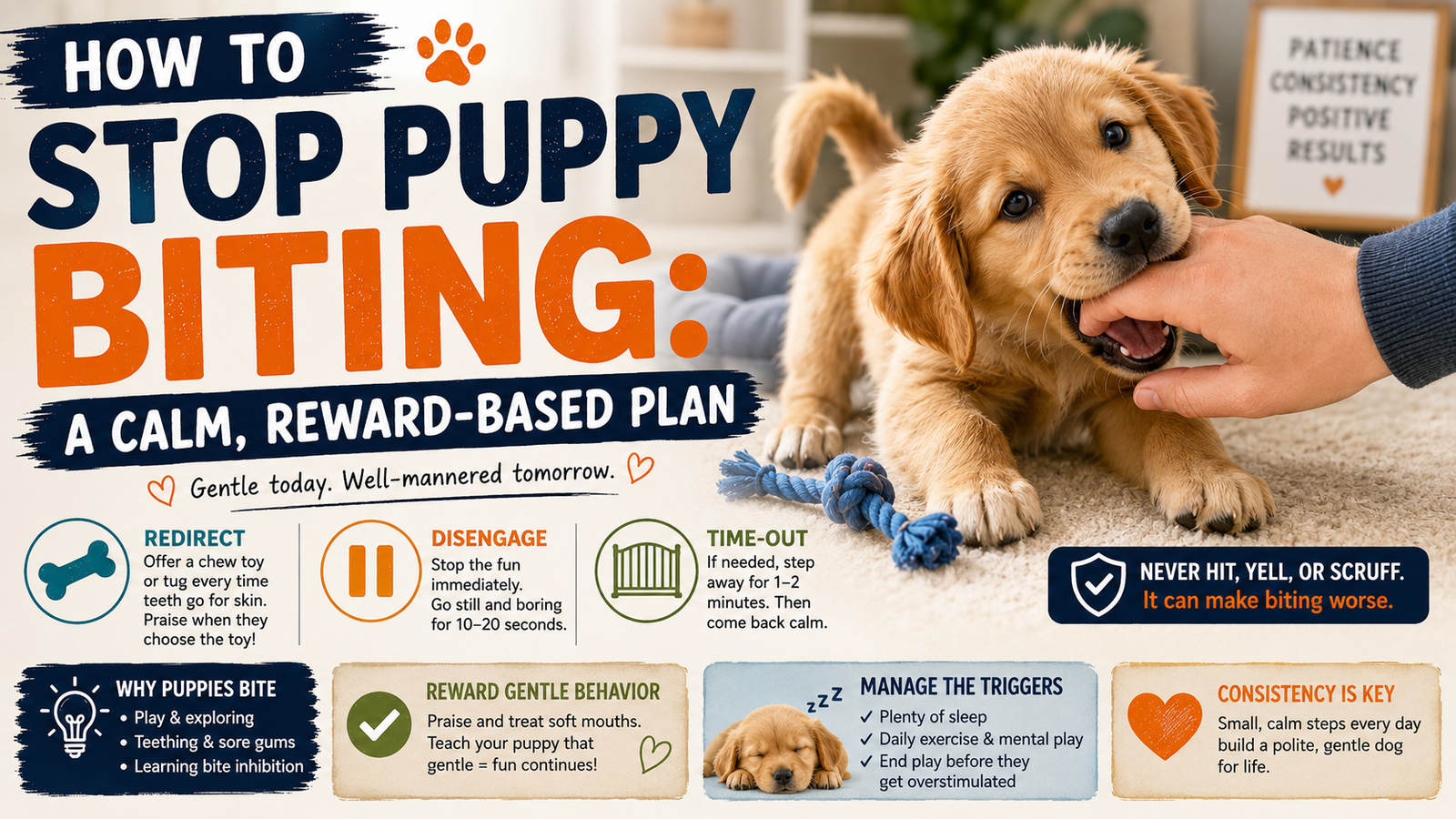
Puppies bite because that is how they play, explore, and get through teething. It is normal, and it is temporary. To stop it, redirect the mouth onto a chew toy every single time teeth reach for skin, calmly end the fun the instant a bite lands hard, and reward your puppy for a soft, gentle mouth. Never hit, pin, yell at, or scruff-shake your puppy, because the ASPCA warns that this can make biting worse. Most puppies grow out of it within a few weeks of consistent practice, and the hard biting is usually gone by around 15 weeks of age.
That is the whole method in one paragraph. The rest of this guide explains the reasoning, gives you a simple order to follow in the moment, and is honest about the parts other guides skip: why the popular "yelp" trick backfires for some puppies, and how to tell ordinary puppy mouthing apart from the rare biting that needs a professional.
First, what to do when teeth are on your hand right now
Most guides hand you a pile of techniques and leave you to guess which one to reach for while a puppy is gnawing your wrist. Here is a clear order. Work down the list, and only move to the next step if the one before it did not work.
- Redirect. Calmly move a chew toy or a tug rope into your puppy's mouth in place of your hand. Let them bite the toy as much as they like, and praise them for it. This is the single most useful response, because it tells your puppy what teeth are for instead of only what they are not for.
- Disengage. If your puppy keeps coming back to skin, stop the fun. Stand up, fold your arms, and go still and boring for ten to twenty seconds. You are not punishing. You are showing that hands-in-mouth ends the game.
- Time-out, done gently. If your puppy is too wound up to settle, quietly step behind a baby gate or leave the room for a minute or two, then come back and try again. The American Kennel Club notes that time-outs work best when a puppy is overtired or overstimulated, which is exactly when the sharpest nipping tends to happen.
Redirect first, disengage second, time-out last. That order handles almost every mouthy moment without a single harsh word.
Why puppies bite (and why it is not aggression)
Understanding the cause makes the training make sense. Puppies bite for three ordinary reasons:
- Play. In a litter, puppies wrestle and mouth each other constantly. That is how they socialize. When your puppy mouths you, they are treating you like a littermate, which is a compliment even when it hurts.
- Teething. Puppy teeth push through and then fall out to make room for adult teeth, and the sorest stretch usually falls between roughly 12 and 16 weeks. A cool chew toy soothes those gums.
- Exploration. Puppies do not have hands. They investigate the world with their mouths, so fingers, ankles, and shoelaces all get sampled.
None of this is aggression. It is a developmental stage, the same way a human toddler puts everything in their mouth. Knowing that is not just reassuring. It changes how you respond, because you stop treating a normal puppy like a bad dog.
The real goal: teach bite inhibition first
Here is a piece of advice that reorders everything. The ASPCA recommends teaching bite inhibition, a puppy's ability to control the force of their mouth, before you try to end mouthing altogether. Gentleness first, restraint second.
Why teach softness before stopping the biting completely? Because a dog who has learned that human skin is delicate will pull their punches for life, even if they are ever startled or in pain as an adult. A dog who was simply shut down early, without ever learning to soften, never got that lesson. Bite inhibition is the safety layer underneath everything else.
Puppies learn it naturally from their mom and littermates: when one puppy bites another too hard, the bitten pup yelps and quits the game, and the biter learns to ease off. You can copy that exact feedback. Let gentle mouthing continue, and let hard biting end the fun immediately. Over time your puppy learns that soft mouths keep the good times going and hard mouths do not.
Why the "yelp" trick works for some puppies and backfires for others
This is the honest part most articles leave out. You will read everywhere that you should give a high-pitched yelp when your puppy bites hard, mimicking a littermate. The ASPCA does suggest it, and for many puppies it works beautifully. Your puppy startles, pauses, and softens.
But for a meaningful number of puppies, a squeal does the opposite. It sounds like a squeaky toy or an exciting invitation to chase, and it revs them up. If you yelp and your puppy bites harder or gets more frantic, the trick is not for your dog. Stop using it. There is nothing wrong with you or your puppy.
The reliable fallback is calm, silent disengagement: no sound, just go still and remove your attention, or step away for a short time-out as described above. Quiet and boring is a signal every puppy understands. If the dramatic yelp is winding your dog up, drop it and let your silence do the teaching.
Manage the triggers, not just the moment
A huge share of biting is not a training problem at all. It is an overtired problem. Puppies need a lot of sleep, often 18 to 20 hours a day, and an under-rested puppy turns into a land shark, the same way an overtired child melts down. When the nipping spikes, ask first whether your puppy is due for a nap rather than reaching for a technique.
Set your puppy up to succeed:
- Protect nap time in a calm, quiet spot so overtiredness does not build into frantic biting. A puppy who naps well in a crate tends to nip less, which is one reason our guide on how to crate train a puppy pairs so well with this one.
- Give daily physical exercise and mental work, like sniffing games and simple training, so energy has somewhere to go.
- End play before your puppy tips over into the wild, bitey zone, not after. You control the off switch.
Anxiety and stress can also crank up mouthing. A puppy who panics when left alone often carries that tension into rough, nippy play. If that sounds like your dog, our guide on dog separation anxiety covers the calm, reward-based fixes.
What not to do, and why it backfires
It is tempting to think a firm physical correction will "show them who is boss." Please do not. The ASPCA states plainly that slapping or hitting puppies for playful mouthing can cause them to bite harder. Avoid all of the following:
- Hitting, smacking, or flicking the nose or mouth
- Pinning your puppy down or "alpha rolling" them
- Scruff-shaking
- Holding the mouth shut or jamming a hand down the throat
- Yelling or any harsh punishment
Every one of these can frighten your puppy, damage their trust in you, and increase fear-based or defensive biting. Reward-based training is not the soft option. It is the option that actually works and does not create a bigger problem later. This whole plan is built on the same approach as our positive reinforcement method: reward what you want, quietly remove the reward for what you do not.
When puppy biting is a red flag
Almost all puppy biting is normal play and needs nothing but patience and consistency. A small amount is not, and a nervous owner deserves a clear line.
Ordinary play mouthing looks loose and wiggly: a relaxed body, a wagging tail, and a puppy who is clearly having fun. Watch for the different picture. See a professional if the biting comes with a stiff, frozen body, growling with a hard stare, snapping when approached near food or toys, or biting that seems driven by fear rather than play, especially if it continues or worsens after about six months of age. The ASPCA notes that repeated biting out of frustration is not something a puppy will simply grow out of.
If you see those signs, do not try to tough it out alone and do not use punishment, which makes fear-based biting worse. Contact a Certified Applied Animal Behaviorist, a veterinary behaviorist, or your veterinarian. Your vet can also rule out pain or a medical cause, because a puppy who hurts somewhere may bite when touched.
It takes weeks, not one trick
One last honesty note. No single tip flips a switch. Bite inhibition is a habit you build through dozens of small, calm, consistent repetitions across a few weeks. Most puppies improve noticeably within a couple of weeks of steady practice and are through the worst of it by four to six months, with hard biting typically gone by around 15 weeks. If everyone in your household responds the same way every time, it goes faster. If responses are inconsistent, it drags out. Consistency is the real secret, not any clever trick.
For more everyday behavior challenges and how they connect, you may also like our explainer on why your dog licks you.
Frequently asked questions
At what age do puppies stop biting?
Most puppies bite the hardest during teething, roughly 12 to 16 weeks, and improve steadily with training after that. Hard biting is usually gone by about 15 weeks, and mouthing largely settles by four to six months as adult teeth come in and bite inhibition takes hold.
Is my puppy biting a sign of aggression?
Almost never. Puppy biting is normal play, teething, and exploration, shown by a loose, wiggly body and a happy tail. True warning signs are stiffness, growling with a hard stare, snapping, or fear-driven biting, especially past six months. If you see those, consult a certified behaviorist or your vet.
Do bitter sprays or taste deterrents work to stop biting?
They can help on furniture, shoes, or hands as one small part of a plan, and the ASPCA mentions taste deterrents as an option. They are not a fix on their own. A deterrent tells your puppy what not to chew, but it does not teach a soft mouth. Pair it with redirection to a toy and reward-based training.
Why does my puppy bite more in the evening?
This is usually the overtired witching hour. A puppy who has not napped enough gets frantic and mouthy as the day wears on, much like an overtired child. Protect nap time, wind down play before your puppy gets wild, and the evening nipping usually eases.
Should I let my puppy bite my hands during play?
Gentle mouthing is fine at first, because it lets your puppy practice controlling their mouth, which is bite inhibition. The moment teeth press hard, calmly end the game. Over time, tighten the standard so that softer and softer mouths keep the fun going, until hands are off the menu entirely.
Sources
- ASPCA, "Mouthing, Nipping and Biting in Puppies"
- American Kennel Club (AKC), expert advice on stopping puppy biting and training bite inhibition
- PetMD, "How To Stop a Puppy From Biting"