
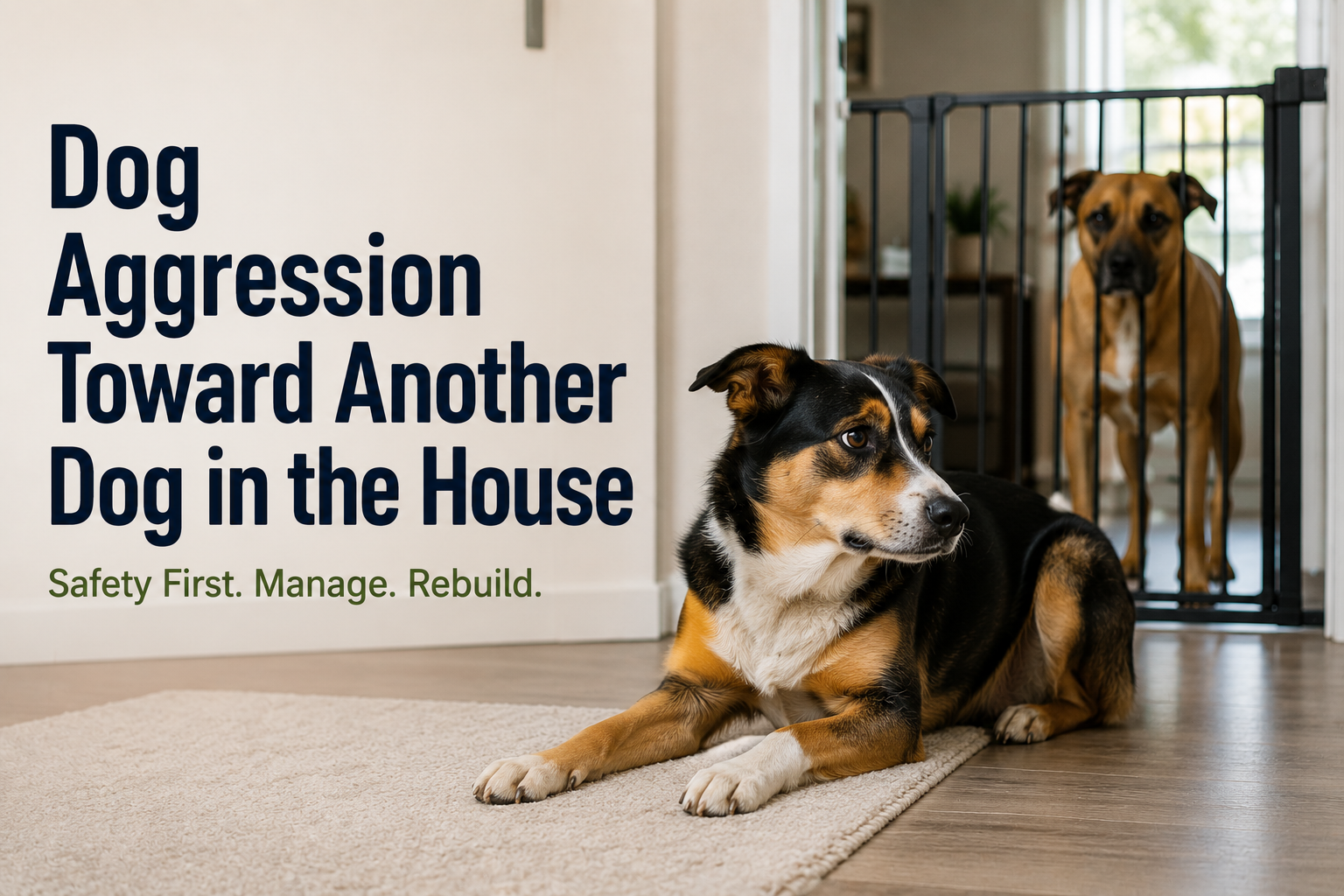
If your dogs have just fought, separate them immediately into different rooms or crates, check both for injuries, and do not let them "sort it out" on their own. Once everyone is calm, have a veterinarian rule out pain or illness, since a sick or hurting dog is far more likely to react aggressively to a housemate. Most ongoing tension traces back to resource guarding, redirected frustration, or an unclear relationship after a change in the household. Manage the environment first (separate feeding, supervised access, remove contested items), then rebuild slowly with structure. A single scare is manageable at home; repeated fights or any injury need a certified dog behavior professional.
Right now: what to do immediately after a fight
If a fight is happening or just happened, safety comes before diagnosis.
- Separate the dogs immediately, into different rooms, crates, or behind a secure gate. Do not reach into a fight with your hands; use a loud noise, a blanket thrown over the dogs, or a barrier to break it up if it's still active.
- Check both dogs for injuries, including under fur where bites can be hard to see. Bleeding, limping, or a puncture wound is a same-day vet visit.
- Do not let them "work it out." This is one of the most persistent pieces of bad advice in dog ownership. Dogs do not resolve conflict by fighting it out further; repetition tends to entrench the pattern, not settle it.
- Give everyone time to calm down before any reintroduction, hours, not minutes. A dog's stress hormones stay elevated well after a fight ends, which makes a second incident more likely if dogs are put back together too soon.
Get a medical check before you assume it's behavioral
Before building a training plan, rule out pain. A dog in pain, from arthritis, a dental problem, an injury, or an illness, is more irritable and more likely to react aggressively to a housemate bumping into a sore spot or crowding it while it doesn't feel well. This is especially worth checking if the aggression is new or has gotten worse recently in a dog that previously got along fine. Your veterinarian is the right first call, not a trainer, when the change is sudden.
Why dogs in the same house turn on each other
A handful of patterns account for most cases:
- Resource guarding. Food, toys, a favorite resting spot, or even a person can trigger conflict between housemates. This is one of the most common drivers of repeated in-house fights.
- Redirected aggression. A dog that is frustrated or aroused by something it can't reach, another dog outside the window, a person at the door, sometimes turns and takes it out on the nearest housemate instead.
- An unclear or shifting relationship. A new dog joining the household, one dog aging or becoming less mobile, or a puppy maturing into adolescence can all unsettle a relationship that used to be stable.
- Illness or pain, covered above, which lowers a dog's tolerance for normal household friction.
- Genuine incompatibility. Occasionally, two individual dogs simply do not get along well, the same as two people who rub each other the wrong way, and this needs active, ongoing management rather than a single fix.
Is this a home project or a professional's job?
Not every tense moment is the same emergency, and being honest about the range helps you respond proportionately.
| What happened | Likely severity | What to do |
|---|---|---|
| A stiff moment over a dropped treat, no contact | Low-level tension | Manage resources, supervise, no crisis |
| Growling or snapping with no contact, resolves quickly | Moderate | Increase management, start structured training, watch closely |
| A fight with contact but no injury | Serious | Full separation protocol below, involve a professional |
| A fight that drew blood, or more than one fight | High risk | Certified dog behavior professional this week, not eventually |
If you are ever unsure which row you're in, treat it as the more serious one. The cost of overreacting is some extra caution; the cost of underreacting is an injured dog.
Rebuilding safely: separation, structure, and slow reintroduction
Once the immediate incident is handled and any medical cause ruled out, the rebuilding process is deliberately slow:
- Full separation first. Feed separately, in different rooms or crated. Rotate access to shared spaces rather than allowing free run together. This isn't a punishment for either dog; it's removing the conditions that produced the conflict while you work on the cause.
- Reintroduce gradually and on leash, short, calm, supervised sessions, ending before either dog shows stress, rather than waiting for tension to appear.
- Reward calm coexistence explicitly. Treats and praise for both dogs resting calmly in the same space, at a distance that doesn't trigger tension, builds new positive associations rather than relying on the absence of conflict as the only measure of progress.
- Increase mental and physical enrichment for both dogs. A dog with an outlet for energy and a job to do has less frustration built up to redirect onto a housemate.
- Keep basic training sharp for both dogs. Reliable cues (sit, come, leave it) give you a way to interrupt rising tension before it escalates, rather than only reacting after the fact.
Preventing the next incident
Long-term management that actually holds usually includes: separate feeding stations or supervised mealtimes, no unsupervised access to high-value items (bones, new toys) until the relationship is stable, consistent house rules so no dog is inadvertently given a status advantage the other resents, and continued structured training for both dogs rather than assuming the problem is solved once a few weeks pass without incident.
What not to do
Don't punish either dog after the fact. A dog cannot connect a correction delivered minutes later to a fight that already ended, and punishment adds stress to an already tense relationship.
Don't force interaction to "prove" they're fine. Progress is measured in calm, supervised repetitions, not by removing management early to test the dogs.
Don't assume the smaller or younger dog is always the victim. Fights in multi-dog households are rarely one-sided in the way owners assume, and a professional assessment is more reliable than guessing from the outside.
FAQ
My dogs used to get along fine. Why did this start now?
Sudden changes are usually explained by one of three things: a new medical issue causing pain or irritability, a change in the household (a new pet, a move, a shift in routines), or one dog reaching social maturity, which typically happens between one and three years old and can unsettle a previously stable relationship. A vet visit is the right first step to rule out the medical explanation.
Can two dogs that have fought ever safely live together again?
Often, yes, with structured management and, for anything beyond a single low-level incident, professional guidance. Some pairs do better with permanent management (separate feeding, rotated access) rather than full free-range coexistence, and that's a legitimate long-term outcome, not a failure.
Should I rehome one of my dogs?
That's a serious, individual decision that depends on the severity and frequency of the aggression, the safety of everyone in the home, and the guidance of a professional who has actually assessed both dogs. It isn't something a general guide can answer, and it shouldn't be decided in the heat of the moment after a single incident.
Is resource guarding the same thing as dog-to-dog aggression?
Not exactly. Resource guarding is one common trigger for in-house aggression, but not the only one. Our guide to resource guarding covers that specific pattern and its own severity ladder in more depth.
This article is general owner guidance drawn from Whole Dog Journal, VCA Animal Hospitals, and K9 of Mine. It is not a substitute for an in-person veterinary or behavioral assessment. If a fight has drawn blood or happened more than once, please contact your veterinarian and a certified dog behavior professional promptly.
Related reading: our guide on growling at strangers covers the same "never punish the warning signal" principle for a different target, and leash reactivity toward other dogs follows a similar safe-management-first structure for encounters outside the home.