
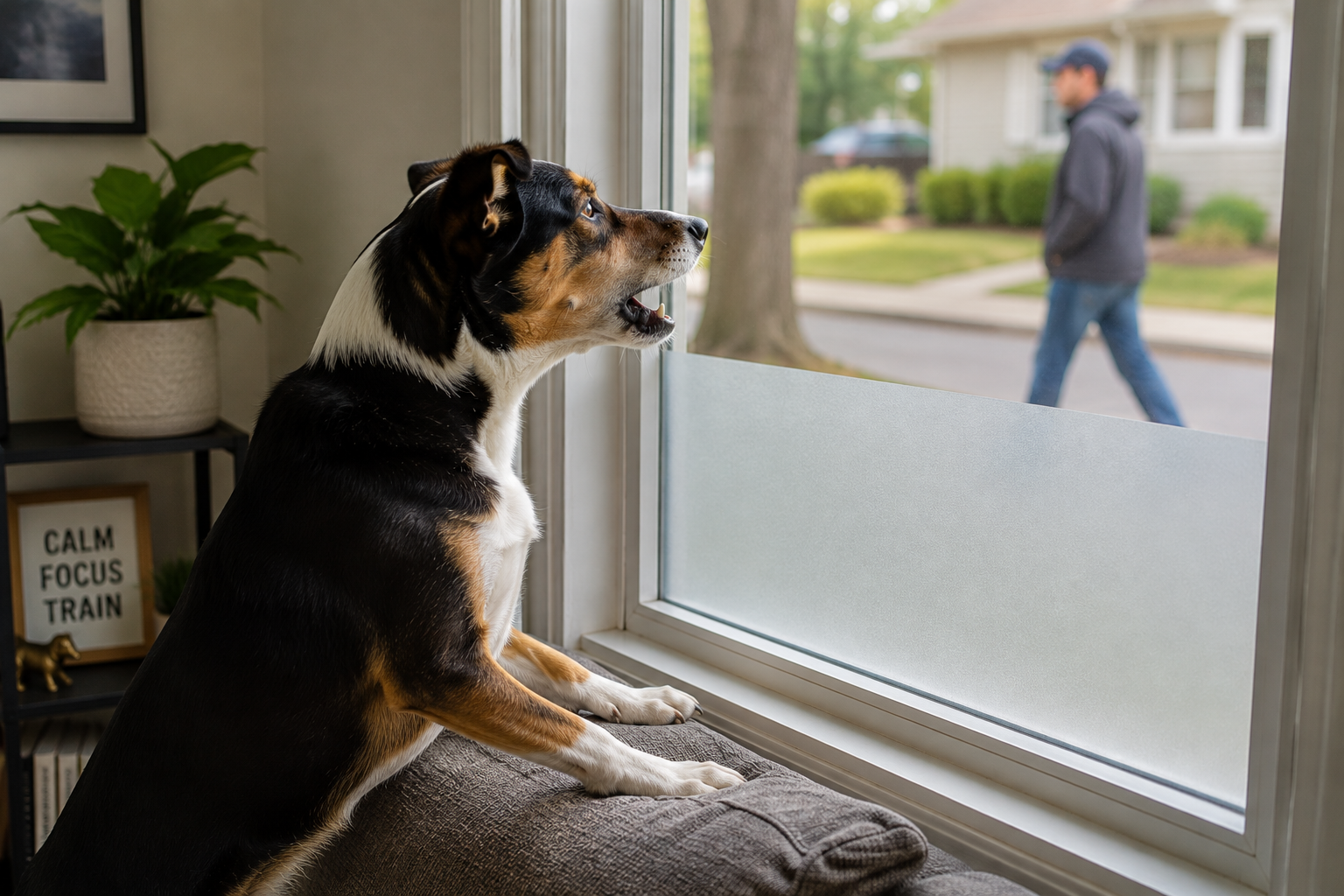
Start by blocking the view, because window barking is the one barking problem that rewards itself every single time. Your dog barks, the person walks on, and from the dog's side the barking worked. That happens dozens of times a day with no help from you, which is why this habit gets entrenched faster than almost any other. Cover the lower half of the glass with window film, close the blinds, or gate the room off, so the rehearsals stop. Then teach two things: that people passing predict food from you, and that there is a specific place to go instead of the windowsill. Yelling does not help, because to your dog it sounds like you joining in.
This article is about barking at people and dogs going past the window. Barking at the doorbell and knocking is a different trigger with a different plan, covered in how to stop a dog barking at the doorbell, and general everyday barking is covered in our guide to stopping excessive dog barking.
Why the window is the hardest barking habit to break
Most barking problems have a mixed record from the dog's point of view. Sometimes the barking coincides with what the dog wanted and sometimes it does not.
Window barking has a perfect record. A person walks toward the house, the dog barks, the person keeps walking and disappears. Every repetition ends with the intruder leaving. The dog did not cause that, but dogs learn from what follows behavior, not from what caused it, and the sequence is identical every time.
That gives you the two facts that matter most on this page. First, the behavior is being reinforced continuously and reliably, with no involvement from you, which is why "just ignore it" does not work here the way it can with attention-seeking barking. Second, the number of rehearsals is doing the damage, so the fastest intervention available to you is not a training exercise. It is reducing the number of times per day it happens.
There is a knock-on effect worth knowing about too. A dog that has spent the morning in a cycle of alarm at the window is not a neutral dog by the afternoon. Arousal carries over, and owners who fix the window often find the evening walk gets easier as a side effect. If your dog is also difficult on leash around other dogs, our guide to leash reactivity uses the same distance-and-reward logic.
Step 1: take the window away for now
Visual management is not cheating and it is not a temporary crutch you should feel bad about. On this problem it is the intervention with the highest return.
Cover the glass at dog height. Translucent static-cling window film on the lower portion of the glass keeps the light and removes the street. Frosted film, a semi-sheer blind, or simply closing the lower shutters does the same job.
Close off the lookout room. Most dogs have one station: a specific couch back, a windowsill, a chair pulled up to the glass. A baby gate on that room, or moving the furniture the dog climbs on, ends most of it.
Manage the times of day that matter. School run, mail delivery, and the dog-walking hour tend to account for most incidents. If you cannot manage the whole day, manage those windows.
Do not leave your dog with a view of a busy street while you are out. Nothing you teach survives eight unsupervised hours of practice.
Tufts University's Cummings School of Veterinary Medicine describes the approach to territorial barking as a combination of proactive avoidance and a trained "quiet" response, and that order is deliberate. Avoidance first, training second, because training against a trigger the dog is rehearsing all day is uphill work.
Step 2: change what a passerby predicts
Once the rehearsals have stopped, you can change the association rather than fight the symptom.
Set up on purpose instead of waiting for surprises. Sit near the window at a time when foot traffic is light, with high value food ready: chicken, cheese, or something equally good, cut small.
The moment a person appears at a distance where your dog notices but has not started barking, food starts raining. Not one treat, a stream of them, delivered on the floor or from your hand while the person is visible. When the person is out of sight, food stops completely and you go quiet.
You are not asking for a sit. You are not saying "quiet." You are not testing obedience. You are building one specific prediction: person outside means chicken from my human. It takes many repetitions across many days, and the sign it is working is that your dog looks at you when a person appears, before it looks harder at the person.
If your dog is already barking before you can start the food, you set up too close to the action. Move further from the window, work at a quieter time of day, or start with a partially covered window so the dog can see movement but not detail.
Step 3: give the barking a job to replace it
A dog with nothing else to do at the window will bark at the window. This is the piece most owners skip.
Acknowledge the first bark, then move. Preventive Vet's guidance on window barking and several trainers describe the same practical move: thank the dog for the alert rather than arguing with it, then redirect. One or two barks is a dog doing its job. The problem is the two minutes that follow.
Teach a "go to your mat" station away from the window. Build it cold, with no trigger present, paying the dog for going to a specific bed or mat and staying there. Once it is fluent, that becomes where the dog goes after the alert bark, and it pays better than the windowsill does. Our positive reinforcement dog training guide covers building a behavior like this from scratch.
Teach "quiet" honestly. The version that works is not a scolding. Wait for the natural pause between barks, mark it, and pay generously, so the word attaches to a silence the dog is already producing. A "quiet" cue trained by shouting is just a louder bark in the conversation.
Fill the day. A dog with a sniffy walk behind it, some food delivered through work rather than a bowl, and something to chew is a less watchful dog than one that has been alone in a quiet house since eight in the morning.
Is it alarm, or is it fear?
Two dogs can look identical at the window and need different plans, so watch the body.
An alert-and-territorial barker is forward, tall, tail high and often moving, barking in bursts, and settles reasonably quickly once the person is gone. A frightened barker is often lower, may bark and retreat, may bark in a higher or more continuous tone, and takes much longer to come down. Frustrated greeters are another version again: the whole body says they want to get out and say hello, and the barking is about the barrier rather than the person.
All three respond to the same first step, which is removing the view. After that, a fearful dog needs more distance and slower progress than a territorial one, and the temptation to push a scared dog closer to the window "to get used to it" is worth resisting. Flooding a frightened dog with the thing it fears tends to make the fear worse, not better.
What not to do
Do not yell. From the dog's perspective an aroused human making noise at the same time is participation, not correction.
Do not haul the dog away from the window mid-bark. Removing a highly aroused dog to another room does not settle it, it relocates it. Call the dog to you and pay instead.
Do not use anti-bark devices that work through discomfort. AVSAB's 2021 Position Statement on Humane Dog Training says aversive tools, naming electronic collars among them, should not be used, and reports no evidence that they outperform reward-based methods. There is a specific problem here as well: a dog punished while looking at a person outside is being given a reason to feel worse about people outside, and suppressed barking can resurface as something less easy to live with.
Do not expect the training to hold while the window is still open for business. Management and training are not alternatives on this problem. The management is what makes the training possible.
The honest limits
Some of this is permanent. A dog living at street level on a busy sidewalk, a breed selected for watchfulness, and a house with one big front window may end up with window film as a lifelong feature rather than a phase. That is a reasonable outcome, not a failure, and it is cheaper than years of frustration.
Progress is also uneven. Expect the barking to reduce in length before it reduces in frequency: the first sign of improvement is usually that a two-minute session becomes a three-bark session, not that the barking stops.
Talk to your veterinarian if barking has increased sharply in a dog that was previously settled, if it comes with other changes such as pacing, restlessness, or new anxiety, or if your dog cannot settle at all. Sudden behavior change in an adult dog is a medical question first. Bring in a certified trainer or a veterinary behaviorist if the barking is fear-driven, if the dog is redirecting onto other pets or people in the household when aroused, or if weeks of consistent work have changed nothing. Look for a board-certified veterinary behaviorist (DACVB), a Certified Applied Animal Behaviorist, or a trainer certified through a reward-based body such as the CCPDT or Karen Pryor Academy.
For the whole set of everyday problems, our hub on common dog behavior problems and their solutions links them together.
Frequently asked questions
Why does my dog bark at the window but not on walks?
Barriers change behavior. Behind glass your dog cannot investigate, cannot move away, and cannot get any information beyond what it sees, and the person always leaves right after it barks. On a walk the same person can be sniffed, passed, and dismissed, which resolves the question rather than leaving it open.
Does covering the window just avoid the problem?
It avoids the rehearsal, which is the point. Every unmanaged bark session strengthens the habit, so covering the glass is what makes any training work at all. For some households the film stays permanently, and that is a legitimate outcome rather than a shortcut.
Should I let my dog bark once to alert me?
That is a reasonable house rule and several trainers recommend it. Acknowledge the first bark calmly, then call your dog away and pay well. What you are training is the length of the episode rather than its existence.
How long does this take to fix?
It depends on how long the habit has been running, how much street traffic passes the house, and how consistently the view stays blocked. Nobody can give you an honest number from the other side of a screen. What you can measure is episode length, which usually shortens before frequency drops.
This article is general owner guidance drawn from Tufts University's Cummings School of Veterinary Medicine, Preventive Vet, AVSAB, and the AKC, verified at the time of writing. It is not veterinary advice or a behavioral diagnosis. If barking has changed suddenly or comes with other new behavior, start with your veterinarian.