
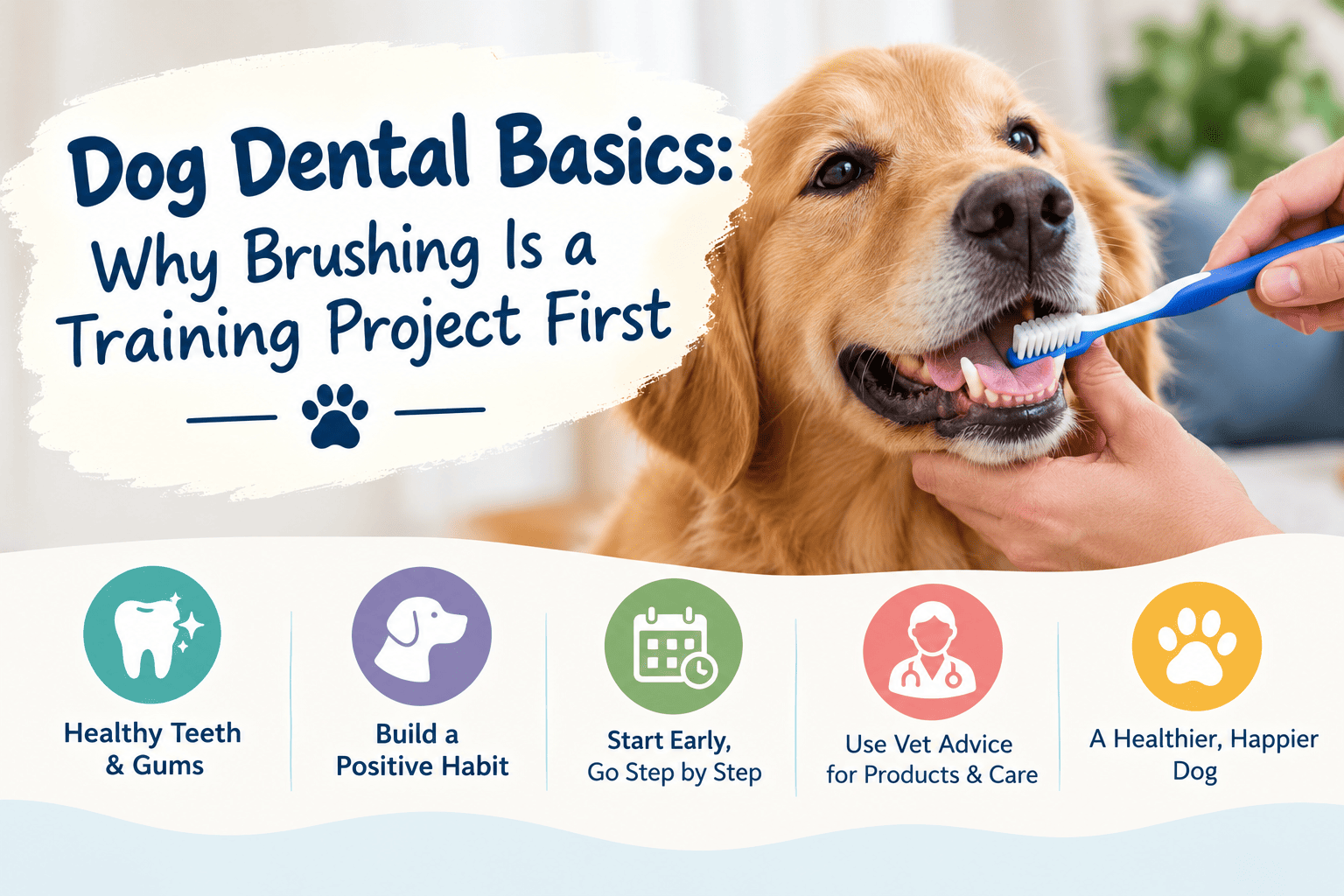
The obstacle to dog dental care is almost never the brush. It is that the dog will not let you. So this page treats it as a training project, which is what it actually is, and routes everything clinical to a vet.
Why it matters, and who says so
The American Veterinary Dental College describes periodontal disease as the most common clinical condition affecting adult pets, despite being almost entirely preventable, and describes it as the destruction of bone, gum tissue and the structures that hold teeth in place. AVDC's published position is that daily brushing is the gold standard for preventing plaque and calculus and slowing the progression of periodontal disease, and that daily dental home care should start from an early age.
An honest sourcing note: we reached AVDC's positions through search results on 28 August 2026 and did not load AVDC's own pages. They are reported here as AVDC's published position and should be read at avdc.org before anyone quotes them further, including us.
What that means for an owner: the thing that works is frequent, and frequent means the dog has to tolerate it. Which makes it a handling problem.
The training half, which is the half that fails
Nobody's dog accepts a toothbrush on day one, and starting with the brush is why most people stop within a week.
Build it in stages, and each stage is seconds long.
Touch the muzzle, treat, stop. That is a session.
Lift a lip for a moment, treat, stop.
Touch a tooth with a finger, treat, stop.
Then a finger with something on it that your vet has recommended.
Then the brush, held near, not used.
Then one tooth. Then stop.
Stop before the dog wants to stop. That is the rule that makes the next session easy, and pushing for one more tooth is what undoes a week's work. Ending well is the whole technique.
And never restrain. A dog held still while its mouth is handled learns that its objections do not work, and the next objection is bigger. That holds for all handling and it applies here with more force, because the mouth is the most sensitive place to get it wrong.
If the dog growls, freezes or pulls away persistently, stop and get help rather than escalating. A punished warning disappears and the fear does not, which is the reasoning on what to do when a dog growls at strangers and it applies identically to handling.
Start with a puppy if you have one
A puppy that has had its mouth handled cheerfully since it arrived is a dog that will accept brushing for life, and it costs thirty seconds a day at an age when you are doing everything else anyway.
The mouth is already being looked at during teething, which is a natural time to build the habit. Note that a retained baby tooth, a bite that looks wrong, or anything painful is a vet appointment rather than a training opportunity. The behavior side of the teething window is on puppy mouthing versus teething.
What to use, and where this page stops
Ask your vet. That is the answer and it is not a dodge.
We name no products, no toothpastes, no brushes, no chews, no water additives and no diets, and we assess no ingredient. What suits a given dog depends on that dog, and your vet sees the mouth.
Two things worth knowing anyway, because they come up constantly:
Human toothpaste is not for dogs. Dogs swallow it, and human toothpaste is formulated to be spat out. Ask your vet what to use.
And a product being sold for dental health is not the same as a product doing anything. Ask your vet which of the things in the aisle they would actually recommend, because they see the outcomes.
What only a vet can do
Professional cleaning happens under anesthesia, and AVDC's material on periodontal disease describes professional cleaning under anesthesia alongside daily home brushing as the treatment at the early stages.
We describe no procedure and no protocol, and the anesthesia question in particular is one to discuss with your vet rather than to research on a general page. Anesthesia-free dental cleaning is a subject with a veterinary position attached to it; ask your vet about it directly rather than taking anyone's summary.
The signs that mean an appointment
These are prompts to call, not diagnoses.
Bad breath, which is the one most owners live with and the one most worth acting on.
Difficulty eating, chewing on one side, or dropping food.
Pawing at the mouth, or drooling more than usual.
Red, swollen or bleeding gums.
A broken, loose or discolored tooth.
A change in behavior, including irritability, reluctance to be touched around the head, or withdrawal. Pain changes behavior, and mouth pain is a common cause that owners bring to a training page instead of to a vet. A dog that has become irritable or withdrawn is a dog to have examined, and panting when it is not hot is one of several signals that ends at the same place.
Frequently asked questions
Which mouth signs mean I should book an appointment?
Book one for bad breath, which is the sign most owners live with and the one most worth acting on, and for difficulty eating, chewing on one side or dropping food, pawing at the mouth or drooling more than usual, red, swollen or bleeding gums, and a broken, loose or discolored tooth. Book one too for a change in behavior such as irritability, reluctance to be touched around the head, or withdrawal, because pain changes behavior and mouth pain is a common cause that owners bring to a training page instead of to a vet. These are prompts to call rather than diagnoses.
How often does brushing need to happen?
AVDC's published position is that daily brushing is the gold standard for preventing plaque and calculus and slowing the progression of periodontal disease, and that daily dental home care should start from an early age. We reached that through search results on 28 August 2026 rather than by loading AVDC's own pages, so read it at avdc.org before quoting it further, ours included. The practical consequence is that the thing that works is frequent, and frequent means the dog has to tolerate it, which is why this is a handling problem before it is a hygiene one.
My dog will not let me near its mouth. Where do I start?
Not with the brush, which is why most people stop within a week. Build it in stages that are seconds long: touch the muzzle, treat, stop, and that is a whole session. Then lift a lip for a moment. Then touch a tooth with a finger. Then a finger with something on it that your vet has recommended. Then the brush held near rather than used. Then one tooth, then stop. Stop before the dog wants to stop, because pushing for one more tooth undoes a week's work. Never restrain, because a dog held still while its mouth is handled learns that its objections do not work and the next objection is bigger.
What should I do if my dog growls or freezes when I try?
Stop, and get help rather than escalating. A punished warning disappears while the fear stays, which is the same reasoning this site applies to growling at strangers and it holds identically for handling. Persistent growling, freezing or pulling away is work for a qualified behavior professional alongside your vet, who can also check whether something in the mouth is hurting.
What toothpaste or dental product should I buy?
Ask your vet, and that is not a dodge. This page names no products, toothpastes, brushes, chews, water additives or diets and assesses no ingredient, because what suits a given dog depends on that dog and your vet is the one who sees the mouth. Two things do come up constantly and are worth stating: human toothpaste is not for dogs, since dogs swallow it and human toothpaste is formulated to be spat out, and a product being sold for dental health is not the same as a product doing anything. Ask your vet which items in the aisle they would actually recommend, because they see the outcomes.
What this page does not publish
No product names, brands, toothpastes, chews, additives or diets, and no ingredient assessments.
No procedure, protocol, anesthesia guidance or treatment of any kind.
No diagnosis. We are a dog behavior site, not a veterinary clinic, and everything clinical here belongs to your vet.