
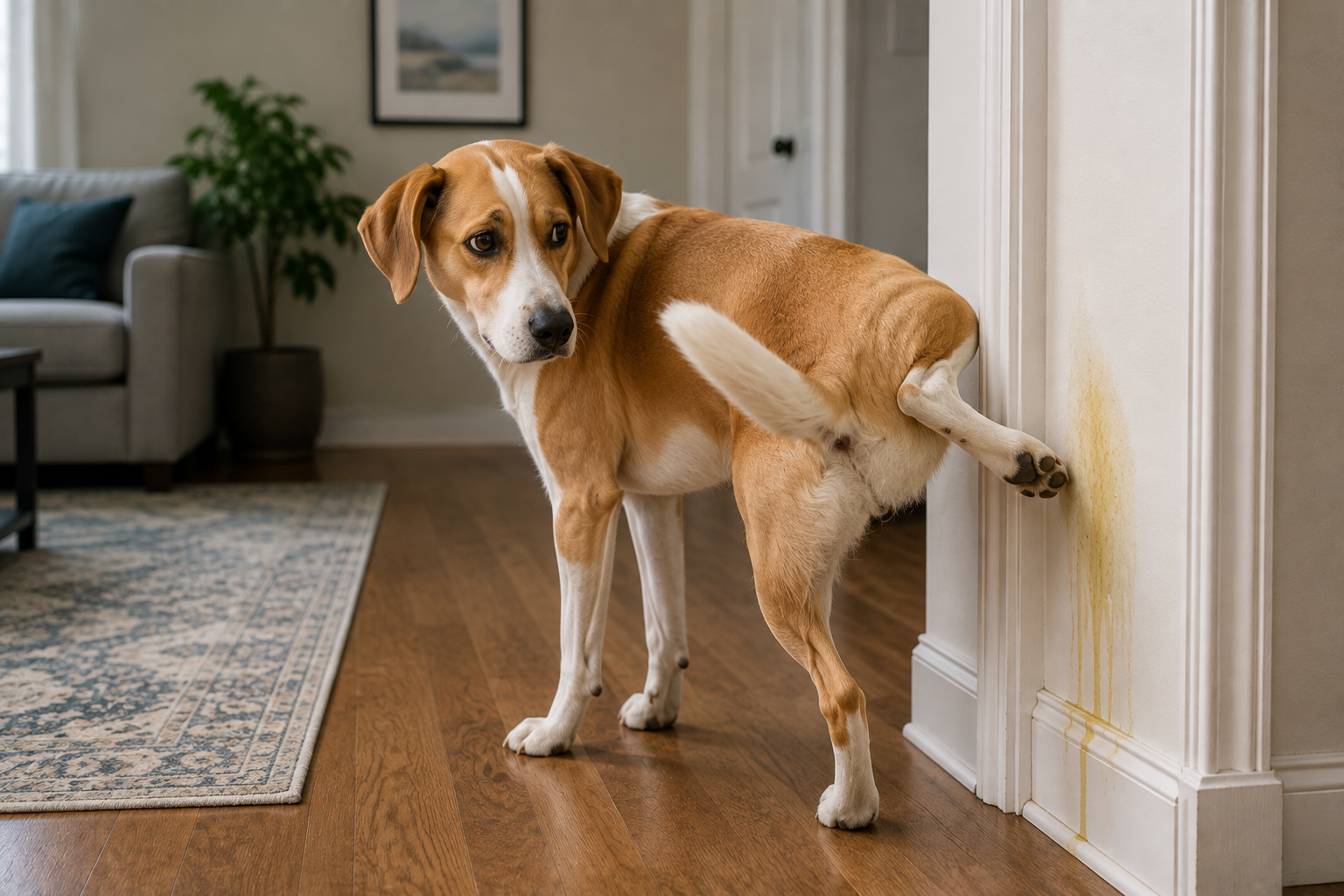
Before treating this as marking, make sure it actually is: marking is a small amount of urine, usually on a vertical surface like a table leg or doorframe, often from an intact male lifting a leg, and it's different from a full-bladder house-training accident or submissive urination during excited greetings. If a previously reliable adult dog suddenly starts marking, see a veterinarian first, since a urinary tract infection or other medical issue can look identical. Once medical causes are ruled out, spaying or neutering resolves or greatly reduces marking in most intact dogs, clean every spot with an enzymatic cleaner rather than an ammonia-based one, and supervise closely so you can interrupt and redirect outside rather than punish after the fact.
Is this actually marking?
Most guides on this topic assume the reader already knows the answer. Worth ten seconds of thought first, because the fix is different for each of these three:
- Marking. A small, deliberate amount of urine, often on a vertical surface (a table leg, a doorframe, a piece of furniture), frequently accompanied by a leg lift in males. It's a scent-communication behavior, not a bladder-control problem.
- A house-training accident. A full bladder's worth of urine, typically on a flat surface (the floor), and usually points to either an incomplete house-training foundation or a schedule that's asking more of the dog's bladder than it can currently handle.
- Submissive or excitement urination. A small puddle that happens during greetings, excitement, or when a dog feels intimidated, often paired with a lowered body posture, tucked tail, or rolling over. This is an emotional response, not a territorial one, and punishing it reliably makes it worse.
Getting this diagnosis right changes everything downstream. A dog that's actually house-training incomplete needs a refresher on the fundamentals, not a marking-specific plan, and a dog urinating submissively needs calmer, less overwhelming greetings, not a training correction at all.
The sudden-onset rule: when this is a vet visit first
If a previously reliable adult dog, one that has not marked indoors before, suddenly starts, the first call is your veterinarian, not a training plan. A urinary tract infection, bladder stones, or other medical issues can produce indoor urination that looks exactly like marking or a house-training lapse, and no amount of behavior modification fixes a medical problem. This is especially true if the marking is frequent, if there's any straining, blood, or unusual odor, or if the dog seems uncomfortable. Treat sudden onset in an otherwise reliable adult as a medical question first and a behavioral one second.
Why dogs mark indoors
Marking is fundamentally a scent-communication behavior, and a few situations make it more likely:
- Being intact. Un-neutered males and, less commonly, unspayed females are considerably more prone to marking, driven by hormones.
- New or unfamiliar scents in the home. A new pet, a visitor's dog's scent on shoes, or new furniture can prompt a dog to "claim" the object with its own scent.
- Anxiety or a change in routine. Marking sometimes increases during stressful periods or after a disruption to the household.
- Social status uncertainty, particularly in multi-dog households, though this is one factor among several rather than the whole explanation.
Spaying and neutering: what it changes and what it doesn't
Neutering resolves or greatly reduces marking in the majority of male dogs, typically within weeks to months of the procedure, and spaying has a similarly strong effect in females who mark. That said, behavior modification is often still needed even after the procedure, especially if the marking has already become a well-practiced habit, and the decision to spay or neuter, along with the right timing for your individual dog, is a conversation for your veterinarian, not something this article decides for you.
Cleaning it up the right way
Residual scent is one of the strongest triggers for a dog to mark the same spot again, so cleanup matters as much as anything else on this list.
- Use an enzymatic cleaner, made specifically for pet urine, which breaks down the compounds that create the scent rather than just masking it.
- Avoid ammonia-based cleaners. Urine itself contains ammonia-like compounds, so an ammonia-based cleaner can actually reinforce the scent marker rather than removing it.
- Clean thoroughly and promptly, including any padding or subfloor if the spot has been marked more than once, since surface cleaning alone often misses what's soaked in underneath.
Supervision and management that actually works
While the underlying cause is being addressed, whether that's a medical treatment, neutering, or straightforward behavior modification, day-to-day management prevents new marks and new habits from forming:
- Supervise closely when your dog has access to areas where marking has happened before, and interrupt calmly (a neutral sound or cue, not a shout) the moment you see the behavior start, then take the dog outside immediately.
- Limit unsupervised access to previously marked areas, using a baby gate or closed door, until the behavior has genuinely stopped.
- Crate or tether your dog when you can't supervise directly, the same principle used for house-training a puppy.
- Never punish after the fact. A dog cannot connect a correction delivered even a minute later to the marking itself, and punishment adds anxiety that can make marking, which is sometimes anxiety-driven to begin with, worse rather than better.
What not to do
Don't rub your dog's nose in it or punish after discovery. This doesn't teach the connection you're hoping for and adds stress that can work against you.
Don't skip the vet visit because "it's probably just marking." Sudden onset in a previously reliable adult dog is exactly the situation where assuming a behavioral cause without checking for a medical one costs the most time.
Don't clean with an ammonia-based product, for the scent-reinforcement reason above.
If your dog's indoor accidents are actually a house-training gap rather than marking, our guide to crate training a puppy covers building that foundation properly. If territorial behavior around resources, rather than scent-marking, is the pattern you're seeing, resource guarding covers that adjacent issue and its own severity ladder. The calm, reward-based redirection approach used throughout this guide comes from our positive reinforcement dog training guide.
Frequently asked questions
Is marking the same as not being house-trained?
No. Marking is a small, deliberate amount of urine on a specific object, usually by a dog that is otherwise reliably house-trained, while a house-training gap involves a full bladder and a lack of the underlying skill. They need different fixes.
Will neutering completely stop marking?
It resolves or greatly reduces marking in most male dogs, typically within weeks to months, but not universally, and behavior modification is often still part of the plan, especially for a well-established habit. Talk to your veterinarian about whether and when neutering makes sense for your dog.
My female dog marks too. Is that unusual?
It's less common than in males but not rare, and can happen in both intact and spayed females, sometimes tied to hormonal cycles, stress, or social dynamics in a multi-dog household. The same diagnostic and management steps apply.
Should I be worried if my dog only marks when a visitor's dog has been in the house?
That's a very common and relatively low-concern pattern, a response to an unfamiliar dog's scent rather than a sign of a bigger problem. Thorough cleanup and normal supervision usually resolve it without needing a broader intervention.
This article is general owner guidance drawn from PetMD, Vetstreet, and the AKC. It is not veterinary advice. If a previously reliable adult dog suddenly starts marking indoors, please see your veterinarian to rule out a medical cause.