
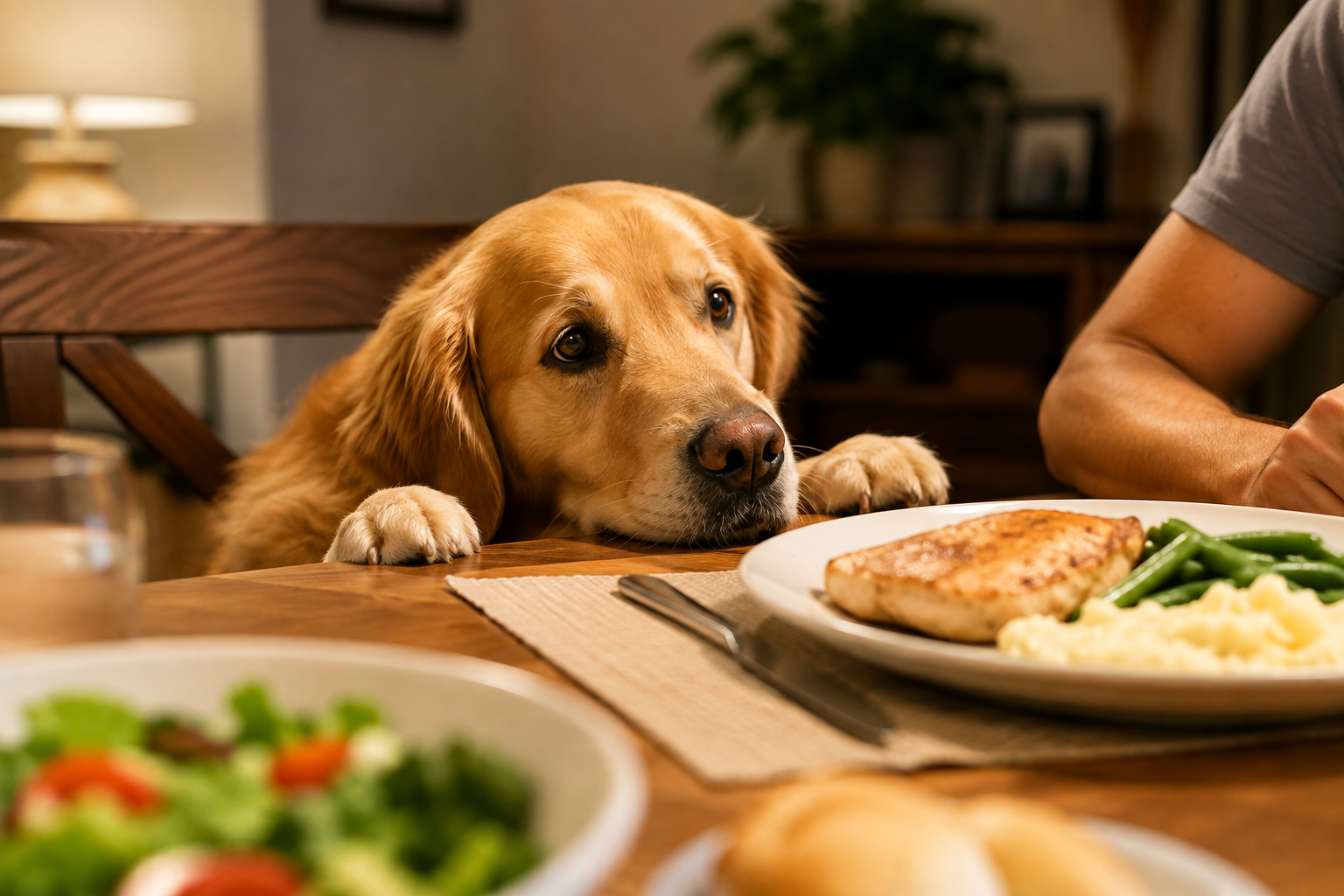
Stopping table begging works best with a routine, not a single trick: feed your dog its own meal or a long-lasting chew a few minutes before your household sits down, so it has its own job during your meal, then send it to a designated spot (a bed or mat) with a "go to your spot" cue and ignore any staring, whining, or pawing completely, including eye contact. The hardest part is consistency: even one occasional scrap makes begging harder to stop, not easier, because intermittent rewards are the most powerful kind. Every household member has to hold the same line for it to work.
Why begging is so hard to un-teach
Most owners have tried ignoring the begging before and felt like it didn't work. Usually it did work, mostly, except for the one time someone slipped the dog a piece of chicken because the dog looked especially pitiful, or a guest fed it under the table "just this once."
That single exception is the whole problem. Behaviors rewarded every single time are actually easier to extinguish than behaviors rewarded occasionally and unpredictably. An occasional payoff, one success in ten tries, teaches persistence, not futility, which is exactly why slot machines work the way they do. A dog that gets a scrap once every ten meals has learned that begging eventually pays off, so it keeps trying. Getting every single household member on the same page, every single meal, is what actually breaks the pattern.
Before you sit down: set your dog up to succeed
Give your dog its own job during your meal instead of leaving it with nothing to do but watch yours:
- Feed your dog its own meal, or a long-lasting chew or stuffed toy, a few minutes before the household sits down. A dog that's already occupied with something worthwhile is far less likely to start begging in the first place.
- Consider a separate space for that meal or chew, especially early on, so the dog isn't sitting right at the table with nothing to do while everyone else eats.
Teach "go to your spot"
A designated spot, a bed, mat, or crate, gives your dog somewhere specific to be during meals, rather than just "not at the table," which isn't a real instruction a dog can follow.
- Choose one consistent spot and a consistent cue word ("place," "go to bed," whatever you'll use every time).
- Practice outside of mealtimes first: lead your dog to the spot, reward heavily for going there and staying, and gradually build up the duration.
- Add the cue word once your dog reliably goes to the spot on the physical prompt.
- Start using it at the beginning of meals, rewarding your dog for settling there, and reinforce occasionally through the meal for staying, especially at first.
- If a gate or tether helps enforce the boundary while you're building the habit, use one. It's a training aid, not a punishment.
What to do when the begging starts anyway
Ignore it completely. That means no eye contact, no talking to the dog even to say "no" or "stop it," and no pushing the dog away, all of which register as attention to a dog. If the begging is happening at the table rather than in the designated spot, calmly return the dog to its spot without fanfare and continue your meal. The moment your dog is calm and quiet, whether at the table or, better, once it has learned to stay in its spot, that's when attention and praise are appropriate.
Getting the whole household on the same page
This is the step that actually determines whether the plan works. One family member sneaking a bite "just this once" resets the intermittent-reinforcement clock for everyone else's consistent effort. Before starting, get explicit agreement from every person who eats at that table, including regular guests where practical, that scraps don't happen, ever, during this process. It's a short, awkward conversation that saves weeks of a plan not working.
A word on table scraps and food safety
Beyond the training reasons to skip table scraps, it's worth remembering that not every human food is safe for a dog, and a "harmless" bite from your plate isn't automatically fine just because it looks like ordinary food. This article isn't a food-safety list; if you're ever unsure whether something your dog ate is a problem, contact your veterinarian or a poison control resource rather than guessing.
What not to do
Don't give in "just this once" to make the begging stop for the evening. This is the single most common reason the plan fails, and it makes future begging worse, not better, because of the intermittent-reward effect above.
Don't scold or push the dog away physically. Both register as attention and can accidentally reinforce the behavior rather than reducing it.
Don't expect the "spot" training to work without practicing it outside of mealtimes first. Asking a dog to hold a new skill under the added distraction of food on the table, before the skill itself is solid, sets the plan up to fail.
For the same food-seeking pattern applied to the kitchen counter rather than the table, see our guide to counter surfing, which shares the same management-and-consistency approach. The redirect-and-reward mechanics used in the "go to your spot" training come from our positive reinforcement dog training guide, and if your dog's attention-seeking shows up as mounting or humping rather than begging, how to stop a dog from humping uses a similar interrupt-and-redirect pattern.
Frequently asked questions
Is it really that harmful to give my dog a bite once in a while?
For the begging behavior specifically, yes, more than most owners expect. An occasional reward makes the behavior more persistent and harder to extinguish than either never rewarding it or rewarding it every time, because the dog learns that persistence eventually pays off.
My dog just stares silently, no whining or pawing. Is that still begging?
Yes. Staring is a form of begging and is usually the first stage before whining or pawing starts if staring doesn't work. Treat it the same way, ignore it completely, and reinforce the designated-spot routine.
How long does it usually take to stop table begging?
It varies by dog and by how consistent the household is. Dogs that have had years of occasional success at the table generally take longer than a puppy just starting to test the behavior. Consistency matters far more than any specific timeline.
Should I feed my dog at the same time as the family, just in a different room?
That can work well and is a common approach, especially for a young dog still learning. Some owners find it simpler to feed the dog its meal a few minutes earlier, so the "I'm busy eating too" phase has already passed by the time the household sits down.
This article is general owner guidance drawn from the AKC, Hill's Pet, and Zoetis Petcare. It is not veterinary advice. If your dog has eaten something you're unsure about, please contact your veterinarian or a poison control resource.