
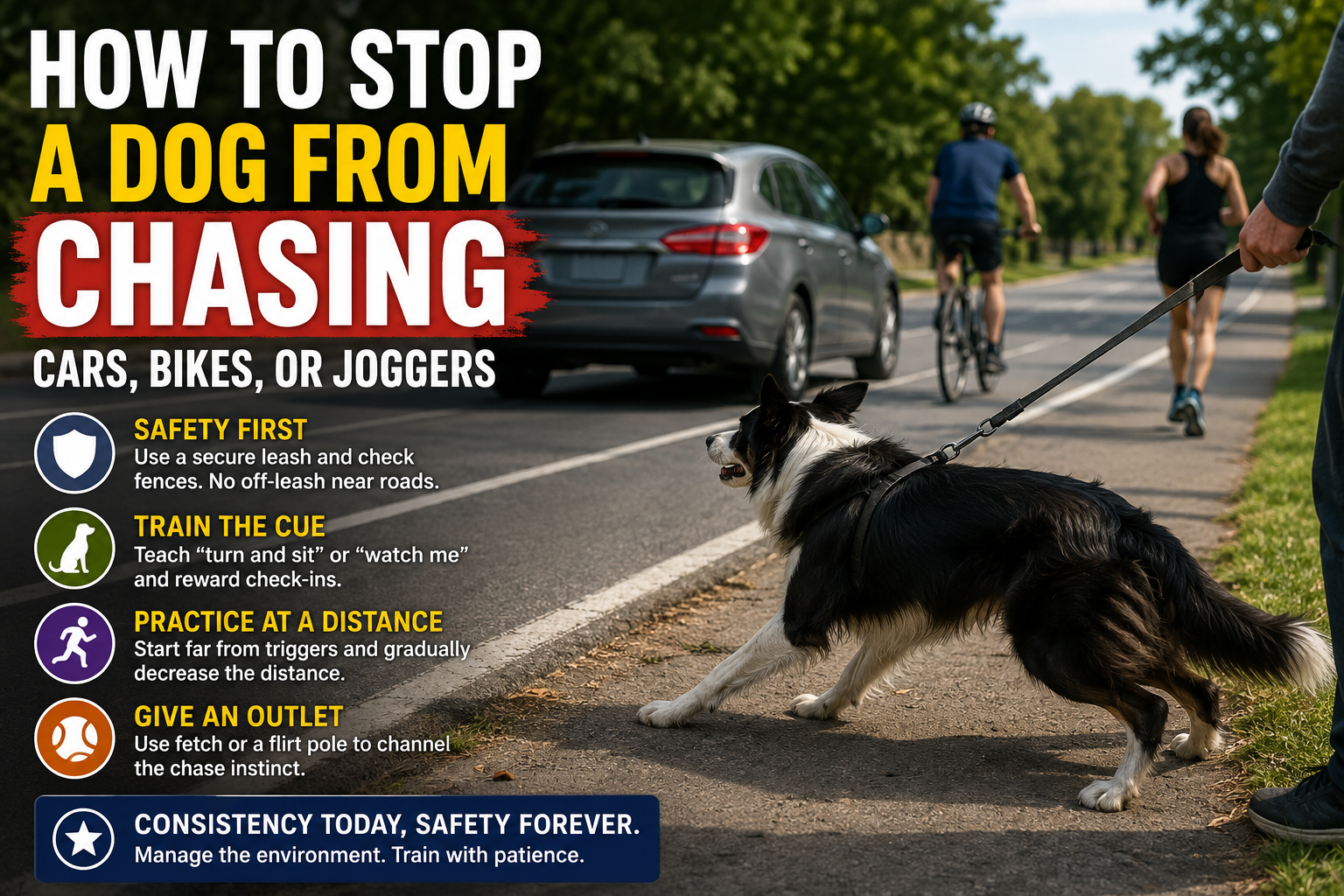
Chasing cars, bikes, or joggers is a safety issue first and a training project second, so start with containment: a secure leash (never retractable or a long line) for every outing, a fence check if the chasing happens from the yard, and no off-leash time until the behavior is reliably under control. The training fix is a "turn and sit" or "watch me" cue, taught first away from any trigger, then practiced at a distance the dog can handle without lunging, rewarded heavily for checking in with you instead of the moving target. A flirt pole or vigorous fetch session gives the chase instinct a legal outlet. If the behavior looks predatory, involves a bite history, or does not improve with consistent management, bring in a certified trainer or veterinary behaviorist.
This is a safety issue first: contain it today
Most of this site's everyday behavior guides can take a few weeks to work through calmly. This one is different, because the risk isn't just a frustrating habit, it's a dog that could be hit by a car, knock over a cyclist, or startle a driver into swerving. A training plan that takes time to work is not an acceptable interim state here. Contain the risk before you start changing the behavior.
- Use a sturdy, fixed-length leash on every walk, never a retractable leash or a long line near roads, bike paths, or jogging routes. A retractable leash gives a lunging dog far more momentum and far less control for you.
- No off-leash time in unfenced or unreliable areas until the behavior is genuinely under control, not just improving.
- Check your fence and gates if the chasing happens from the yard. A determined chaser will find a gap, and the fix here is physical, not behavioral, until the underlying impulse is addressed.
- As the owner, you're responsible for what your dog does to a passing cyclist or jogger, not just for your own dog's safety. That's not meant to alarm you, it's the honest reason containment comes before training on this particular topic.
Why dogs chase moving things
Chasing draws on one of the oldest, strongest instincts a dog has, and it shows up differently depending on the driver:
- Prey or motion instinct. Fast-moving objects, cars, bikes, running joggers, trigger a chase response that predates any specific training. Herding and sighthound breeds tend to have this instinct especially strong, and it's not a flaw, it's what they were bred to do.
- Fear. Some dogs chase or lunge at bikes or joggers because they're startled or frightened by the sudden approach and fast movement, not because they want to catch anything.
- Predatory drive, rarer, but real, especially in dogs with a history of intensely fixating on and pursuing small moving targets. This category needs professional input, not a home plan.
Telling these apart matters, because a herding-instinct chaser responds well to outlet and redirect, a fearful dog needs desensitization aimed at reducing fear rather than just blocking the chase, and a genuinely predatory response calls for a certified professional rather than a general guide.
The "turn and sit" cue, step by step
Teach this away from any trigger first, in a quiet room or yard where your dog can focus.
- Say your dog's name or a consistent cue word, then immediately reward when your dog turns to look at you.
- Once that's reliable, ask for a sit the moment your dog turns, and reward generously.
- Practice this daily until it's automatic, then start introducing it at increasing levels of distraction, still nowhere near a real trigger yet.
- Only once the cue is solid in a calm setting do you start using it near actual triggers, at a distance where your dog can still succeed (see below).
Desensitize at a distance the dog can actually handle
Find the distance from a passing car, bike, or jogger where your dog notices but doesn't lunge or fully fixate. That might be much farther than feels necessary. At that distance, use the "turn and sit" cue the moment your dog notices the trigger, and reward heavily for checking in with you instead of tracking the target.
Gradually, over repeated sessions, decrease the distance only as long as your dog keeps succeeding. If your dog lunges or can't disengage, you've moved too close, too fast; back up to the last distance that worked. There's no set number of sessions this takes; it depends on the individual dog and how strong the instinct is.
Give the chase instinct a legal outlet
A dog with a strong chase drive generally does better with a structured way to use it. A flirt pole (a long pole with a toy on the end, mimicking prey movement) or a vigorous game of fetch gives the same instinct a safe, controlled target. Dogs that get this kind of outlet regularly tend to have an easier time disengaging from real-world triggers, because the underlying drive has somewhere else to go.
What not to do
Don't let your dog off leash "to test it" before the behavior is reliably solid. A single successful chase is enough to reinforce the behavior and put the dog and others at real risk.
Don't use aversive corrections tied to the trigger (a leash jerk timed to a passing bike, for instance). This can teach a dog to associate the trigger itself with discomfort, which sometimes worsens fear-based chasing rather than fixing it.
Don't assume this is "just energy" and skip the safety steps while you work on training. Exercise and enrichment help, but they don't replace a secure leash and a checked fence in the meantime.
When this needs a professional
If the chasing looks predatory rather than instinctive or fear-based, if your dog has ever caught and shaken or injured a target, if there's any bite history, or if consistent management and training aren't producing improvement, a certified trainer or veterinary behaviorist should be part of the plan. This is one of the everyday behavior problems where getting professional eyes on the specific dog is worth the cost, given what's at stake if it goes wrong.
If your dog also struggles with leash reactivity toward other dogs specifically, our guide to leash reactivity covers the same safe-management-first approach for that trigger. The reward-based training principles behind the "turn and sit" cue come from our positive reinforcement dog training guide, and if arousal and escalation around a different trigger is the issue, growling at strangers covers reading a dog's arousal before it boils over.
Frequently asked questions
Is chasing cars or bikes ever completely trainable away?
Many dogs improve substantially with consistent management, an outlet, and desensitization, but a dog with a very strong instinct-driven chase response may always need some level of management, a secure leash, supervised off-leash time only, rather than being considered "cured." That's a realistic goal, not a failure.
My dog only chases at the yard fence, never on walks. Is that different?
It's the same underlying instinct, triggered by whatever passes the fence line. The fix combines the same desensitization principles with a physical check of the fence, since a determined dog at a fence can injure itself or find a way through.
Are head halters a good tool for this?
Many trainers recommend them because they give more control over where a dog's head and attention go, which helps with the "turn and sit" cue in real situations. Introduce any new equipment gradually and positively before using it around real triggers.
Should I be worried this means my dog is aggressive?
Not necessarily. Chasing moving objects is usually a prey or motion-driven instinct rather than aggression toward the target, especially in breeds developed to herd or course game. That said, any bite history or a caught-and-shaken incident should be assessed by a professional rather than assumed to be "just instinct."
This article is general owner guidance drawn from the AKC, AKC Reunite, and Vetstreet. It is not a substitute for an in-person professional assessment. If your dog has a bite history or the behavior looks predatory, please contact a certified trainer or veterinary behaviorist.