
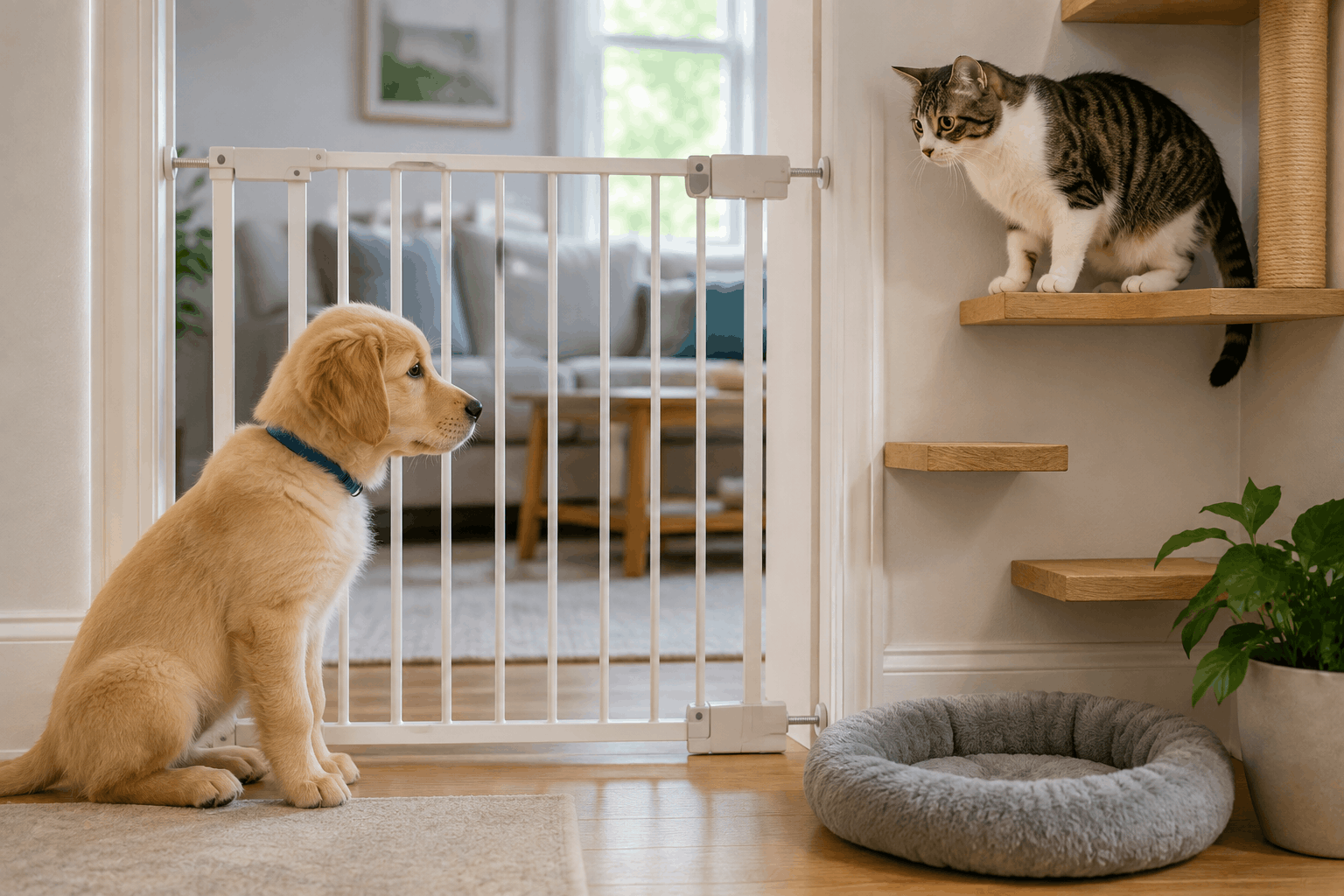
Most of this is decided before the two animals ever see each other, and it is decided by your furniture rather than your training. A cat that has high places to get to, a route through the house the puppy cannot follow, and food, water and a litter tray in places the puppy cannot reach will usually cope. A cat without those things will not, no matter how well the puppy is trained. RSPCA guidance and International Cat Care both put the resident cat's safe space and escape routes first, then scent, then barrier introductions, then short supervised meetings. Never leave them alone together until you are certain, and a chasing puppy is a stop, not a stage.
Why the cat's side is an environment problem
Dog training gets the attention here because the dog is the one doing the learning. That is a mistake in emphasis.
A cat's main coping strategy is distance. If it can leave, it usually settles. If it cannot leave, or it can only leave by running past the thing it is avoiding, it moves quickly to defensive behavior, and a cat that has had to defend itself once treats the puppy as a threat from then on. The ability to retreat is what prevents the fight, not the puppy's manners.
RSPCA guidance is explicit that the existing pet needs a safe place containing all their necessary resources, food, water, toys and sleeping areas, and that the home should initially be time-shared so each animal has a space where it feels comfortable and the resident pet can live more or less as normal. That is an architecture instruction, and it is the highest-value thing on this page.
Set up the cat's side before the puppy arrives
Do all of this while the house is still calm.
Vertical routes, not just one high shelf. A cat needs to get up, and then to get somewhere else while staying up. Look at the path from the floor to the top of a bookcase to a windowsill and see whether it exists without touching the ground.
A dog-free room, permanently. Not for the introduction period. Permanently. Gate it, or fit a cat flap or a gate the cat can pass and the puppy cannot.
Resources moved up and apart. Food, water and the litter tray go where the puppy cannot get to them, and not all in the same corner. A cat that has to run a gauntlet to eat will eat less.
Baby gates rather than closed doors where possible, so the cat keeps its freedom of movement while the puppy does not follow. Cat shelves and high refuges do the same job in rooms where a gate is impractical.
The floor-level survey that finds the puppy's hazards will also show you the cat's blind corners, so it is worth doing both passes at once, as in puppy-proofing your home room by room.
The litter tray is the failure point nobody plans for
If this introduction goes wrong in a small, ordinary way, it is usually here.
Three things happen. The tray is in a spot the puppy can reach, so the cat is ambushed or watched while using it and starts avoiding it. The puppy eats out of the tray, which is extremely common, unpleasant and a genuine health issue worth raising with your vet. Or the tray is in the one room the puppy now sleeps in, and the cat quietly stops going in there.
The fix is placement, and it is worth over-solving. Put the tray somewhere the puppy physically cannot get, behind a gate the cat can pass or up a step the puppy cannot manage, with two exits so the cat is never cornered on it. Add a second tray in a different part of the house if you have the space.
Puppies raiding litter trays is a specific version of a wider habit, and the reward-based approach to it is in how to stop a dog eating poop. Management comes first here, because a tray a puppy cannot reach solves it on day one.
How to introduce a puppy to a cat: scent, then barrier, then supervised
RSPCA advice is to swap scents before the new pet comes home. Rub a soft cloth over the puppy and place it at cat height around the house, on door frames and furniture corners, and do the same in reverse. The point is that the first encounter is not also the first time either animal has smelled the other.
Then feed on either side of a closed door so each associates the other's smell with something good, which is the specific technique RSPCA describes. Then barrier sessions with a gate or a mesh screen, kept short and ended early.
Only then, supervised contact in the same room with the puppy on a leash held by a person, the cat free and with its escape routes open. RSPCA advises introducing when the dog is at their calmest, and International Cat Care's guidance is that slower is better and meetings should be short, regular and positive.
Timescales are weeks, not days. Give the puppy a day or two to settle in one room first, and remember that cats generally need longer to adjust than dogs do.
The puppy's side: one skill, and it is not "leave it"
The puppy needs to be able to do nothing in the presence of the cat. That is the whole requirement.
RSPCA guidance frames this as teaching the dog to relax, using settle exercises and rewarding calm behavior on a mat or bed, so the dog can regulate itself around the cat rather than being interrupted every time. Reward the puppy for noticing the cat and choosing to look away, not for staring quietly, because a still, focused puppy is often the one about to move.
Do all of it with rewards. AVSAB's 2021 Position Statement on Humane Dog Training states that only reward-based methods should be used for all dog training, and that aversive methods including electronic collars, prong collars, choke chains and other physical or psychological punishment should not be used under any circumstances. Spraying, shouting or startling a puppy for looking at the cat teaches it that the cat predicts bad things, which is the opposite of the association you want.
Leash and long-line handling matter more here than usual, since a puppy that pulls toward the cat drags the situation with it. How to stop a dog pulling on the leash is the groundwork, and a puppy that settles happily in a crate gives you a legitimate way to stop a session before it goes wrong, which is one of the practical uses of crate training a puppy.
Read the cat, not the puppy
The puppy will look fine long after the cat has stopped being fine. Cats are quiet about stress and easy to misread as "getting used to it."
Signals the introduction is moving too fast include a cat that has moved permanently to one room, stopped coming out at the times it used to, stopped eating normally, started toileting outside the tray, over-grooming, or sitting hunched and still in an odd place. Slow down the moment you see any of these, and get your cat seen by a vet, because those signs have medical causes as well as stress causes and you cannot separate the two by looking.
For the cat side of a multi-species household beyond the introduction itself, International Cat Care and the RSPCA both publish free owner guidance, and your vet is the right route for anything about the cat's health. This site covers dog behavior, and the honest answer is that your cat's welfare here is a question for people who write about cats.
The red line: chase
If the puppy chases the cat, the session ends. Not "gets redirected." Ends.
Chase is self-rewarding, which means every repetition makes it more likely, and a puppy that has successfully chased a cat twice has learned something that takes months to unpick. It is also how cats get injured in ordinary family homes.
A puppy that stiffens, fixes and locks on, that whines with a hard stare, or that will not disengage when the cat moves, needs a professional rather than another session. Ask your vet for a referral to a veterinary behaviorist, credentialed Dip ACVB, or a certified applied animal behaviorist, CAAB or ACAAB. This page publishes no protocol for predatory behavior toward another animal, because a plan for that has to be built by someone who has watched these two animals in this house.
If you also have a resident dog in the mix, the sequencing gets more complicated and the dog side is covered in introducing a new puppy to a resident dog.
What success actually looks like
Not friendship. Coexistence.
The realistic good outcome is a cat that uses the whole house on its own terms, a puppy that can be in the same room without focusing on the cat, and no chasing. Some pairs go further and sleep together. Many never do, and that is not a failure of technique. An older cat, a cat that has never lived with a dog, or a cat with painful joints has good reasons to want distance, and forcing proximity is what turns tolerance into avoidance.
Keep the gates and the high routes permanently. They cost nothing to leave up and they are the reason it keeps working.
FAQ
How long does introducing a puppy to a cat take?
Weeks, commonly, and longer for cats new to dogs. RSPCA and International Cat Care both frame it as gradual and supervised rather than time-boxed, with slower being better.
Can I let them work it out themselves?
No. Unsupervised contact is how injuries happen and how a chase habit gets established, and a cat that has been cornered once does not forget it. Supervise until you have weeks of calm evidence.
My cat hissed and swiped at the puppy. Is that a problem?
A cat telling a puppy to back off is communication, and it usually means the cat had no easier option. Add distance and escape routes rather than reprimanding either animal. If it keeps happening, the setup is asking too much.
What if my cat goes outdoors and the puppy does not yet?
Manage them as separate lives for now and keep the cat's indoor route to its resources dog-free. Do not use the introduction as a reason to change the cat's outdoor routine, since that is its own stressor.
The short version
- Set the environment first: vertical escape routes, a permanently dog-free room, resources up and apart, gates the cat can pass and the puppy cannot.
- RSPCA: the resident pet needs a safe place with all its resources, and the home should be time-shared at first.
- Move the litter tray somewhere the puppy cannot reach, with two exits. This is the most common small failure.
- Sequence: scent swap, then feeding either side of a door, then barrier sessions, then short supervised meetings with the puppy on leash.
- Teach the puppy to settle, with rewards only. AVSAB: reward-based methods only, no aversives, ever.
- Read the cat. Hiding, not eating, or toileting outside the tray means slow down and see a vet.
- Chase ends the session and starts a referral to a Dip ACVB or a CAAB.