
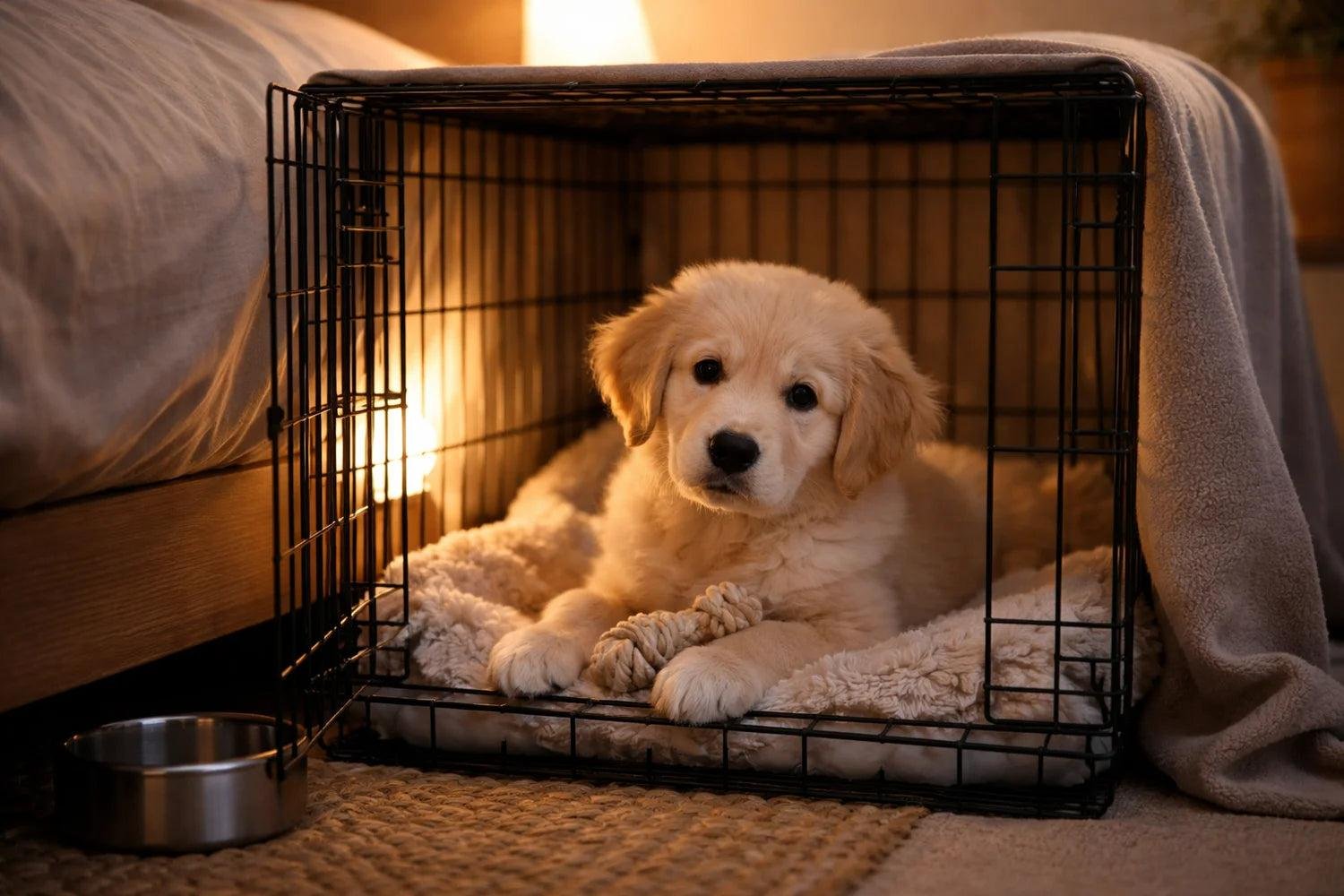
Your puppy's first week should be smaller and quieter than you expect. Keep the world tiny: one or two rooms, the same few people, the food the breeder or shelter was already feeding, a safe place to sleep, and frequent trips outside. Book the veterinary appointment for the first few days, start toilet training and name recognition immediately, and skip the visitors, the long car trips, and the meet-the-neighborhood tour. Weeks two through four are where structure, socialization and short training sessions get built on top. The plan below is what to do in each of those four weeks, in the order that actually works, plus the week-three dip that catches most new owners by surprise.
This page is the hub for our puppy content. It is written for the first 30 days specifically, which is a different job from puppyhood in general.
Before the puppy arrives
Two decisions save the most trouble later, and both are easier before you are sleep-deprived.
Decide where the puppy sleeps and where the puppy stays. A crate, a pen, or a small puppy-proofed room. Pick it now, set it up now, and do not change your mind on night two.
Decide who does what. Who does the 6am toilet trip, who does the midnight one, what the puppy is and is not allowed to do, and what word everybody uses for each thing. Puppies learn from consistency, and households are usually the inconsistent part.
Then puppy-proof at floor level: cables, shoes, houseplants, medications, small objects, and anything you would be upset to lose. Get down and look at the room from ten inches off the ground, because that is the only reliable way to see what your puppy sees.
Week 1: the new puppy first week is about settling, not training
Your puppy has just lost its mother, its littermates, its smells, and every routine it has ever had. Nothing about this week is normal for it, and nothing you see this week is a reliable picture of the dog you have. Rescue organizations often describe new arrivals as needing days to decompress before their real personality shows, and the same is true of an eight-week-old puppy arriving from a breeder.
Book the vet. A health check in the first few days is standard advice, including from the AKC and most veterinary practices. Bring any paperwork, vaccination records and worming history. This is also your chance to ask about the vaccination schedule, parasite control, and neutering timing for your individual dog, all of which are veterinary decisions rather than internet decisions.
Keep the food the same. Whatever the breeder or shelter was feeding, continue it. If you plan to change, change gradually over a week to ten days by mixing increasing amounts of the new food, which reduces the chance of stomach upset. Puppies this age generally eat three or four small meals a day, and your vet can confirm amounts for your puppy's breed and size.
Start toilet training on day one. Outside first thing in the morning, after every nap, after every meal, after every play session, and last thing at night. Go with the puppy, wait, and pay well with food the moment it finishes. Accidents indoors get cleaned with an enzymatic cleaner and no reaction at all: a puppy that has been told off for weeing indoors learns to wee out of sight, which makes house training slower.
Make the sleeping space a good place. Feed meals in it, put chews in it, and never use it as punishment. Our guide to crate training a puppy step by step covers the staged version.
Teach the name and one marker. Say the name, puppy looks, food appears. That is it. Ten repetitions a few times a day.
What to skip this week: visitors in numbers, the neighbor's dog, the pub, a long car journey, a bath, and anything that involves a crowd. There will be time. There is no rush.
Nights will be bad, and there is one reliable fix. Most puppies settle far faster if they sleep near a person for the first week or two. Put the crate or pen next to your bed, take it out for a toilet trip when the puppy wakes, and move the crate gradually to its final home over the following weeks if you want it elsewhere. Leaving a puppy alone to cry through the first night is common advice and a poor trade, because it teaches a puppy that being alone is frightening. That is the same emotional lesson that sits underneath separation anxiety later.
Week 2: routine, and the socialization that actually matters
By the second week most puppies have found their feet, and the job changes from settling to building structure.
Build the daily shape. Sleep, toilet, food, a short play or training session, then sleep again. Puppies this age need a great deal of sleep, and most "difficult" puppy behavior in the late afternoon is an overtired puppy, not a defiant one. If your puppy gets frantic and bitey around the same time each evening, try more sleep before you try more training.
Keep training sessions tiny. Two to five minutes, a few times a day, and always end while the puppy still wants more. Sit, name, and coming when called are enough for now. Everything in this house runs on reward-based methods, and our positive reinforcement dog training guide explains the mechanics of marking and paying.
Start socialization properly, and understand the tension in the advice. New owners get told two things that sound contradictory: keep the puppy home until the vaccination course is finished, and socialize the puppy during a window that closes early. The American Veterinary Society of Animal Behavior addresses this directly in its Position Statement on Puppy Socialization. Its position is that puppies should begin socialization before the vaccination series is complete, that the primary window is the first three months of life, and that more deaths in dogs under three years old are attributed to behavioral problems than to infectious disease. The statement also sets out how to do it with the risk managed, including that puppies can start classes as early as 7 to 8 weeks with at least one set of vaccines given at least 7 days beforehand.
What that means in practice: socialization is not "meeting lots of dogs at the park." It is controlled, positive exposure at a level your puppy enjoys. Carry your puppy to a bench and watch traffic. Sit in a friend's clean kitchen. Meet one calm, vaccinated adult dog you know. Handle paws and ears and pay for it. Play recordings of household noise quietly. Let the puppy investigate an umbrella, a bin bag, a bicycle, and a person in a hat, at its own pace, with food.
The exact timing for your puppy is a conversation with your veterinarian, who knows the disease risk where you live. Nothing on this page overrides that.
Watch for the wrong kind of exposure. If your puppy freezes, hides, tucks its tail, or refuses food, the situation is too much. Increase distance immediately. Forcing a frightened puppy through something teaches fear, not resilience.
Week 3: the dip nobody warns you about
Here is the thing that gets left out of almost every "first 30 days" article.
Around the second or third week, many puppies stop being polite. The puppy that was quiet and careful starts stealing socks, biting harder, testing whether "come" is optional, and having accidents in a house that seemed nearly trained. Owners read this as regression, or as their fault.
It is usually the opposite. The careful puppy of week one was a puppy that had not yet settled. The one causing trouble in week three is a puppy that feels at home, and confident puppies experiment. This is when real training starts, because now you are working with the actual dog.
Two things to expect and handle rather than panic about.
Biting gets worse before it gets better. Puppy mouthing is normal, it is how puppies explore and play, and it peaks in this period and again during teething. It is not aggression. Our guide to stopping puppy biting and building bite inhibition covers the method, and the short version is: no rough hand games, feedback the moment teeth touch skin, an appropriate thing to chew always within reach, and more sleep.
Chewing arrives with teething. Anything at floor level is a candidate. Manage the environment, provide legal chews, and see how to stop a dog chewing furniture if it is already a problem.
Also expect a possible wary phase. Puppies go through periods where things they previously ignored suddenly seem alarming. Do not force them through it, do not make a fuss, add distance, pay for calm, and it usually passes.
Week 4: making it stick
By the end of the first month you are consolidating rather than starting.
Extend alone time deliberately. Start with seconds and build. Give something good to chew, walk out of sight, come back before the puppy gets worried, and repeat. Puppies that are never left alone in the first months are the ones most likely to struggle with it later.
Widen the world slowly. New surfaces, new sounds, new places, one at a time, with food and an exit. Quality beats quantity: one calm encounter is worth more than five overwhelming ones.
Look for a good puppy class. A well-run class does controlled socialization, gives you a professional watching your puppy weekly, and catches problems early. Ask what happens if a puppy is scared and what equipment is required. If the answer includes prong collars, choke chains, or electronic collars, look elsewhere: AVSAB's 2021 Position Statement on Humane Dog Training says aversive methods should not be used and reports no evidence that they work better than reward-based training.
Book the follow-up vet visits. Vaccinations, worming, and the conversations about neutering timing and diet are ongoing, not one-off.
What honest progress looks like at 30 days
At the end of the first month, a realistic picture is: a puppy that sleeps most of the night with maybe one toilet trip, has far fewer indoor accidents but is not reliably house trained, comes when called in the house but not in the yard when something interesting is happening, still bites hands sometimes, and can be left for a few minutes without distress.
That is a good month. House training in particular usually takes several months rather than several weeks, and bladder control is a physical limitation before it is a training one. If you are behind that picture, you are not failing. If you are ahead of it, enjoy it and expect adolescence to have opinions later.
Call your veterinarian rather than waiting if your puppy has diarrhea or vomiting that persists, is not eating, is unusually lethargic, or seems painful. Puppies are small and dehydrate quickly, so a wait-and-see approach carries more risk in a puppy than in an adult dog. For behavior, if your puppy is showing intense fear, stiffening or growling over food or toys, or you cannot leave the room without panic, ask early rather than late: a certified trainer working with reward-based methods (look for CCPDT or Karen Pryor Academy certification) or a board-certified veterinary behaviorist (DACVB) is much more effective at eight weeks than at eight months.
Once you are through the first month, our hub on common dog behavior problems and their solutions covers what tends to come next.
Frequently asked questions
What should I do on the first day with a new puppy?
Keep it small. Toilet trip on arrival, one or two rooms only, the food the puppy was already eating, the sleeping space set up, and no visitors. Let the puppy explore at its own pace, and expect a lot of sleeping and some crying. Book the veterinary check for the first few days.
How long does it take for a puppy to settle in?
Most puppies look settled within one to two weeks, and the personality you see in week three or four is closer to the real one. The quiet, careful puppy of the first days is often a puppy that has not yet decompressed, which is why so many owners feel like their puppy changed.
When can my puppy go outside and meet other dogs?
That is a veterinary question, because the disease risk depends on where you live and on your puppy's vaccination status. AVSAB's position is that socialization should begin before the vaccination series is complete, done in ways that manage the risk, since the socialization window closes early. Ask your vet what is safe for your puppy, and in the meantime socialize in controlled, low-risk ways.
Should I ignore my puppy crying at night?
It is common advice and it is not the approach we would take. A puppy that has just lost its litter is not manipulating anyone. Sleeping close to a person for the first week or two settles most puppies quickly, and you can move the crate gradually afterwards. Crying can also mean a toilet trip is needed, which is worth checking before assuming it is protest.
How much should a puppy sleep?
A great deal, considerably more than most new owners expect. Puppies that seem hyperactive, frantic, and bitey in the evening are usually overtired rather than under-exercised, and enforcing nap time in a pen or crate fixes more evening behavior than extra play does.
This article is general owner guidance drawn from AVSAB's position statements on puppy socialization and humane dog training, the AKC, the ASPCA, and veterinary practice resources, verified at the time of writing. It is not veterinary advice. Vaccination timing, feeding amounts, parasite control, and neutering decisions belong with your veterinarian, who can advise for your individual puppy and your area.