
Every puppy schedule you will find online is somebody else's day with times written next to it, and it will not survive contact with yours. That is why they get abandoned in week two and why the reader feels like they have already failed.
A routine is a shape, not a timetable. This page gives you the shape and the method for putting your own hours on it.
Why the routine matters at all
Two reasons, and both are practical.
Predictability reduces stress, for the puppy and for you. A puppy that knows roughly what happens next is a calmer puppy, and much of what looks like a behavior problem in the first months is a puppy with no idea what is coming.
And most of the early training happens inside the routine rather than in training sessions. Potty training is a routine. Settling is a routine. Alone time is a routine. Getting the shape right does more work than any individual exercise.
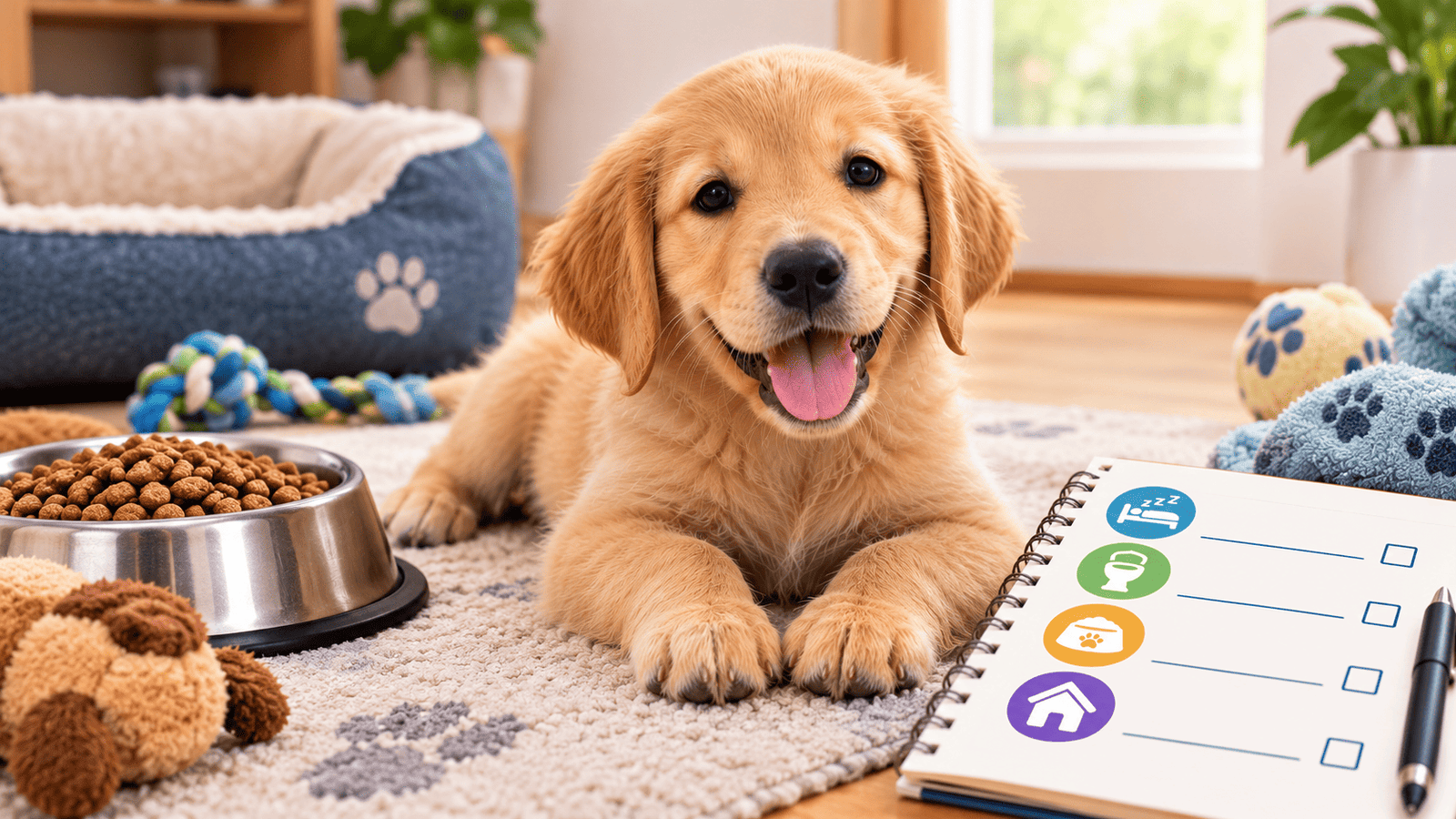
The four things it has to contain
Everything else is arrangement.
1. Sleep, and much more of it than you expect
This is the one that is missed and it causes the most trouble. Puppies sleep a great deal, and an over-tired puppy does not become quiet. It becomes frantic, mouthy and unable to settle, which is then read as a behavior problem and treated with more activity, which makes it worse.
If your puppy is worst in the evening, look at whether it has slept, not at whether it has been exercised.
We publish no hours figure, because it varies with age and with the individual. The signal is the puppy, and the practical version is: build naps into the day deliberately rather than waiting for them to happen.
The night half of this is on puppy sleep training, and the tool most people use to make daytime naps happen is the crate, on how to crate train a puppy.
2. Toilet breaks, on a rhythm rather than on a clock
The rhythm is the useful part: after waking, after eating, after playing, and regularly in between. Those four moments are more reliable than any interval, because they are tied to what the puppy just did.
We publish no interval in minutes, and the full method, including the frequency question, is on the puppy potty training schedule.
3. Meals, at consistent times
Consistent meal times make the toilet rhythm predictable, which is most of why they matter for a routine.
We publish no amounts and no meal counts. Those are on the puppy feeding schedule as general information, and for your particular puppy they are a question for your vet, who knows the breed, the growth rate and the food.
4. Deliberate time alone
The thing almost every new owner leaves out, and the one with the largest consequence.
A puppy that is never alone in the first months is a puppy that has never practiced being alone. Alone time has to be built while somebody is home to keep it short and unremarkable, and it is much harder to add later.
Start with minutes, in another room, with the puppy settled and something to do. The problem this prevents is set out on separation anxiety in dogs, and it is easier to prevent than to treat.
The other things that go in the gaps
Short training sessions. A few minutes, several times a day, beats one long session. They are also enrichment, and they tire a puppy more efficiently than walking does. Starting points are on teaching a puppy its name.
Socialization outings, which are their own project rather than part of the exercise budget. See the puppy socialization checklist, and the timing question on when puppies can go outside.
Chewing and sniffing time, which are needs rather than treats.
Handling practice, thirty seconds at a time, which is what makes grooming and vet visits possible later.
Physical activity, in the amount that suits your puppy, which is a question for your vet rather than for a rule. The widely repeated minutes-per-month figure is a rough heuristic rather than a limit, and your vet is the person who can answer it for your breed and your dog.
How to actually build it
Write down your own day first. When you get up, when you leave, when you are home, when you eat, when you go to bed. The routine has to fit that, because a routine that fights your life will not last two weeks.
Attach the four essentials to fixed points in your day, not to clock times. After I get up. Before I leave. When I get in. Before bed.
Fill the gaps with the short things, which are flexible by design.
Then write it down and put it where everyone in the house can see it, because the most common cause of a routine failing is two people doing it differently.
And expect it to change. A routine that works at ten weeks does not fit at six months, and that is the routine succeeding rather than failing.
Two things that will go wrong
The weekend. Most routines break because Saturday looks nothing like Tuesday. Keep the four essentials on the weekend even if everything else moves.
Over-scheduling. A day packed with activity is a day with no rest in it, and see point one. The gaps are part of the plan.
When something is not a routine problem
Go to your vet if house-training goes backwards after being established, if there is a change in drinking, appetite or toileting, if the puppy cannot settle at all, or if anything about the puppy's energy or behavior changes suddenly. We are a dog behavior site, not a veterinary clinic, and a behavior change is one of the things a vet appointment is for.
Get a qualified behavior professional if the puppy panics when left, or if there is growling or snapping around any part of the routine. Ask for a certified applied animal behaviorist or a veterinary behaviorist, because "dog trainer" is not a regulated title.
Frequently asked questions
My puppy was house-trained and has started having accidents again. Do I need to tighten the routine?
Take it to your vet before you rework the schedule. House-training going backwards after being established is on the list above of things to raise with a vet, along with a change in drinking, appetite or toileting, a puppy that cannot settle at all, and any sudden change in energy or behavior. A behavior change is one of the things a vet appointment is for, and we are a behavior site rather than a veterinary clinic.
Why does this page not give me clock times?
Because a published schedule is somebody else's day with times written next to it, and it will not survive contact with yours, which is why these get abandoned in week two. The method here is to write down your own day first, attach the four essentials to fixed points in it, after I get up, before I leave, when I get in, before bed, and fill the gaps with the short, flexible things.
My puppy is wild in the evening. Does it need a longer walk?
Look at whether it has slept rather than at whether it has been exercised. An over-tired puppy does not become quiet, it becomes frantic, mouthy and unable to settle, and that gets read as a behavior problem and treated with more activity, which makes it worse. This page publishes no hours figure, because it varies with age and with the individual, so the practical version is to build naps into the day deliberately rather than waiting for them to happen.
My puppy is never left on its own. Is that a good thing?
It is the omission with the largest consequence. A puppy that is never alone in the first months is a puppy that has never practiced being alone, and alone time has to be built while somebody is home to keep it short and unremarkable, because it is much harder to add later. Start with minutes, in another room, with the puppy settled and something to do. If the puppy panics when left, that is a qualified behavior professional's work, and the article's routing is a certified applied animal behaviorist or a veterinary behaviorist.
The routine falls apart every weekend. How do I stop that?
Keep the four essentials on the weekend even if everything else moves. Most routines break because Saturday looks nothing like Tuesday, and the fix is to protect sleep, toilet breaks, meals and deliberate time alone rather than to protect the whole arrangement. It also helps to write the routine down where everyone in the house can see it, because the most common cause of a routine failing is two people doing it differently.
What this page does not publish
No timetable with clock times. That is the whole argument of the page.
No feeding amounts, meal counts, sleep hours, toileting intervals or exercise durations. Those are per puppy and several of them are veterinary questions.
No aversive methods of any kind.