
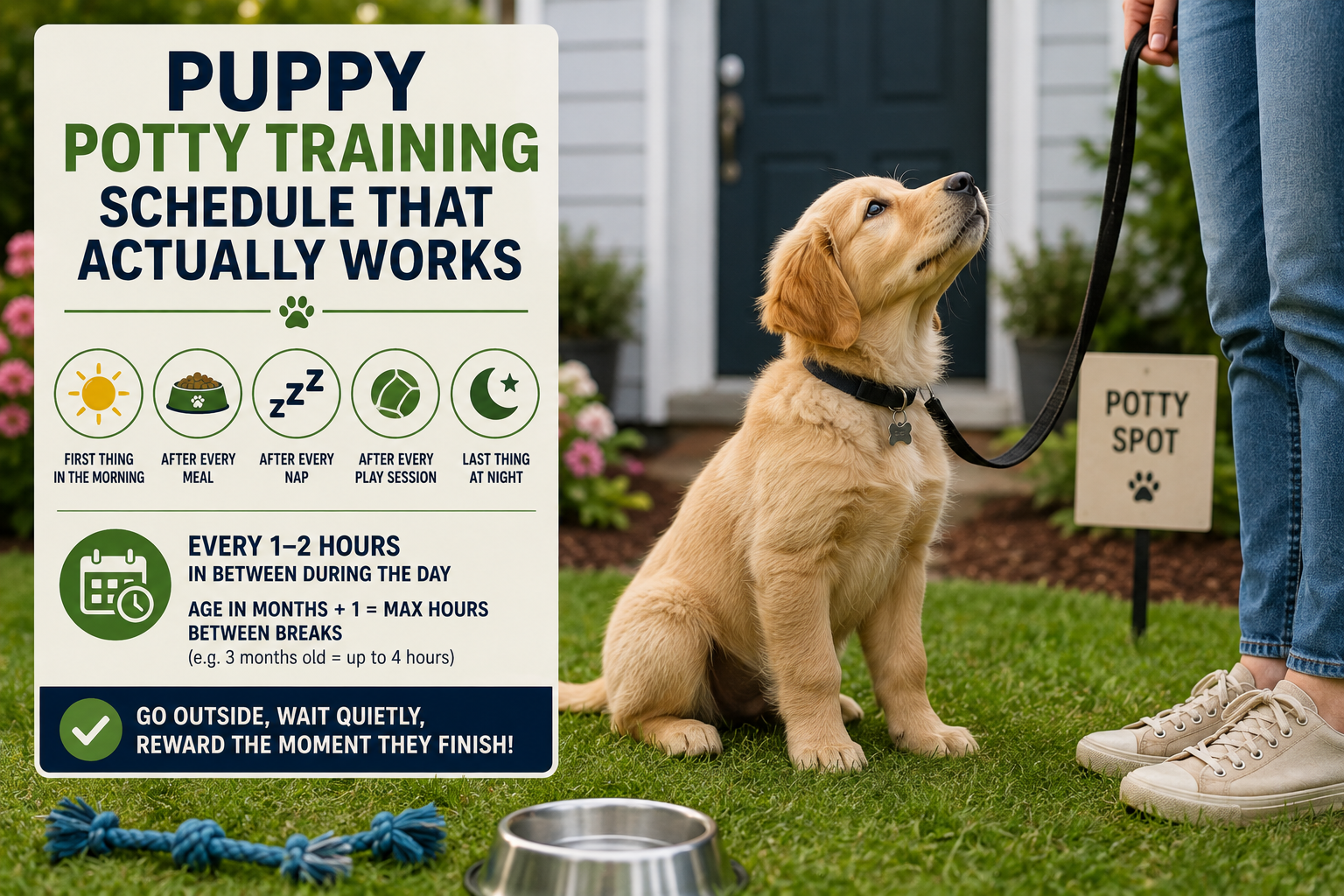
Take your puppy out first thing in the morning, after every meal, after every nap, after every play session, and last thing at night, roughly every one to two hours in between during the day. A simple rule for how long a puppy can hold it: age in months plus one equals the maximum hours between breaks, so a three-month-old puppy tops out around four hours, not all day. Go outside with your puppy, wait quietly, and reward the moment it finishes, not after you're back inside. Full house training usually takes a few months of consistency, not a few days, and accidents along the way are normal, not a sign the plan has failed.
This page covers the schedule itself, what different accident patterns actually mean, and the part most potty training guides skip: what a realistic timeline to "fully trained" looks like, and why setbacks happen even when you are doing everything right.
The schedule, by age
Bladder control is a physical limitation before it is a training one. A very young puppy simply cannot hold it as long as an older one, regardless of how well the training is going.
| Puppy age | Maximum time between breaks | Daytime frequency |
|---|---|---|
| 8-10 weeks | 1-2 hours | Every hour when awake and active |
| 3 months | About 4 hours | Every 1-2 hours, plus after every meal/nap/play |
| 4 months | About 5 hours | Every 2-3 hours |
| 5-6 months | About 6 hours | Every 3-4 hours |
| 6+ months | Up to about 6-8 hours (adult range varies) | Morning, midday, evening, night as routine settles |
These are ceilings, not targets. A puppy that can technically hold it for four hours will still have far fewer accidents on a two-hour schedule, because a full bladder plus excitement, cold weather, or a new smell is often enough to push it over.
The moments that matter more than the clock
Four situations reliably trigger the urge to go, and missing any one of them causes more accidents than a slightly-too-long gap between scheduled breaks.
Right after waking up, whether that is a full night's sleep or a ten-minute nap on the floor. Within minutes of finishing a meal or a big drink of water. After a burst of play or excitement, including greeting visitors. Last thing before bed, even if your puppy just went twenty minutes ago.
Take your puppy to the same spot outside each time. The scent left behind becomes a cue that speeds up learning.
What an accident is actually telling you
Most potty training guides treat every indoor accident the same: clean it up, try again. In practice, the timing and pattern of accidents are diagnostic, and reading them correctly saves weeks.
Accidents right after being let out of the crate or a confined space usually mean the schedule is too loose for this puppy's current bladder control. Tighten the gap between breaks rather than adding more corrections.
Accidents during high excitement, like a visitor arriving, can be submissive or excitement urination rather than a house training failure. This tends to fade as puppies mature and often responds better to calmer greetings than to more potty breaks.
Small, frequent dribbling rather than a full accident, especially in a puppy that seems otherwise well, is worth a call to your veterinarian rather than more training. Urinary tract issues can look exactly like a stalled house training plan, and no amount of scheduling fixes a medical cause.
A sudden run of accidents in a previously reliable puppy is common around developmental stages such as adolescence, and is usually not a reason to start over. It is a reason to briefly go back to a tighter schedule and more supervision.
The part nobody puts on the schedule: how to respond in the moment
What you do in the ten seconds around an accident matters more than the schedule itself.
Catch it, don't punish it. If you see your puppy starting to go indoors, an upbeat interruption and a fast trip outside works. Finishing outside still earns a reward. Punishing a puppy after the fact, even by pointing at the mess, does not connect to the act of eliminating in your puppy's mind. What it does teach is that going to the bathroom in front of you is risky, which makes a puppy start hiding to go, including behind furniture where you are less likely to catch and redirect it.
Clean with an enzymatic cleaner, not a household surface cleaner. Standard cleaners can leave a scent trace a dog's nose still picks up, which pulls the puppy back to the same spot.
Reward the outside success itself, not the walk back inside. A puppy that gets praised and paid the instant it finishes, while still outside, learns faster than one that gets a treat once you're both back in the kitchen.
Confinement and supervision do most of the real work
A schedule only works if accidents can't happen unsupervised in between. Three tools do this:
Crate or pen when you can't watch. Most dogs avoid soiling a space that small if it is sized correctly (room to stand, turn, and lie down, not much more), which is part of why crate training and potty training are usually built together. Our guide to crate training a puppy step by step covers sizing and the settling-in process.
A tether or leash indoors when the puppy is out of the crate but you're busy, so you catch the early signs (circling, sniffing, heading to a doorway) before they become a puddle.
A consistent potty spot outside, reached the same way every time, so the walk itself becomes part of the routine rather than a distraction.
A realistic timeline, honestly stated
Most sources describe a puppy as reliably house trained somewhere between four and six months old, and some puppies, especially smaller breeds with smaller bladders, take longer. That is a timeline measured in months of consistency, not a weekend project. If your puppy is regularly accident-free for two to four weeks straight and then has a setback, that is a normal part of the process, not evidence the plan has failed. If accidents are frequent, sudden, or paired with straining, blood, increased drinking, or unusual lethargy, treat that as a question for your veterinarian rather than a training problem, since it may be medical rather than behavioral.
Everything on this page builds on the routine described in our first 30 days plan for a new puppy, which starts potty training on day one alongside settling in and sleep. If nighttime accidents specifically are the sticking point, our guide to puppy sleep and settling at night covers the last-break-before-bed routine in more detail. Marking behavior in an older puppy or adult dog is a different pattern with a different fix, covered in how to stop a dog marking indoors.
Frequently asked questions
How often should I take a puppy out to potty?
Roughly every one to two hours during the day for a young puppy, plus immediately after waking, eating, playing, and before bed. Use the age-in-months-plus-one rule as an upper limit on how long a puppy can comfortably hold it, not as the schedule itself.
How long does it take to fully potty train a puppy?
Most puppies are reliably house trained somewhere between four and six months of age, with real variation by size and individual puppy. Consistency in the schedule matters more than any single technique.
Should I punish my puppy for accidents?
No. Punishing after the fact does not teach a puppy to stop going indoors; it teaches a puppy to hide when it goes, which makes accidents harder to catch. Interrupt gently if you see it happening, take the puppy outside, and reward the finish outside.
Why does my puppy keep having accidents right after I let it out of the crate?
That pattern usually means the time between breaks is longer than the puppy can currently hold, not that the training is failing. Shorten the gap between potty breaks and reassess as the puppy gets older.
My puppy was doing well and suddenly started having accidents again. What happened?
A short regression is common, especially around growth spurts or routine changes, and usually resolves by briefly tightening supervision and the schedule. If it is sudden, frequent, or comes with other symptoms like straining or lethargy, check with your veterinarian to rule out a medical cause first.
This article is general owner guidance drawn from AKC and veterinary practice resources on house training, verified at the time of writing. It is not veterinary advice. A sudden or persistent change in a puppy's toileting pattern is worth a call to your veterinarian.