
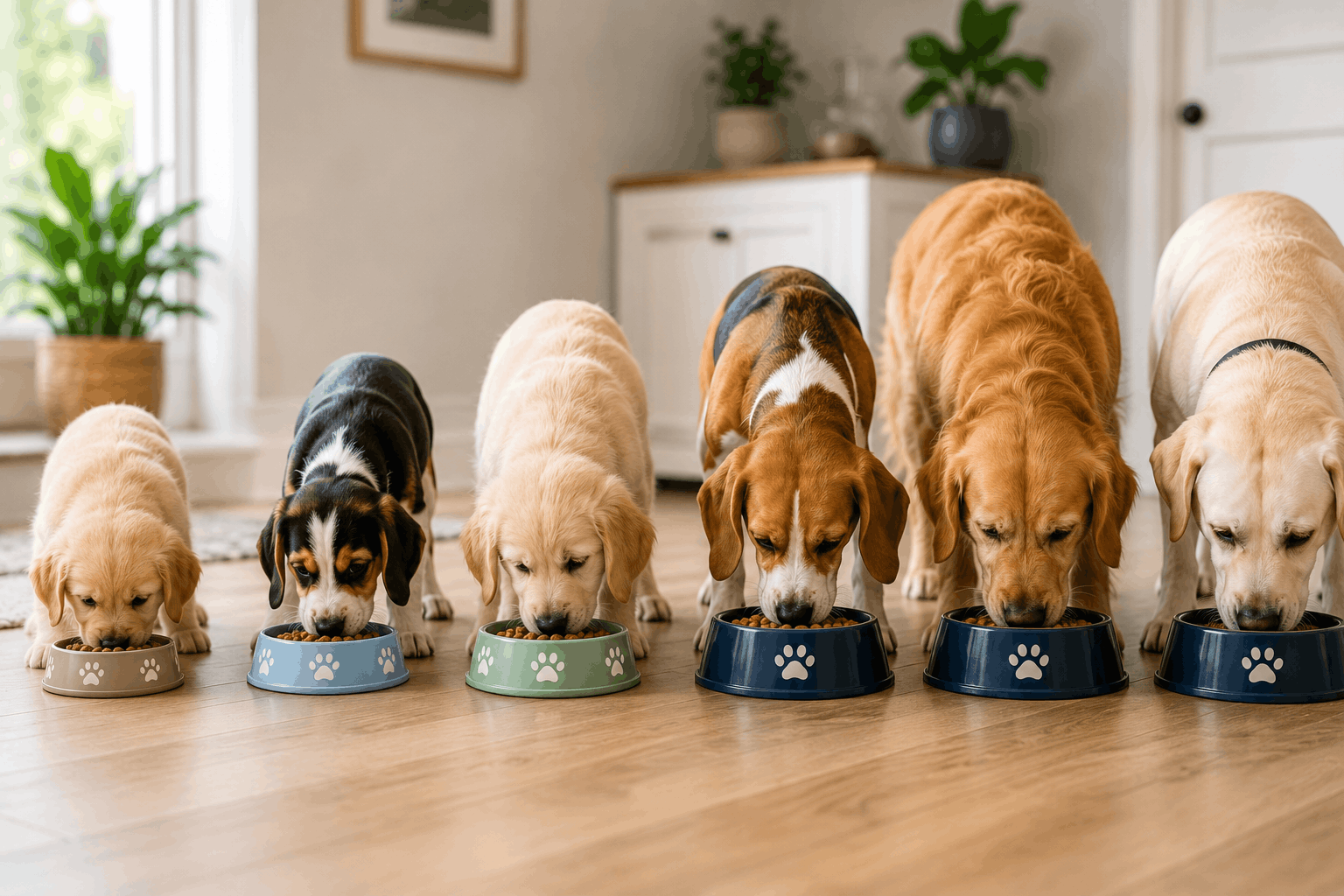
The Merck Veterinary Manual's routine care guidance for dog owners sets meals by age: four daily meals at 6 to 12 weeks, three from 3 to 6 months, two from 6 to 12 months, and one or two daily meals after 12 months. Merck's professional feeding guidance puts it slightly differently, three meals a day from weaning to six months and two from six to twelve months, and adds that small-breed puppies may have to be fed more than three times a day. Both are ranges rather than rules. This page covers how often. It does not tell you how much, because the amount depends on your specific food and your individual dog, and that number belongs to your veterinarian.
One thing before the schedule. If a dog, particularly a large or deep-chested one, is retching without bringing anything up, drooling heavily, pacing and unable to settle, or its abdomen looks distended, that is an emergency and it goes to a veterinarian or an emergency clinic immediately, not into a feeding plan.
The feeding schedule by life stage
| Life stage | Meals per day | Source |
|---|---|---|
| 6 to 12 weeks | 4 | Merck Veterinary Manual, puppy care, dog owner guidance |
| 3 to 6 months | 3 | Merck Veterinary Manual, puppy care |
| Weaning to 6 months | 3, and more than 3 for some small breeds | Merck Veterinary Manual, feeding practices in small animals |
| 6 to 12 months | 2 | Merck, both the owner guidance and the professional section |
| Adult, over 12 months | 1 or 2 | Merck Veterinary Manual, puppy care table |
| Adult, portion control | 2 premeasured meals at set times | Merck, feeding practices in small animals |
| Senior | No separate frequency given | Merck sets meal frequencies for puppies and adults and does not set a different one for older dogs |
Notice that the same authority prints two slightly different puppy numbers in two places. That is not sloppiness, it is the honest shape of the answer. Meal frequency is a band that works, not a dose, and inside that band the schedule that fits your household is usually the right one.
What actually changes across the life stages
The table is the easy part. The reason behind it is what tells you when to deviate.
Puppies eat often because they cannot store much. A young puppy is growing fast on a small body with limited reserves, so the same daily food does more good spread across several meals than dumped into one. As the puppy grows, its capacity grows and its growth rate slows, which is why the schedule steps down rather than staying at four meals forever.
Adults eat on a schedule mostly because of what the bowl does to their weight. Merck's guidance is that the best regimen for preventing obesity in most adult dogs is portion controlled feeding, for example two premeasured meals at regular times each day, and that while some adult dogs can be fed free choice, most cannot without becoming obese. The frequency here is doing a different job than it did in puppyhood.
Older dogs are the stage nobody has a clean number for. Merck's feeding guidance sets frequencies for puppies and for adults and does not set a separate one for older dogs. What usually changes with age is not the number of meals but appetite, body condition, dental comfort and whatever health conditions have appeared, all of which are your veterinarian's territory rather than a chart's. If an older dog's appetite or weight changes, that is a reason to book a visit, not a reason to guess at a new schedule.
Small and toy breed puppies: why the gap between meals matters more
This is the part that general feeding charts skip, and it is the reason Merck flags small breeds separately.
Very young puppies have not fully developed the ability to hold their blood glucose steady, and small ones have the least room for error. Metropolitan Veterinary Associates, a specialty and emergency veterinary hospital, describes small breed puppies as at a greater disadvantage because they have a relatively higher metabolic rate, on top of the limited energy reserves young animals have generally. A long gap between meals is a bigger event for a two pound puppy than for a Labrador.
The signs that veterinary hospital lists for low blood sugar are weakness, lethargy, poor appetite, altered mentation, twitching, tremoring, seizures and coma. Any of those is an immediate veterinary emergency, not a feeding adjustment. Do not try to treat it at home and do not put anything into the mouth of a puppy that is not fully alert. Phone the clinic or the nearest emergency clinic, tell them what you are seeing, and go.
For prevention, the publishable part is frequency, and Merck's line is the one to work from: small-breed puppies may have to be fed more than three times a day. How many more, and how much at each meal, is a question for the vet who can see the puppy. If your puppy is very small, ask at the first appointment rather than working it out from a website. The puppy vaccination schedule visits are a natural place to raise it, since you will be in the room anyway.
Free feeding or scheduled meals: an honest trade off
Most pages treat this as settled. It is not quite.
The case for scheduled meals is strong and it is what Merck's obesity guidance points at: portion controlled meals for most adult dogs, because free choice feeding makes most of them fat. Scheduled meals also give you something free feeding hides completely, which is a daily, unmissable signal of whether your dog is eating normally. In a house with a bowl always down, a dog that has gone off its food can lose a day or two before anyone notices, and appetite is one of the earliest things owners can actually observe.
The case for free feeding is narrower but real: Merck does allow that some adult dogs can be fed free choice, and a dog that self regulates well and lives alone is a different situation from a competitive multi dog household.
What tips it for most homes is not weight at all, it is the rest of the day. Predictable mealtimes make house training predictable in puppies, they give you a reliable moment to practice calm behavior, and they take food off the floor for the hours in between. If your dog scavenges, a bowl that is down all day is working against you, and so is the habit that starts at the table. Those are the same problems covered in how to stop a dog counter surfing and how to stop a dog begging at the table.
What the once a day research actually found
In 2022, Bray and colleagues published an analysis of Dog Aging Project data in the journal GeroScience, and it is the reason you may have seen headlines saying dogs should eat once a day.
What the study found: among 24,238 dogs in the health analysis, and 10,474 in a separate cognitive analysis, dogs fed once daily had lower scores on a canine cognitive dysfunction scale and lower odds of gastrointestinal, dental, orthopedic, kidney and urinary, and liver and pancreas disorders than dogs fed more often.
What the study did not find, in the authors' own words: causation. It is a cross sectional analysis, meaning every dog was measured once, and the authors say plainly it cannot establish causality and that longitudinal data would be needed. They also raise the obvious alternative explanation themselves. They cannot rule out that owners shifted to more frequent feeding because their dog had a health condition, which would produce exactly this pattern with the arrow pointing the other way. A dog with a sensitive stomach gets fed little and often, and then shows up in the data as a frequently fed dog with a gastrointestinal disorder.
So the honest reading is that once daily feeding in adult dogs is not the reckless choice a lot of pages imply, and it is also not a proven upgrade. It is inside Merck's stated adult range of one or two meals. If your adult dog is healthy and does well on one meal, the evidence does not tell you to change. If it does well on two, the evidence does not tell you to change that either.
Large and deep chested dogs, and the part of the literature that is genuinely contested
Read this section knowing the ending first: gastric dilatation volvulus, commonly called bloat, is a surgical emergency. Cornell University's Riney Canine Health Center describes it as requiring immediate medical and surgical intervention, and lists the signs as nonproductive retching or attempts to vomit, excessive drooling, panting, a bloated abdomen, abdominal pain, restlessness and pacing, pale gums, weakness or collapse, and a praying position with the front end down. If you see those, you drive to a clinic. Nothing on this page is a reason to wait and watch.
Now the contested part, because it bears directly on how often you feed.
Cornell's risk factor list includes feeding once daily or a large volume of food per meal, alongside large breed size, deep chest, a first degree relative with GDV, eating too quickly, older age, nervous temperament, a raised food bowl, and exercising soon after eating.
The prospective cohort study most often cited on this, Glickman and colleagues in the Journal of the American Veterinary Medical Association in 2000, followed 1,637 dogs of eleven large and giant breeds and found that increasing age, having a first degree relative with a history of GDV, faster speed of eating and a raised feeding bowl were significantly associated with increased risk. Meal frequency was not what that model highlighted.
Even the raised bowl finding has been challenged. A 2017 knowledge summary by Louise Anne Buckley in the peer reviewed journal Veterinary Evidence reviewed the available studies and found the evidence conflicting, with only one of two studies showing a significant association, and concluded that in the absence of further evidence the safest advice for at risk dogs is to feed from a bowl on the floor.
What that adds up to for a household with a Great Dane or a deep chested breed: the specifics of bloat risk are unsettled, the sources disagree with each other, and this is exactly the conversation to have with your own veterinarian rather than with a chart. The measures the sources do broadly agree on are unglamorous: split the day's food into more than one meal rather than one large one, slow down a dog that inhales its food, keep the bowl on the floor unless your vet has a reason to raise it, and do not exercise hard right after eating. Ask your vet about prophylactic gastropexy if you have a high risk breed, because that is a surgical decision and belongs to them.
The one situation where changing the schedule is a treatment
There is a specific pattern where meal timing is the answer, and it still starts with a vet.
Deborah E. Linder, DVM, MS, DACVIM (Nutrition), writing for Petfoodology at the Cummings School of Veterinary Medicine at Tufts University, describes bilious vomiting syndrome as a dog vomiting yellow fluid or froth but not food after going a long period without eating, typically the overnight gap between dinner and breakfast. The approaches she describes are smaller and more frequent meals, or a late evening meal to shorten the fasting window.
The caution attached to it is the important half. She writes that it is important to consult your veterinarian to rule out other causes of vomiting, some of which can be serious, before assuming this is what is happening. A dog vomiting in the morning is not a schedule problem until a vet has said it is one.
Where a feeding schedule stops and a vet call starts
Frequency is a routine question right up until it is not. Contact your veterinarian if your dog is losing weight, refusing food or eating noticeably less, vomiting repeatedly, has diarrhea that persists or contains blood, seems lethargic, or has a distended or painful abdomen. Do not adjust meals and wait a few days to see. Puppies in particular have small reserves and decline quickly, so the threshold for phoning about a puppy is lower than for an adult dog.
Three situations are outside what any general article can answer, and they go straight to a veterinarian:
- A puppy with a suspected medical condition. Feeding frequency is part of the treatment plan then, not a lifestyle choice.
- Pregnant and nursing dogs. Their energy needs change dramatically through pregnancy and lactation, and the schedule is set case by case.
- Dogs with diabetes. Meal timing is tied to insulin and is prescribed by the vet who manages the case. Never change it based on a web page.
Making the schedule work in a real household
Consistency does more than the exact number. Meals at roughly the same times each day make a puppy's toilet routine predictable and give an adult dog a settled shape to the day, which is one reason feeding times feature in the new puppy first week guide.
Feed in a consistent place, away from the household traffic path, and pick the bowl up afterward. In a multi dog home, feed separately, ideally behind a closed door, and supervise the preparation as well as the meal. If a dog stiffens, freezes, eats faster when someone approaches or hovers over the bowl, do not test it and do not take the bowl away to make a point. The reward based alternative is in our guide to resource guarding around food, and anything involving teeth goes to a veterinary behaviorist, credentialed Dip ACVB, or a certified applied animal behaviorist, CAAB or ACAAB.
When you step down a stage, from four meals to three or three to two, keep the total food for the day the same and just redistribute it. Households routinely underfeed a growing dog by accident at exactly this moment, because dropping a meal feels like dropping a portion.
FAQ
How many times a day should I feed an adult dog?
Merck's owner guidance gives one or two daily meals for dogs older than 12 months, and its obesity guidance favors portion controlled feeding, for example two premeasured meals at set times. Two is the common default, one is inside the recommended range for a healthy adult.
Is it bad to feed a dog only once a day?
For a healthy adult dog it is within Merck's stated range. The 2022 Dog Aging Project analysis in GeroScience even found once daily fed dogs had lower odds of several health problems, but the authors state it is cross sectional and cannot show cause. For large and deep chested breeds, some sources including Cornell list once daily feeding among bloat risk factors, so that is a conversation for your vet.
How often should I feed a small or toy breed puppy?
More often than a larger puppy. Merck's feeding guidance says small breed puppies may have to be fed more than three times a day, because very young small dogs are least able to hold their blood glucose steady across a long gap. Confirm the number with your veterinarian rather than a chart.
Do senior dogs need to eat more often?
Merck sets meal frequencies for puppies and adults and does not set a separate one for older dogs. What changes with age is usually appetite, body condition, teeth and health status, so a change in an older dog's eating is a reason to see the vet rather than to redesign the schedule yourself.
Can I leave food down all day instead?
Merck's position is that some adult dogs can be fed free choice but most cannot without becoming obese, and portion controlled meals are recommended for most. Meal feeding also shows you immediately when a dog goes off its food, which a full bowl hides.
The short version
- Merck Veterinary Manual, owner guidance: 4 meals at 6 to 12 weeks, 3 from 3 to 6 months, 2 from 6 to 12 months, 1 or 2 after 12 months.
- Merck, professional feeding guidance: 3 meals from weaning to 6 months, 2 from 6 to 12 months, and more than 3 for some small breed puppies. Two numbers from one authority, because this is a band and not a dose.
- Adults: portion controlled meals at set times are the anti obesity default. Most adult dogs cannot be free fed without gaining weight.
- Seniors: no separate frequency is specified. Changes in appetite or weight are a vet visit.
- Small and toy breed puppies: feed more often, and treat weakness, tremors, twitching or collapse as an emergency, not a meal.
- Large and deep chested breeds: the bloat literature genuinely disagrees with itself on meal frequency and raised bowls. More than one meal, slower eating, floor level bowl and no hard exercise straight after eating are the points of agreement. Bloat signs mean the emergency clinic now.
- The amount is not on this page. Frequency is publishable, quantity is your veterinarian's.