
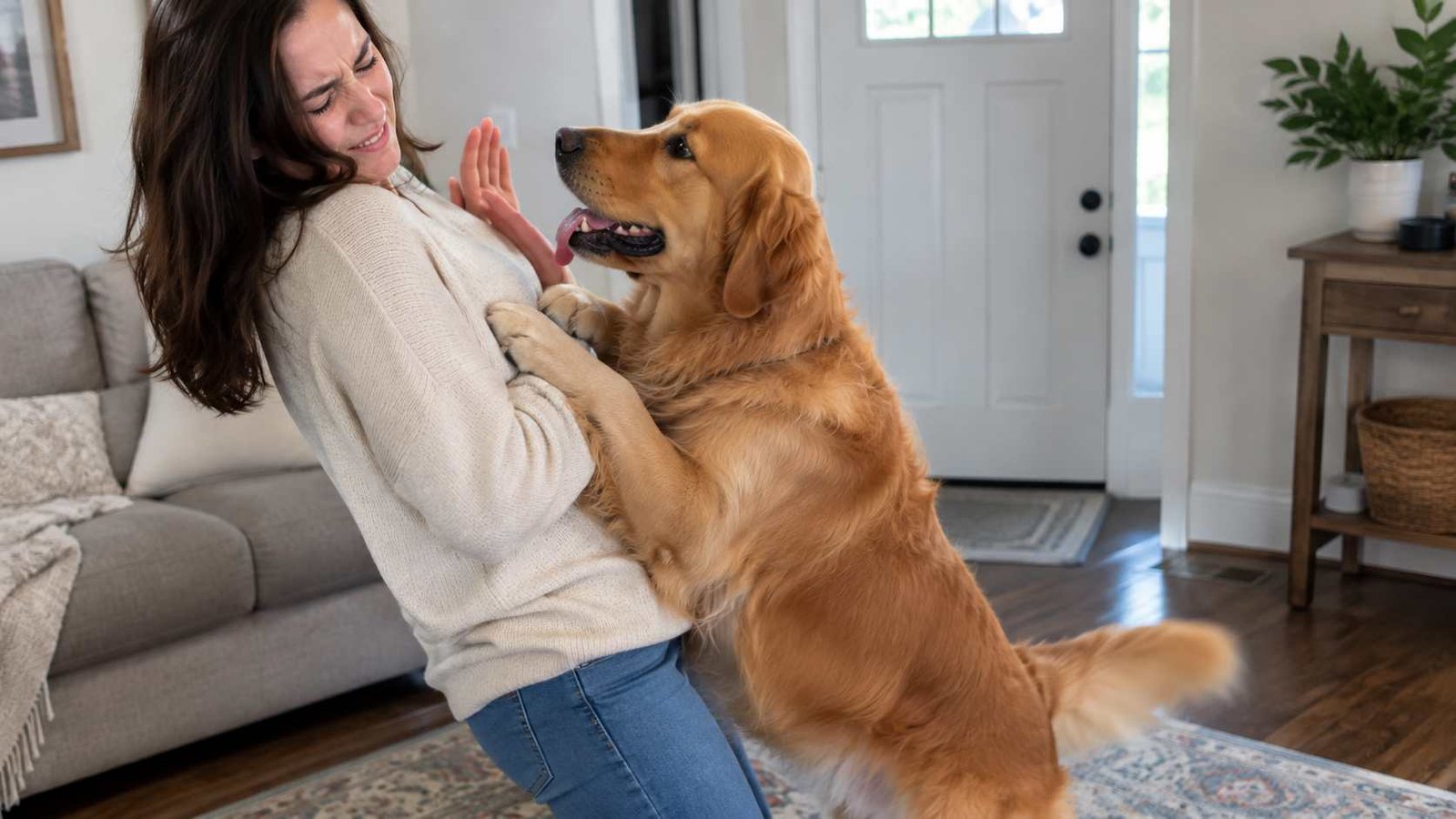
To stop a dog jumping on people, make jumping stop paying and make four paws on the floor pay instead. Dogs jump because it gets them attention, and even a push or a "no" counts as attention. So when your dog jumps, turn away and go still. The moment all four paws land, calmly reward with attention or a treat. Then teach a sit greeting, manage visits with a leash or gate while you train, and get every person your dog greets to follow the same rule. Consistency across people is what fixes it.
That is the whole method. The rest of this guide explains why it works, how to run it step by step, and why the part most owners skip (everyone else) is the part that decides whether it works.
Why dogs jump on people in the first place
Jumping is a greeting. Dogs greet each other face to face, and our faces are a long way up. A dog that jumps is usually trying to get closer to the part of you that talks, smiles and looks at them.
It also works. Most dogs learn early that jumping gets a reaction: a laugh, a pat, eye contact, a hand pushing them down, their name said loudly. To a dog, all of that is attention, and attention is the reward they were after. The American Veterinary Society of Animal Behavior (AVSAB) makes the general point in its position statement on dominance theory (read September 11, 2026): most unwanted behavior in pets comes from accidentally rewarding it, not from a dog trying to rank above its people. Jumping is a textbook case.
That matters because it tells you what not to do. A dog that jumps is not challenging you, so there is nothing to "win." Older advice to knee a dog in the chest, step on its back toes, squeeze its paws or spray it in the face is punishment. It can hurt a dog, frighten it, and teach it that people coming close is unpleasant. AVSAB's guidance on reward-based training methods (read September 11, 2026) recommends reward-based methods only and lists fear, anxiety, stress and aggression among the documented risks of aversive methods. A dog that learns greetings are scary is a worse problem than a dog that jumps.
Step 1: Take away the payoff for jumping
The first job is to make jumping boring.
- When your dog jumps, turn away. Fold your arms, turn your side or back, and look away. Say nothing.
- Wait for four paws on the floor. It may take a few seconds at first. Stay still and quiet.
- The instant all four paws land, reward. Turn back, say a calm "yes" or "good," and give a small treat low, near the floor, or offer quiet praise and a gentle stroke under the chin.
- If your dog jumps again as you turn back, repeat. Turn away again and wait.
Keep your greeting low-key. A big, excited hello winds your dog up and makes the next jump more likely. Calm attention for calm behavior is the deal.
If your dog is persistent, step out of the room or behind a gate for a few seconds when the jumping starts, then come back in and try again. Leaving takes away the thing the dog wanted most, which is you.
Step 2: Teach a sit greeting to replace it
Taking away the payoff tells your dog what does not work. A replacement behavior tells them what does. Dogs cannot sit and jump at the same time, so a sit is the most useful greeting to teach.
- Teach sit in a quiet moment first, away from any greeting, with treats. If your dog does not yet know sit, practice it in short sessions before you ask for it at the door.
- Practice greetings you control. Walk out of the room, come back in, and ask for a sit before your dog has a chance to jump. Reward the sit with a treat and calm attention.
- Make the reward bigger than the jump ever got. A sit should earn your attention, a treat, and sometimes a short game. Your dog should find that sitting is the fastest way to get you.
- Add excitement slowly. Once sit greetings work when you walk in calmly, practice after a short absence, then after a longer one, then when you come home carrying bags.
Some dogs find it easier to keep four paws down than to hold a full sit when they are excited. "Four on the floor" is a fine goal too. Pick one and reward it every time.
Our positive reinforcement dog training guide covers how markers, timing and reward size work if you want the method behind these steps.
Step 3: Manage visitors while you train
You cannot train every greeting, so you have to prevent the ones you cannot train. Every time your dog jumps on a guest who laughs and pets them, jumping gets paid again.
- Use a leash or a gate when guests arrive. A leashed dog can still greet, but you control the distance. A dog behind a baby gate can see visitors without practicing the jump.
- Let the excitement drop before greeting. Many dogs are at their jumpiest in the first minute. Let visitors come in and settle first, then bring your dog over on leash to practice a sit greeting.
- Give your dog a job. A toy to carry, a scatter of treats on the floor, or a chew in another room gives them something to do other than launch at the door.
If the doorbell sets off a barking and bouncing spiral, the arrival itself may need its own plan first. Our guide to a dog that barks at the doorbell breaks that routine into stages.
Step 4: Put everyone on the same script
This is the step that decides whether the whole plan works, and it is the one most guides give a single line.
Jumping is kept alive by whoever still pays for it. If you turn away every time but a family member laughs and pats, or a neighbor says "I don't mind, I love dogs," your dog learns that jumping still works on some people. A behavior that pays some of the time is often harder to stop than one that pays every time, because the dog keeps trying.
| Who greets your dog | What usually happens | What to ask for instead |
|---|---|---|
| You and your household | Mixed: some turn away, some pat the jumping dog | Same rule for everyone: turn away for jumps, reward four paws |
| Visitors who "don't mind" | Pet the dog while it jumps | "Please wait until he sits, then say hi" |
| Strangers on walks | Bend down and encourage it | Ask them to wait, or skip the greeting that day |
| Children | Squeal, run or wave arms, which excites the dog more | Children stand still like a tree and let an adult manage the dog |
It is fine to tell people plainly what you need. "We are teaching him to sit to say hi, so please ignore him until he sits" is a normal thing to ask. If you cannot count on a person, keep your dog on leash or skip that greeting.
Child safety comes first
A jumping dog can knock a small child over, scratch a face, or frighten a child who then screams and runs, which can excite the dog even more. Until the jumping is reliably fixed, keep your dog on leash or behind a gate when young children visit, and never leave a child alone with a dog, even a friendly family dog. The American Veterinary Medical Association says exactly that in its dog bite prevention guidance (April 2026 Dog Bite Prevention Week release, read September 11, 2026): never leave children unsupervised with dogs, because even familiar, well-trained family pets can react unpredictably.
Teach children in your home to "be a tree" when a dog jumps: stand still, fold their arms, and look away. That is safer than running, and it is the same rule the dog is learning from adults.
When jumping is not just a greeting problem
Most jumping is plain excitement, and the steps above are the fix. Some situations need a different first step.
If the jumping comes with hard mouthing, grabbing clothes, growling or snapping, treat it as more than a manners issue. A young dog that mouths hard when excited may still be learning bite inhibition; our plan for how to stop puppy biting covers that stage. In an adult dog, grabbing or snapping during greetings deserves a professional look.
If jumping is new, sudden or out of character, see your veterinarian first. A change in behavior can have a medical cause. The Merck Veterinary Manual's owner guide to diagnosing behavior problems in dogs (read September 11, 2026) stresses ruling out medical causes, including pain, before treating a behavior problem. The same applies if your dog seems restless or unsettled in ways that are new.
If your dog jumps at people out of worry rather than joy, for example jumping, then backing off, barking, or jumping at strangers but not at family, fear may be part of it. Our guide for a dog that is scared of strangers describes that pattern and routes it safely.
If there is any bite history or aggression toward people, do not work on it alone. Start with your veterinarian to rule out pain and illness, then work with a board-certified veterinary behaviorist (the American College of Veterinary Behaviorists lists its diplomates, who use the initials DACVB, in a public directory, read September 11, 2026) or a certified trainer who uses only reward-based methods. AVSAB's advice for choosing a trainer is simple and easy to check: pick one who uses food to train.
How long it takes, honestly
There is no fixed timeline, and any page that promises one is guessing. A young puppy who has only jumped for a few weeks usually has a shorter history to undo than an adult dog who has been paid for jumping for years. What speeds it up is the same every time: fewer rewarded jumps (management), more rewarded sits (training), and the same rule from every person.
Expect a burst of extra jumping at first. When a behavior that used to work stops working, many dogs try harder for a while before giving up on it. That is a sign the plan is working, not a sign it failed. Keep turning away, keep paying the sit, and the effort fades.
Frequently asked questions
Why does my dog only jump on some people?
Usually because those people still reward it, even by accident, with eye contact, laughter or a pat. Some dogs also jump more on people who get excited back. Ask everyone to follow the same rule, and manage greetings with the people who will not.
Is it OK to push my dog down or say no when it jumps?
Pushing and scolding are still attention, so they often keep the jumping going. Kneeing, stepping on toes and spraying water are punishment, which AVSAB's reward-based guidance advises against because of the risk of fear and stress. Turning away and rewarding four paws on the floor works without those risks.
My dog jumps on me when I come home. Should I ignore it completely?
Ignore the jump, not the dog. Stay calm and still until all four paws are down, then greet quietly. Keeping your homecomings low-key helps your dog stay calmer in that first minute.
When should I get professional help for jumping?
If jumping comes with growling, snapping, hard grabbing or any bite, or if it started suddenly in a dog that did not do it before. Begin with your veterinarian to rule out pain or illness, then a board-certified veterinary behaviorist or a certified reward-based trainer.
The short version
Jumping is a greeting that got paid. Stop paying it, pay a sit instead, manage the moments you cannot train, and get everyone on the same script. Keep children safe while you work on it, and if the jumping comes with fear, grabbing or a sudden change, see your vet first. Calm, consistent and reward-based takes longer to explain than a quick correction, but it teaches your dog what to do instead, and that is what makes it last.