
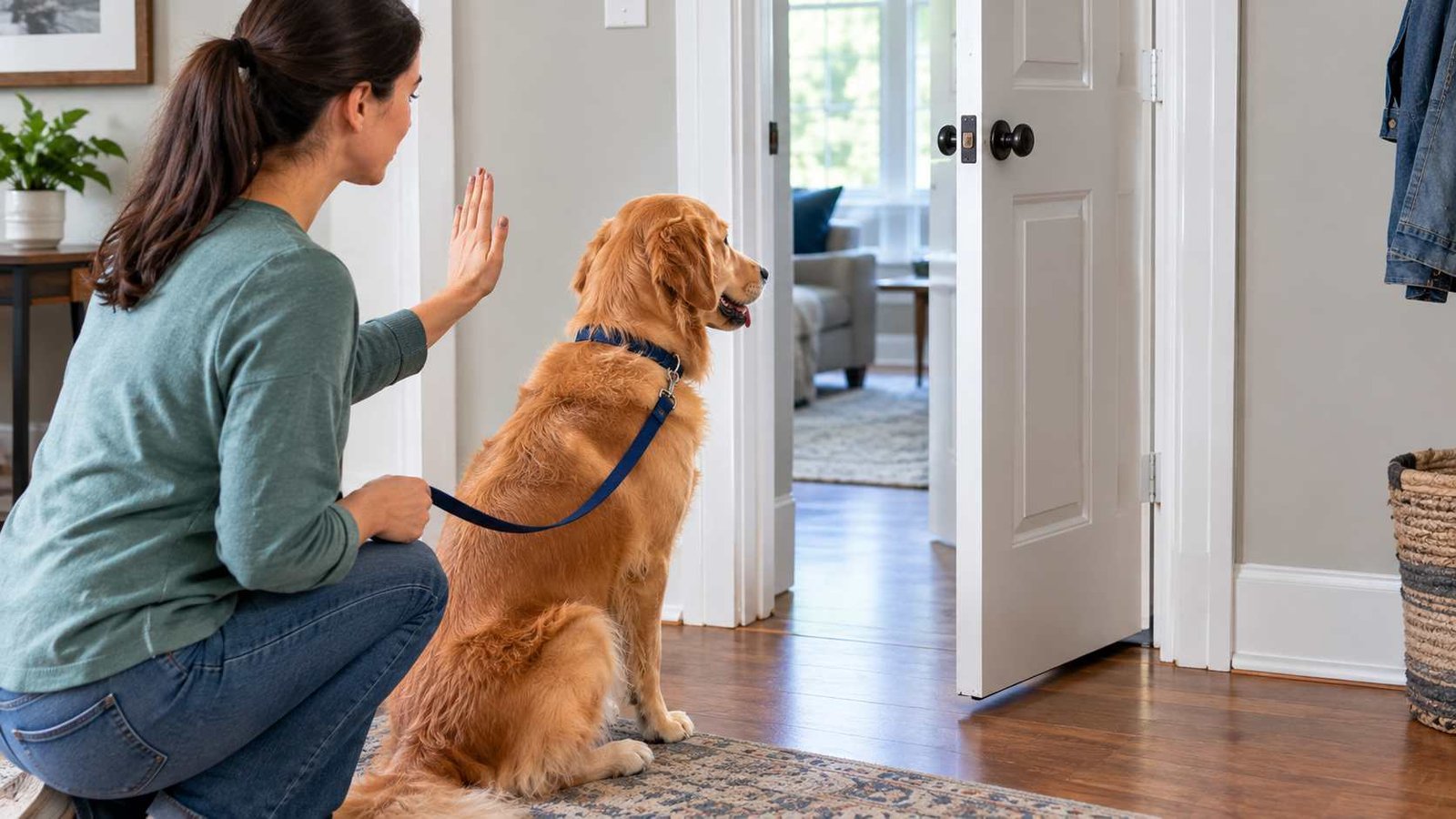
To teach a dog to wait at the door, start at an inside door with your dog on leash, open the door a crack, and gently close it again if your dog moves toward the gap. The moment your dog holds still, mark it with "yes," reward, and open a little wider. Build up in tiny steps until the door can open fully while your dog stays put, then walk through together only when you say a release word such as "okay." The release word is the real lesson: the door opening is no longer the signal to go. Your voice is.
A dog that bolts through an open door can end up in traffic or lost. A calm doorway wait is one of the most practical safety skills you can teach, and it takes short, patient sessions rather than any force at all.
Wait vs stay: what you are actually teaching
Owners often use "wait" and "stay" as the same thing, but they are handy as two different cues.
| Wait | Stay | |
|---|---|---|
| What it means | "Pause here until I release you" | "Hold this exact position until I come back" |
| Position | Any position is fine: sit, stand or lie down | Usually a set position, such as sit or down |
| How long | Short, a few seconds to a minute | Can be longer |
| How it ends | A release word, then the dog moves forward | You return to the dog, then release |
| Typical use | Doors, car doors, crate doors, before crossing into a room | Settling while you do something else |
For doors, a wait is the simpler goal. Your dog can shift from sitting to standing and that is fine. What matters is that they do not move forward through the doorway until you say so.
Before you start
Pick a release word and use it every time. "Okay," "free" or "let's go" all work. Say it, then let your dog move forward. Without a clear release word, dogs guess when the wait is over, and they usually guess early.
Start at an inside door. A bedroom, bathroom or closet door is ideal. If your dog gets past you during practice, they end up in the hallway, not the street.
Keep your dog on leash. Hold the leash loosely. It is a safety line, not a tool for pulling your dog back.
Use small, soft treats your dog likes, and practice when your dog is a little calm rather than wildly excited. A short play session first can help.
If your dog is a puppy still learning to pay attention to you, it helps to have the basics of name recognition in place first. Our guide to teaching a puppy its name and basic cues covers those building blocks.
How to teach your dog to wait at the door, step by step
- Stand at the door with your dog beside you. Put your hand on the handle.
- Open the door just an inch or two. If your dog stays still, say "yes" and give a treat right away. Close the door.
- If your dog moves toward the gap, gently close the door before they reach it. Never close it on your dog or use it to bump them. You are simply taking away the opening. Wait a moment and try again with a smaller opening.
- Repeat until your dog stays still for the small opening several times in a row. Then open it a little wider.
- Build to a fully open door. Each time your dog holds still, mark and reward. If they break, make the next step easier rather than repeating the same hard step.
- Add the release. With the door open and your dog waiting, say your release word and walk through together. Now going through the door is also the reward.
- Add the cue last. Once your dog reliably holds still while the door opens, say "wait" just before you reach for the handle. You can pair it with an open palm held in front of your dog, as a hand signal.
The American Kennel Club and Best Friends Animal Society both describe this same core approach of opening the door in small steps and closing it if the dog moves forward. What makes it work is how small you keep each step.
Building it up: distance, duration and distraction
Once your dog waits at a quiet inside door, change only one thing at a time.
| Change | Start easy | Work up to |
|---|---|---|
| Duration | Release after 1 to 2 seconds | Release after 10 to 30 seconds |
| Distance | You stand right beside your dog | You step through the door first, then release |
| Distraction | A quiet room | Family walking by, a toy on the other side, the leash being picked up |
| Door | Inside door | Back door, front door, car door, crate door |
If your dog starts breaking the wait, you have moved too fast. Go back to the last step that was easy and stay there for a few more sessions. This is normal and is not a sign your dog "knows better."
Short sessions work best. A few minutes of practice at a time, spread through the day, keeps your dog keen. Our positive reinforcement dog training guide explains why timing and small, frequent rewards matter so much.
Taking it to the front door, the car and the crate
The front door is the hardest door. It usually leads to the most interesting places, and it is also where visitors appear. Practice there only after the wait is solid at inside doors, and keep the leash on or a gate in front of it at first.
Car doors deserve their own practice. A dog that jumps out the moment a car door opens can land in a parking lot or road. Practice with the car parked somewhere safe, your dog on leash, and a release word before they hop out.
Crate doors are a gentle place to practice too. Many dogs rush out of the crate. Open the crate door a little, close it if your dog pushes forward, and reward stillness, just like a house door.
The honest part: a wait is not a lock
This is the section most guides skip, and it matters.
A trained wait is a good habit, not a containment system. Even a well-practiced dog can break a wait when a squirrel runs past, another dog appears, or they are frightened by a loud noise. That is not a training failure; it is a dog being a dog. So keep the safety layers in place:
- Leash first, then open the door whenever the door leads to a street or an unfenced area.
- Use a gate in the hallway or entry when guests, delivery drivers or children are coming and going.
- Keep ID tags and microchip details up to date, so a dog who does get out can be returned.
If your dog has a habit of getting out of the yard as well as the house, our guide to a dog that escapes the yard looks at why dogs leave and how to make home more appealing.
Children and doors
Children are often the ones who open doors, and they may not check where the dog is first. Until your dog's wait is very reliable, keep a gate between the dog and the front door when children are around, and teach children to call an adult before they open an outside door. A child should never be the one holding back a dog that is lunging for the door.
More broadly, the American Veterinary Medical Association's dog bite prevention guidance (April 2026 release, read September 11, 2026) says never to leave children unsupervised with dogs, even familiar, well-trained family pets. The doorway is a busy, exciting spot, so the same rule applies there.
When the door brings out something else
Sometimes the door is not just about rushing through.
If your dog barks, spins or jumps every time someone knocks, the arrival is the trigger, not the open door. Our three-stage plan for a dog that barks at the doorbell is a better starting point, and a wait fits in once that excitement is lower.
If your dog growls, lunges or snaps at people coming through the door, do not work on it alone. Start with your veterinarian to rule out pain and illness, then work with a board-certified veterinary behaviorist or a certified trainer who uses reward-based methods. The American College of Veterinary Behaviorists (read September 11, 2026) is the certifying board for veterinary behaviorists and keeps a searchable directory of its diplomates.
If door behavior changes suddenly, for example a dog that used to wait calmly now panics or refuses to go through, see your vet first. The Merck Veterinary Manual's owner guide to diagnosing behavior problems in dogs (read September 11, 2026) stresses ruling out medical causes, including pain, before treating a behavior problem.
Skip any method that uses fear or discomfort, such as leash jerks, blocking with your knee or startling the dog. The American Veterinary Society of Animal Behavior's guidance on reward-based training methods (read September 11, 2026) recommends reward-based methods only, noting fear, anxiety and aggression among the risks of aversive ones. A dog that finds the doorway stressful is harder to teach, not easier.
Frequently asked questions
How long does it take to teach a dog to wait at the door?
It varies with the dog's age, excitement level and how often you practice. Many dogs pick up the first stage at an inside door within a few short sessions, but making it reliable at the front door, with distractions, takes much longer. Build slowly and keep the leash and gate in place in the meantime.
Should my dog sit while waiting at the door?
It does not have to. For a doorway wait, the important part is that your dog does not move forward until released. Some owners like to ask for a sit because it makes stillness easier, and that is fine too.
My dog waits indoors but bolts at the front door. What now?
The front door has the biggest rewards on the other side, so it is a much harder version of the skill. Go back to tiny door openings there, use higher-value treats, keep your dog on leash, and practice when nobody is arriving.
Can a wait replace a gate or leash?
No. A trained wait lowers the chance of a dash, but no training is perfect around sudden distractions. Keep a leash on or a gate in place wherever an escape could put your dog near traffic.
The short version
Open the door a little, close it gently if your dog moves forward, and reward stillness. Build to a fully open door, then let your release word, not the door, be what sends your dog through. Keep sessions short, keep the leash on at outside doors, and treat the wait as a safety habit layered on top of gates and leashes, never as a replacement for them.