
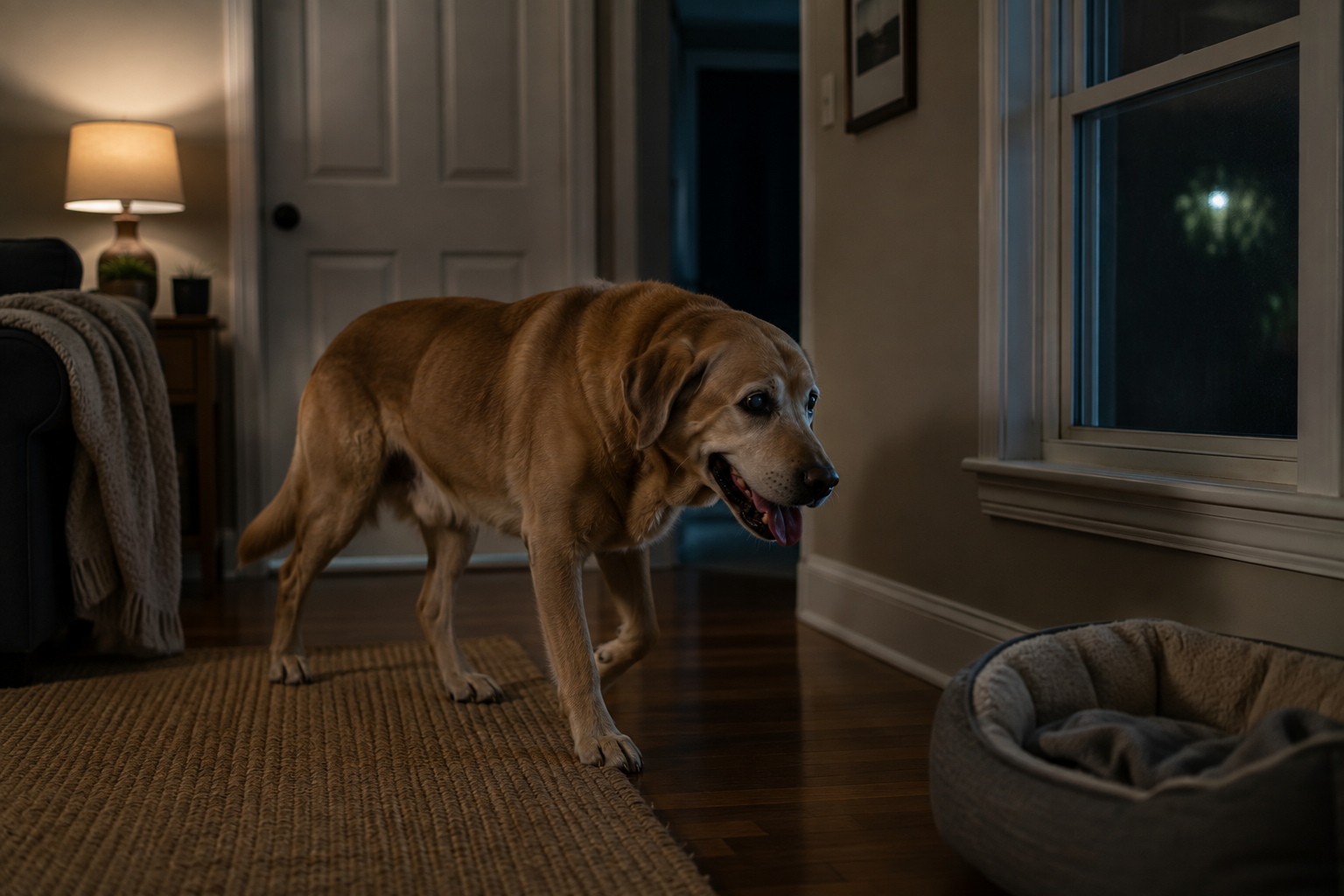
A dog that pants and paces at night when the house is cool and quiet is showing a symptom, not a training problem, and the first call is your veterinarian rather than a trainer. In older dogs especially, night restlessness is commonly linked to pain, canine cognitive dysfunction (the dementia-like syndrome in senior dogs), heart or respiratory disease, and hormonal conditions such as Cushing's disease, as well as to anxiety. Those are veterinary questions. Do not start a behavior plan, a supplement, or a training protocol until a medical cause has been ruled out, because settling a dog that is in pain or struggling to breathe does not help it, and the delay costs time that matters. This article is not a diagnosis and cannot be one.
That is a blunt opening for a dog behavior site, and it is deliberate. Most of what ranks for this question reads like a behavior article with a line about the vet near the bottom. For this particular symptom, that order is backwards.
Why the order matters here
Most behavior advice on the internet is written with a young, healthy dog in mind, and for most problems that is a fair assumption. Night pacing is the exception, because the base rates change with age.
A two-year-old dog that paces at night after a hot afternoon, a big meal, or a thunderstorm is usually doing something explainable. A ten-year-old dog that has started circling the hallway at three in the morning, panting in a cool room, is far more likely to be telling you about its body. Pain, cognitive change, cardiac disease, and endocrine disease all rise sharply with age, and all of them can present exactly like this.
So the honest structure for this topic is: find out whether it is medical, and only then think about routines and settling. If your dog is a senior, treat the veterinary appointment as step one, not as the escalation option.
What to record before you call the vet
You will get a better appointment if you arrive with observations rather than impressions. None of this is diagnosis. It is the raw material your vet needs.
Take video. Thirty seconds of the actual behavior at two in the morning is worth more than any description you can give, and the pacing will almost certainly not happen in the exam room.
Note the timing. When does it start, how long does it last, is it every night, and did it begin gradually or all at once. Sudden onset and gradual onset point in different directions.
Count breaths while your dog sleeps. Veterinarians commonly ask owners to count a sleeping dog's breaths per minute and report the trend, especially where the heart is a question. Count the rise and fall of the chest for a full minute a few times, write the numbers down, and ask your vet what number they want you to watch for in your particular dog.
Track water and appetite. Increased drinking and urinating, increased hunger, or a changed appetite are relevant to several of the conditions on the list, and owners often do not connect them to the pacing.
Watch for pain signals. Slow to rise, reluctance on stairs, changing position repeatedly, difficulty settling into a lie-down, licking a joint, stiffness in the morning.
List every medication and supplement. Some medications, steroids among them, are well known to increase panting and restlessness. Your vet needs the full list including anything bought over the counter.
Note the room. Temperature, humidity, and whether the panting also happens in the daytime under the same conditions.
What veterinarians commonly look for
The point of this section is orientation, not self-diagnosis. Knowing the shape of the list helps you describe what you are seeing and helps you understand what your vet is checking. It does not let you skip the appointment, and none of it can be sorted out from a keyboard.
| Area | Why it produces night restlessness | Signs owners often notice alongside |
|---|---|---|
| Pain, commonly arthritis in seniors | Lying still gets uncomfortable, so the dog keeps changing position or gets up | Slow to rise, stiffness, stairs avoided, licking a joint |
| Canine cognitive dysfunction | The dementia-like syndrome in older dogs disrupts sleep-wake cycles and orientation | Staring at walls, getting stuck in corners, altered greeting behavior, day-night reversal |
| Heart and respiratory disease | Lying down can make breathing harder, so the dog stands or paces | Coughing, tiring easily, faster or harder breathing at rest |
| Endocrine conditions such as Cushing's disease | Excess cortisol is associated with heavy panting | Increased drinking and urination, increased appetite, coat and skin changes, pot-bellied appearance |
| Fever, nausea, or general illness | Discomfort prevents settling | Off food, drooling, lip licking, vomiting, lethargy in the day |
| Anxiety, including noise phobia and distress at being alone | Arousal keeps the dog moving | Trembling, hiding, vocalizing, seeking people out, damage near exits |
| Medication side effects | Several drug classes increase panting and restlessness | Onset that lines up with a new prescription |
Two conditions on that list are urgent rather than routine. Breathing difficulty and heavy panting in a dog that is not hot and has not exercised, especially with pale or bluish gums, coughing, or collapse, is an emergency call now, not a booked appointment. Signs of severe abdominal pain, a distended abdomen, or unproductive retching in a large or deep-chested dog is also an emergency. If you are reading this at night and either of those describes your dog, stop reading and phone an emergency veterinary service.
What changes if the vet finds nothing
Sometimes the workup comes back clean, and that is genuinely good news rather than a dead end. It means you can now look at the environment and the routine with a clear conscience.
Look at what changed. Night restlessness that started with a house move, a new baby, a change in your working hours, a new dog, or a season of fireworks usually has an obvious cause once you line up the dates.
Check the daytime. A dog that sleeps most of the day, gets a short on-lead walk, and is asked to sleep again at ten at night is not tired. Sniffing walks, food delivered through work rather than a bowl, and training sessions tire dogs in a way that a longer march does not.
Fix the last two hours before bed. A predictable wind-down beats a busy evening: last toilet trip at the same time, low light, no games right before bed, and a bed that is genuinely comfortable and out of the traffic path.
Deal with the bladder honestly. Many older dogs need a later last toilet break than they did at three, and some need a middle-of-the-night one. That is not a training failure.
Give a nervous dog a better place to be. Some dogs settle much better in a crate they already like, some settle better in the bedroom with people. If crate work is part of your plan, our guide on how to crate train a puppy covers building it as a place a dog chooses.
If the restlessness is clearly anxiety-shaped, our guides to dog separation anxiety and dogs afraid of thunder and fireworks go into the plans properly. If the pacing comes with a lot of vocalizing, how to stop excessive whining covers telling attention-seeking from a genuine need.
What not to do
Do not punish a pacing dog. If the cause is pain, confusion, or breathlessness, punishment adds distress to a body that is already struggling and teaches the dog not to seek you out when something is wrong.
Do not start a supplement, a calming product, or a melatonin dose without asking your vet. Products marketed for canine sleep and cognition vary widely, some interact with prescribed medication, and giving something before the appointment can mask exactly the signs your vet is trying to see.
Do not shut an older, disoriented dog in a dark unfamiliar room to make it stop. A dog with cognitive change that gets stuck behind furniture in the dark can injure itself.
Do not read a symptom list, including the one above, as a diagnosis. Several of these conditions look identical from the hallway and are separated by an exam and lab work, not by observation.
The honest limit of this page
We are dog owners writing from reputable veterinary sources, not veterinarians, and this is the topic on this site where that distinction matters most.
Behavior advice is genuinely useful once the medical picture is clear. Before that point it is a risk, because the most common way this goes wrong is an owner spending three months on a settling routine while an untreated condition progresses. If your dog is a senior and this is new, the single most valuable thing you can do this week is book the appointment and bring the video.
For the wider set of everyday behavior problems, our hub on common dog behavior problems and their solutions links the full set together.
Frequently asked questions
Is night panting and pacing always serious?
No. A young, healthy dog that pants after a hot day, a long run, or a stressful evening and then settles is usually fine. What raises concern is a change: new behavior, an older dog, panting in a cool room with no exertion, or restlessness that comes with coughing, increased drinking, disorientation, or difficulty rising. Change is the signal, not the panting itself.
My dog is old and paces every night. Is this just aging?
Aging is not a diagnosis, and treating it as one is how treatable conditions get missed. Arthritis pain, cognitive dysfunction, cardiac disease and endocrine disease are all more common in older dogs and several have real management options. A vet visit is what separates "this is age" from "this is something we can help with."
Should I try melatonin or a calming supplement first?
Ask your veterinarian before giving anything. Products vary in what they contain, some interact with prescribed medications, and giving a sedative-type product before an exam can obscure the signs your vet needs to see. If the cause turns out to be behavioral, your vet can also tell you which options have evidence behind them.
When is this an emergency rather than an appointment?
Labored or noisy breathing, heavy panting in a cool resting dog, pale or blue-tinged gums, collapse, a swollen or hard abdomen, or repeated unproductive retching all mean contacting an emergency veterinary service straight away rather than waiting for morning.
Could it be anxiety rather than a medical problem?
It can be, and anxiety is on the list above for that reason. The way to find out is to rule out the physical causes first, because anxiety is the one diagnosis on the list you cannot confirm by test, and it is usually reached after the others are excluded.
This article is general owner guidance drawn from Purina's senior dog behavior resources, veterinary practice publications, and AVSAB, verified at the time of writing. It is not veterinary advice, it is not a diagnosis, and it is not a substitute for an examination. Night panting and pacing can indicate a medical emergency. If you are worried about your dog's breathing, contact a veterinarian immediately.